
 Worksheets
6.6A Solids, Liquids, and Gases
Total questions: 50
Worksheet time: 30mins

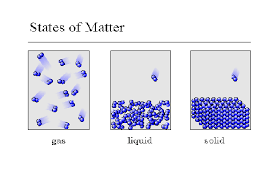
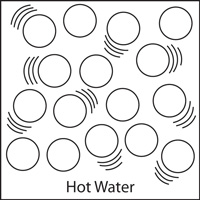

When a gas turns into a liquid, the particles move faster and further apart.
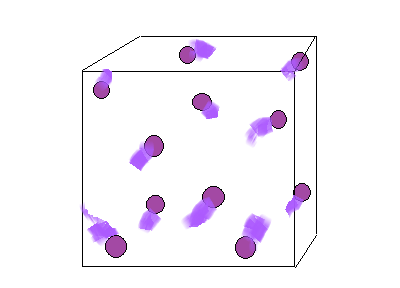
Which phase is represented in the model.
Solids
Liquids
Gas
Carousso

What is a physical property?
How two chemicals react with one another when combined
A property that we can measure or observe with our 5 senses or other tools
When two chemicals react with one another to form a new substance
When a change occurs but it does not result in the formation of a new substance
A substance has a fixed volume and no definite shape. This substance is ________.
gas
solid
liquid
not possible
How are molecules in a gas different from molecules in a liquid?
Molecules in a gas can move but molecules in a liquid cannot.
Molecules in a gas are more tightly packed than molecules in a liquid.
Molecules in a gas are in a similar arrangement as molecules in a liquid.
Molecules in a gas can move more than molecules in a liquid.

Which state of matter has particles arranged like this?
solid
liquid
gas
Which of the following is NOT a physical property?
boiling point
electrical conductivity
luster
reactivity
shape
Label the following image
Liquid
Gas
Solid
Particles move quickest in:
Solid
Liquid
Gas
Volume
In this state of matter the particles are "tightly packed" together and don't move
Liquid
Solid
Gas
This is the only state of matter that has a "Definite Shape"
Liquids
Solids
Gases
a state of matter in which the substance expands to take both the shape and volume of its container
(a)
a state of matter in which the substance takes the shape of the container and has an unchanged volume when poured from one container to another
(a)
Water is an example of which state of matter?
Solid
Liquid
Gas
Plasma
Which of the following is a property of both gases and liquids?
Fixed shape
Fixed volume
Ability to flow
Incompressibility
The boiling of water is an example of a:
Chemical change
Physical change
Compound formation
Mixture
In which state of matter do particles have the highest energy?
Solid
Liquid
Gas
Plasma
Which of the following is NOT a physical state of matter?
Solid
Liquid
Gas
Heat

Solids have...
definite volume
indefinite volume
The particles in a solid...
vibrate in place
are perfectly still
move around but stay close together
move around in all directions and have lots of empty space between them

The particles in a liquid...
vibrate in place
are perfectly still
move around but stay close together
move around in all directions and have lots of empty space between them
Liquids have...
definite volume
indefinite volume

Gases have...
definite volume
indefinite volume

This model shows a....
solid
liquid
gas
plasma

This model shows a....
solid
liquid
gas
plasma

This model shows a....
solid
liquid
gas
plasma

These are the molecules in a _________.
solid
liquid
gas

These are the molecules in a _________.
solid
liquid
gas
These are the molecules in a _________.
solid
liquid
gas

These are the molecules in a _______.
solid
liquid
gas

A student is examining three diagrams that show particle arrangements in a solid, liquid, and gas.
Q →R → S
S → Q → R
R → S → Q
R → Q → S

The graph shows how the temperature of a substance changes over time when heat is applied. Which particle diagram best represetns the change in the substance from location 1 to location 2?


What tool would you use to measure temperature?
thermometer
gram
balance
fulcrum
The amount that a container will hold when it is FULL is called
capacity
volume
length
mass
The definition of density is
the amount of matter in an object/substance
The amount of space an object/substance takes up
How compact the molecules are in an object/substance
The ability to float or sink in water.

Which of the pictures demonstrates a state of matter without a fixed shape or fixed volume?
J
K
L
M

Which of the pictures demonstrates a state of matter with a fixed shape and a fixed volume?
J
K
L
M

