
 Worksheets
Domains and Kingdoms
Total questions: 46
Worksheet time: 37mins
The Eukarya Domain has which organisms?
Bacteria that causes diseases
Bacteria found in volcanoes
plants, animals., fungi and protists
none of the above
Multicellular, no cell wall, moves and is heterotroph; which kingdom does it belong to?
Animalia
Eubacteria
Fungi
Plantae
Multicellular decomposers are in which kingdom
Fungi
Protist
Plantae
Animalia
I have no nucleus and live in very hot liquids. Which Kingdom am I in?
Fungi
Protist
Eubacteria
Archaebacteria
Which domain has organisms that live in extreme environments (vocanoes, Yellowstone hot pools, deep under water with no light)
Bacteria
Archae
Eukarya
No organism can live in those conditions
I am multicellular and autotrophic which kingdom would I be in?
Plantae
Animalia
Fungi
Protists
I am Eukaryotic, mainly multicellular, heterotrophic and reproduce with spores (asexual) and sexually.
Plantae
Animalia
Fungi
Protist
What are the names of the domains?
Eukarya, Bacteria, Archaea
Bacteria, Archaebacteria, Protista, Animalia, Fungi, Plantae
Based on the following characteristics, what kingdom would you classify the organism below?
Eukaryotic
Autotrophic
Unicellular
Asexual Reproduction
Usually in water
Eukarya
Plantae
Protista
Fungi
Prokaryotic
Autotrophic
Unicellular
Asexual Reproduction
Salty enviroment
Eukaryotic
Autotrophic
Multicellular
Asexual or Sexual Reproduction
Based on the following characteristics, what kingdom would you classify the organism below?
Prokaryotic
Autotrophic
Unicellular
Asexual Reproduction
Normal Environment
Protista
Bacteria
Archaebacteria
Fungi
Eukaryotic
Autotrophic
Unicellular
Asexual Reproduction


My Kingdom includes mushrooms and yeast!
Animalia
Plantae
Bacteria
Fungi
Who am I?
In what kingdom would you find trees and flowers?
Plantae
Fungi
Bacteria
Animalia
Which of the following is the highest level of organization within the environment?
population
organism
ecosystem
biosphere
Which is the simplest level of organization within the environment?
cell
organism
population
community
All the alligators in a swamp are an example of a(n) _______________.
organism
community
population
group
The correct order of ecological organization from the smallest to the largest is _______________.
organism, community, population, ecosystem, biosphere,
biosphere, ecosystem, community, population, organism
organism, population, community, ecosystem, biosphere
population, organism, biosphere, community, ecosystem
More than one population living and interacting in the same area.
Organism
Population
Community
Ecosystem
One of a species.
Organism
Population
Community
Ecosystem
More than one of the SAME species living together in the same area at the same time.
Organism
Population
Community
Ecosystem
Biome
Made up of a community AND the abiotic environment. All the living and nonliving things in the same area.
Biosphere
Population
Community
Ecosystem
The part of Earth where life exists; from the deepest part of the ocean to high in the atmosphere where tiny insects and spores drift. All of the biomes together.
Biosphere
Population
Community
Ecosystem

What part of the environment is this parrot?
Organism
Population
Community
Ecosystem

What part of the environment is this group of seagulls?
Organism
Population
Community
Ecosystem

What part of the environment are these different types of birds?
Organism
Population
Community
Ecosystem

What part of the environment are these plants, different types of fish, jellyfish, and water?
Biosphere
Population
Community
Ecosystem

What do scientists call the part of the environment shown here.
Biosphere
Population
Community
Ecosystem


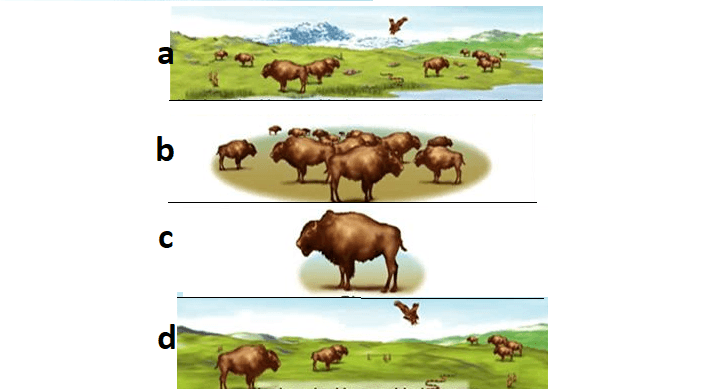
Which represents an organism?
a
b
c
d

Which of the following shows the correct order of the pictures from the LOWEST (smallest) to the HIGHEST (largest) level of organization?
Q > S > T > R
Q > R > T > S
R > T > S > Q
S > T > R > Q
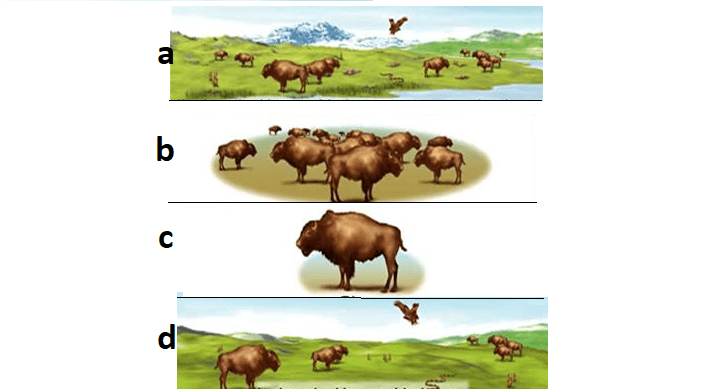
Which represents a community?
a
b
c
d

Which of the following shows the correct order of the pictures from the LOWEST (smallest) to the HIGHEST (largest) level of organization?
c > b > d > a
b > c > a > d
c > b > a > d
a > d > b > c

