wayground logo

Free Printable Worksheets

NEW

Font size

S
M
L
XL
Worksheets

Homeostasis

Total questions: 69

Worksheet time: 53mins

Name
Class
Date
1.
The term for maintaining internal temperature is: 
a)
Thermoregulation
b)
Thermometer
c)
Homeothermal
d)
Homeostasis
2.
If the calcium in your blood decreases below homeostasis levels, a gland in the brain will sense the decrease and send a chemical message to your bones. Your bones will release calcium into the blood, bringing blood calcium levels back up.
a)
Positive Feedback Response
b)
Negative Feedback Loop 
3.
Rapid growth during puberty causes your body to release more and more growth hormones. As you grow, more and more growth hormones are released until puberty is reached, and then the hormones stop.
a)
Positive Feedback Response
b)
Negative Feedback Loop 
4.
Homeostasis
a)
allows for a wildly fluctuating internal environment
b)
is impossible in vertebrates
c)
is the maintenance of a relatively stable internal environment and often incorporates a form of feedback regulation
d)
is the maintenance of a relatively stable external environment and often incorporates a form of feedback regulation
5.
Which system sends electrical messages that helps control the body's responses to internal and external changes?
a)
nervous
b)
endocrine
c)
reproductive
d)
integumentary
6.

What hormone is produced in the pancreas that lowers blood sugar?

a)

Insulin

b)

Glucagon

c)

Ketones

d)

Glucose

7.
These two body systems regulate feedback mechanisms.
a)
Skeletal & Muscular
b)
Skeletal & Endocrine
c)
Muscular & Nervous
d)
Endocrine & Nervous
8.

Homeostatic cooling mechanisms include

a)

piloerection and panting

b)

panting and vasoconstriction

c)

sweating and piloerection

d)

sweating and vasodilation

9.

Blood sugars are controlled by

a)

brain generated chemicals

b)

blood

c)

hormones from the pancreas

d)

chemicals from the liver

10.

The hormone that makes the liver store sugars is

a)

glucose

b)

glycogen

c)

glucagon

d)

insulin

11.

The liver normally stores blood sugar as

a)

glucose

b)

glycogen

c)

glucagon

d)

fats

12.

Tissue fluid balance is maintained by the

a)

bladder

b)

kidney

c)

liver

d)

urine

13.

High blood sugar levels after a meal usually stimulate

a)

Glucagon release from the liver

b)

Glucagon release from the pancreas

c)

Insulin release from the liver

d)

Insulin release from the pancreas

14.

The action of insulin causes

a)

The liver to secrete enzymes

b)

The liver to make glycogen

c)

The liver to make glucose

d)

none of these

15.

After a period of fasting the brain makes the pancreas produce

a)

glucose

b)

glycogen

c)

glucagon

d)

insulin

16.

Glycogen is a

a)

hormone

b)

short term protein

c)

sugar stored in the liver

d)

sugar stored in the liver and muscles

17.

Homeostasis mechanisms...

a)

keep everything exactly the same.

b)

usually operate by positive feedback systems.

c)

act to keep the internal environmental conditions outside the normal range

d)

is the ability to maintain a relatively stable internal environment

18.

Which type of feedback system is more common in maintaining homeostasis?

a)

positive

b)

negative

c)

neutral

d)

balanced

19.

This feedback system amplifies a change until a desired outcome is reached.

a)

positive feedback system

b)

negative feedback system

c)

neutral feedback system

d)

self-monitoring feedback system

20.

This is the term used to describe a body part that provides the response needed to influence a change.

a)

control center

b)

effector

c)

sensor

d)

set point

21.

The reaction of the effector is called..

a)

response

b)

sensor

c)

stimulus

d)

set point

22.

A noticeable change in an organism's environment.

a)

control center

b)

response

c)

stimulus

d)

set point

23.

What type of feedback system does the model represent?

a)

positive

b)

negative

c)

neutral

d)

glyogen

24.

What is the stimulus in the model above?

a)

body temperature

b)

increase in body temperature

c)

decrease in body temperature

d)

blood vessels dilating

25.

What is the sensor in the model above?

a)

Hypothalamus

b)

muscles

c)

thermoreceptors

d)

Blood vessels

26.

What is the control center in the model above?

a)

Hypothalamus

b)

muscles

c)

thermoreceptors

d)

Blood vessels

27.

What is an effector in the model above?

a)

Hypothalamus

b)

sweat glands

c)

thermoreceptors

d)

sweating

28.

What is a response (not the result) in the model above?

a)

body temperature increasing

b)

sweat glands

c)

thermoreceptors

d)

sweating

29.
a body system that controls and coordinates all body activities through electric impulses/messages between brain, spinal cord and nerves.
a)
endocrine system 
b)
nervous system
c)
nerve
d)
neuron
30.
If the environment gets cold, we will often shiver in order to:
a)
keep body temperature the same as the external temperature
b)
decrease body temperature
c)
increase body temperature
d)
regulate blood pressure
31.
Failure to maintain homeostasis could result in:
a)
lack of internal balance
b)
eventual death
c)
difficulty carrying on metabolism 
d)
all three
33.
The shrinking of blood vessels, which increases blood pressure
a)
vasodialation
b)
vasoconstriction
33.
The shrinking of blood vessels, which increases blood pressure
a)
vasodialation
b)
vasoconstriction
34.
Homeostatic blood glucose controlling enzymes are produced in
a)
the islets of Langehans in the pancreas
b)
in the liver
c)
Loop of henle in the kidneys
d)
pituitary gland
35.
What hormone is produced in the pancreas that raises blood sugar?
a)
Insulin
b)
Glucagon
c)
Ketones
d)
Glucose
36.
The name for a chemical made by glands that tell cells to make something or respond in some way.
a)
acid
b)
enzyme
c)
perspiration
d)
hormone
37.

What is the function of the Thyroid gland

a)

Hormones that are used to change the metabolic rate of a person's body

b)

Hormones that are used to help you run

c)

Hormones to help you swallow

d)

Penguin

38.

These are responses when body temperature rises

a)

vasoconstriction, shivering

b)

vasoconstriction, sweating

c)

vasodilation, shivering

d)

vasodilation, sweating

39.

Why do you get warmer when exercising?

a)

You are creating more ATP from glucose which releases heat as a byproduct

b)

blood is flowing faster through your body

c)

it's warm where you're working out

40.

These are responses when body temperature drops

a)

thyroid releases TSH to increase metabolic rate, shivering, hairs stand up, vasoconstriction

b)

pancreas releases insulin, shivering, hairs flatten, vasodilation

c)

thyroid releases TSH to decrease metabolic rate, shivering, hairs flatten, vasoconstriction

d)

pancreas releases insulin, sweating, hairs flatten, vasodilation

41.
This part of the neuron receives chemical messages from the neurotransmitters of other neurons.
a)
Axon Terminal
b)
Dendrites
c)
Myelin Sheath
d)
Cell Body
42.
The part of the neuron that insulates the axon and increases the speed of the neural message within the neuron.
a)
Synapse
b)
Dendrite
c)
Myelin Sheath
d)
Axon Terminal Button
43.
This part of the neuron stores then releases neurotransmitters into the synapse.
a)
Axon 
b)
Dendrite
c)
Myelin Sheath
d)
Axon Terminal
44.
The correct direction of the neural impulse within one neuron.
a)
Axon Terminal to Dendrite
b)
Dendrite to Axon Terminal
c)
Cell Body to Axon
d)
Axon Terminal to Cell Body
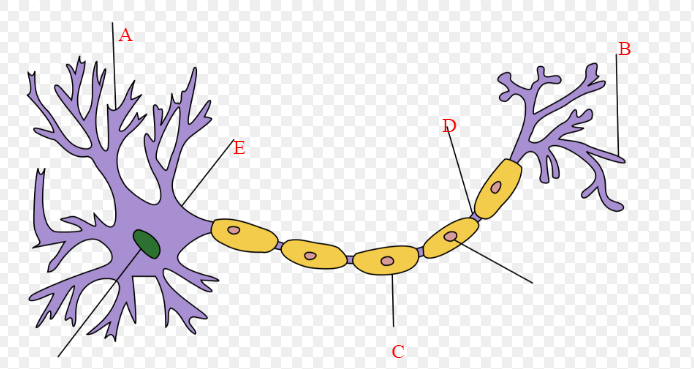
45.
A
a)
Dendrite
b)
Axon
c)
Axon Terminal
d)
Cell Body
46.
B
a)
Dendrite
b)
Axon
c)
Axon Terminal
d)
Cell Body
47.
C
a)
Synapse
b)
Soma
c)
Axon Terminal
d)
Myelin Sheath
48.
D
a)
Synapse
b)
Axon
c)
Axon Terminal
d)
Dendrite
49.
A chemical produced by neurons that carries messages to other neurons
a)
myelin sheath
b)
neurotransmitter
c)
axon
d)
axon terminal
50.

Neurons carrying information from the CNS to the viscera and/or muscles and glands

a)

sensory neurons

b)

interneurons

c)

motor neurons

d)

association neurons

51.
What element is needed to produce proper amounts of Thyronine (T3) and Thyroxine (T4)?
a)
Iodine
b)
Iron
c)
Calcium
d)
Zinc
52.
Insulin is secreted by:
a)
α-cells in the Islets of Langerhans
b)
β-cells in the Islets of Langerhans
c)
β-cells in the pancreatic medulla
d)
α-cells in the pancreatic cortex
53.
Glucagon is secreted by:
a)
α-cells in the Islets of Langerhans
b)
β-cells in the Islets of Langerhans
c)
β-cells in the pancreatic medulla
d)
α-cells in the pancreatic cortex
54.
The gland that controls regulation of metabolic rate is the:
a)
Thyroid
b)
Parathyroids
c)
Pancreas
d)
Adrenal Glands
55.
Hormones that enter cells directly to cause changes are usually:
a)
Steroids
b)
Proteins
56.

The beta cells of the pancreas are stimulated during hyperglycemia to produce:

a)

glucagon

b)

insulin

c)

calcitonin

d)

PTH

57.

ADH is produced where?

a)

Thyroid

b)

Adrenal cortex

c)

Posterior pituitary

d)

Pineal

58.

Which is NOT a function of the nervous system?

a)

responding to information

b)

making blood cells

c)

receiving information on the environment

d)

maintaining homeostasis

59.

Which system is responsible for voluntary actions like jumping?

a)

somatic nervous system

b)

temporal system

c)

autonomic nervous system

d)

limbic system

60.

Controls long term changes such as growth

a)

limbic system

b)

endocrine system

c)

nervous system

d)

temporal lobe

61.
Which of the following terms means insufficient sugar in the blood?
a)
hypercalcemia
b)
hyponatremia
c)
hyperkalemia
d)
hypoglycemia
62.
Which of the following is a function of the Endocrine System?
a)
growth and development
b)
maintaining homeostasis
c)
response to stress and injury
d)
all of the above
63.
Which of the following hormones is responsible for regulation of water balance?
a)
Antidiuretic hormone 
b)
Oxytocin
c)
Insulin 
64.

These chemical messengers circulate through the blood.

a)

Neurotransmitters

b)

Hormones

65.
When a bat flew into Chris' hair, she panicked and her heart started racing. Her ____ was activated.
a)
Somatic Nervous System
b)
Sympathetic Nervous System
c)
Parasympathetic Nervous System
d)
Central Nervous System
66.

Which hormone is released during a "fight or flight" response?

a)

Serotonin

b)

Acetylcholine

c)

Epinephrine (Adrenaline)

d)

Insulin

67.
What is the difference between nervous & endocrine communication?
a)
Endocrine takes longer, but lasts longer than nervous
b)
Nervous takes longer, but lasts longer than endocrine
c)
Both nervous & endocrine use neurotransmitter molecules
d)
Neither type use molecules to communicate
68.

How do hormones ensure that they travel to and communicate with the correct cells/tissues?

a)

Hormones travel between the synapses of neurons and communicate with the tissues

b)

Hormones travel throughout the bloodstream and only communicate with the tissues that have the correct receptors

c)

hormones travel throughout the bloodstream and communicate with all the cells they come in contact with

d)

Hormones travel throughout all the tissues of the body and are not specific

69.

What hormone from the endocrine system & part of the peripheral nervous system work together in the "fight or flight" response?

a)

Adrenaline & parasympathetic nervous system

b)

adrenaline & sympathetic nervous system

c)

cortisol & parasympathetic nervous system

d)

cortisol & sympathetic nervous system