wayground logo

Free Printable Worksheets

NEW

Font size

S
M
L
XL
Worksheets

SC1 Test Review

Total questions: 77

Worksheet time: 2hrs 36mins

Name
Class
Date
1.

Which of the following subatomic particles are located inside the nucleus?

a)

Proton

b)

Proton and neutron

c)

Electron and proton

d)

Neutron

2.
The atomic number tells you what?
a)
number of electrons
b)
number of protons
c)
number of neutrons
d)
both electrons and protons in an atom.
3.
Which is a halogen?
a)
Helium
b)
Chlorine
c)
Oxygen
d)
Neptune
4.
Where does fusion occur naturally?
a)
Underwater
b)
All around us
c)
In the radioactive waste
d)
On the sun
5.
24.1% of all the isotopes of a an element have a mass of 75.23 amu, 48.7% have a mass of 74.61 amu, and 27.2% have a mass of 75.20 amu.
What is the average mass of this element?
a)
74.92 amu
b)
24.97 amu
c)
75.01 amu
d)
74.51 amu
6.
Which of the following will have a lower ionization energy than Scandium (Sc)?
a)
Helium (He)
b)
Titanium (Ti)
c)
Calcium (Ca)
d)
Magnesium (Mg)
7.
As atoms of elements in group 16 are considered in order from top to bottom, the electronegativity of each successive element....
a)
decreases
b)
increases
c)
remains the same
d)
none of the above
8.

Which atom has the largest atomic radius?

a)

potassium

b)

rubidium

c)

francium

d)

lithium

9.
What atom matches this electron configuration?
1s22s22p63s23p64s23d10
a)
Zinc
b)
Copper
c)
Nickel
d)
Germanium
10.
What electron configuration matches an oxygen atom?
a)
1s22s22p63s2, 3p64s23d104p5
b)
1s22s22p4
c)
1s22s22p6
d)
1s22s22p63s23p64s23d1
11.
How many electrons can the first energy level hold?
a)
1
b)
2
c)
8
d)
0
12.
Which element is pictured?
a)
neon
b)
fluorine
c)
magnesium
d)
argon
13.

In 1s2, the 1 means

a)

there is 1 electron

b)

the electrons are in the 1st energy level

c)

the shape is circular

d)

there is a -1 charge

14.

What is the number of protons that the element in this image contain? (SC1.b)

a)

14

b)

7

c)

15

d)

18

15.

Which subatomic particles contribute the most to the mass of an atom? (SC1.a)

a)

Protons, Neutrons, Electrons

b)

Protons only

c)

Protons and Electrons

d)

Protons and Neutrons

16.

If an atom has 12 positively charged subatomic particles, which of the following must it also have to be considered a neutral atom? (SC1.a)

a)

12 neutrons

b)

12 electrons

c)

12 protons

d)

24 protons and neutrons

17.

An atom has 10 protons, 15 neutrons and 10 electrons what is its mass number. (SC1.a)

a)

20

b)

10

c)

5

d)

25

18.

An element with a mass number of 11 and an atomic number of 5 has how many neutrons? (SC1.a)

a)

11

b)

5

c)

6

d)

16

19.

What is the atomic mass of the atom pictured? (SC1.a)

a)

9

b)

10

c)

18

d)

19

20.

What is the element name of the atom pictured? (SC1.b)

a)

Fluorine

b)

Neon

c)

Argon

d)

Potassium

21.

An isotope has three forms. 30% have a mass of 4 amu, 20% have a mass of 5 amu and 50% have a mass of 3 amu. Average atomic mass will be closest to (SC1.d)

a)

2 amu

b)

3 amu

c)

4 amu

d)

5 amu

22.
Which has the greater EN: 
Cl or Al?
a)
Cl
b)
Al
23.
Which has the greater EN: 
N or C?
a)
C
b)
N
24.
Which of the following will have a larger radius than Zinc?
a)
Gallium
b)
Aluminum
c)
Magnesium
d)
Strontium
25.
Which of the following will have a lower ionization energy than Scandium (Sc)?
a)
Helium (He)
b)
Titanium (Ti)
c)
Calcium (Ca)
d)
Magnesium (Mg)
26.
As atoms of elements in group 16 are considered in order from top to bottom, the electronegativity of each successive element....
a)
decreases
b)
increases
c)
remains the same
d)
none of the above
27.
Which atom has the largest atomic radius?
a)
potassium
b)
rubidium 
c)
francium
d)
cesium
28.
As you move down the periodic table atoms get bigger.  This is because ____________.
a)
The atoms have more mass.
b)
The atoms have more protons.
c)
The atoms have more energy levels
d)
The atoms have more nuetrons
29.
Atoms that have a high electronegativity, _______________.
a)
give up their electrons more easily.
b)
hold on to their electrons more tightly.
c)
have more electron shells.
30.
As you move across the periodic table atoms tend to get smaller because, ______________.
a)
the atoms have more mass.
b)
the atoms have less mass
c)
the atoms have more protons.
d)
the atoms have less electrons.
31.
Which periodic group has the smallest atomic radius?
a)
Alkali metals
b)
Halogens
c)
Noble Gases
d)
Transition metals
32.

Vertical columns of elements (these are also known as a "family") - they also have the same number of valence electrons and are known as ________________.

a)

groups

b)

periods

c)

quadrants

d)

rows

33.
The family in the periodic table that contains the most reactive metals is the_______
a)
Alkaline Earth Metals
b)
Transition Metals 
c)
Alkali Metals
d)
Other Metals
34.
Which is a halogen?
a)
Helium
b)
Chlorine
c)
Oxygen
d)
Neptune
35.

Most noble gases have _______ valence electrons.

a)

1

b)

2

c)

7

d)

8

36.

Which two elements on the periodic table are in the same period?

a)

Sn and Rb

b)

K and Ba

c)

F and Cl

d)

Se and Te

37.

The horizontal rows on the periodic table, which indicate the number of energy levels/orbitals that an atom has, are called ___________.

a)

Periods

b)

Element

c)

Atomic Number

d)

Group

38.

Rank the following from lowest ioniziation energy to highest ionization energy: C, P, S, As

a)

C, P, S, As

b)

As, C, P, S

c)

P, S, As, C

d)

C, As, P, S

39.
When an electron emits a photon of light, it also...
a)
gains positive charge
b)
gains negative charge
c)
increases energy level
d)
decreases energy level
40.

The following path of an electron emits a light wave that our eyes can detect.

a)

Ground -> Excited

b)

Excited -> Ground

c)

One full orbit of the nucleus

d)

Protons emit light. The question is misleading.

41.
How many valence electrons are represented here?
a)
7
b)
5
c)
2
d)
8
42.
What atom matches this electron configuration?
1s2s2p3s2
a)
Neon
b)
Magnesium
c)
Aluminum
d)
Potassium
43.
Which is the electron configuration for an oxygen atom?
a)
1s22s22p63s23p64s2
b)
1s22s22p4
c)
1s22s22p6
d)
1s22s22p63s23p6
44.
What is the shorthand electron configuration for Sulfur atom?
a)
[Ar] 3p4
b)
[He] 3s23p4
c)
[Ne] 3s23p4
d)
[Na] 3s23p3
45.
Which element is pictured?
a)
neon
b)
fluorine
c)
magnesium
d)
argon
46.
What electron configuration matches an oxygen atom?
a)
1s22s22p63s2, 3p64s23d104p5
b)
1s22s22p4
c)
1s22s22p6
d)
1s22s22p63s23p64s23d1
47.
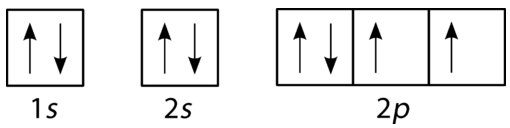
This orbital diagram represents:  
a)
C
b)
B
c)
N
d)
O
48.
This orbital diagram represents:  
a)
C
b)
B
c)
N
d)
O
49.
What is incorrect about this orbital diagram?
a)
Both arrows in the 2p box should be pointing up
b)
There is nothing incorrect with this diagram
c)
In the there should only be 1 orbital in the first 2p box and one in the 2nd 2p box
d)
All the arrows should be pointing up.
50.
What is the electron configuration of Aluminium?
a)
2.8.3
b)
2.11
c)
13
d)
2.8.2
51.

List the following in increasing order: 2p 1s 3s 2s 3p

a)

2s 1s 3s 2s 3p

b)

3p 3s 2p 2s 1s

c)

1s 2s 2p 3s 3p

52.
24.1% of all the isotopes of a an element have a mass of 75.23 amu, 48.7% have a mass of 74.61 amu, and 27.2% have a mass of 75.20 amu.
What is the average mass of this element?
a)
74.92 amu
b)
24.97 amu
c)
75.01 amu
d)
74.51 amu
53.
24.1% of all the isotopes of a an element have a mass of 75.23 amu, 48.7% have a mass of 74.61 amu, and 27.2% have a mass of 75.20 amu.
How many protons does this element have?
a)
32
b)
33
c)
34
d)
no way to know
54.
Calcium has three different isotopes. One has a mass of 35.00 amu; another has a mass of 41.00 amu; and another has a mass of 40.00 amu. Which isotope is the most abundant of the three?
a)
40.00 amu
b)
41.00 amu
c)
35.00 amu
d)
impossible to tell
55.
An isotope has three forms.  30% have a mass of 4 amu, 20% have a mass of 5 amu and 50% have a mass of 3 amu.  Average atomic mass will be closest to
a)
2 amu
b)
3 amu
c)
4 amu
d)
5 amu
56.
What is the name of the atom pictured here?
a)
Nitrogen
b)
Nitrogen-15
c)
Nitrogen-7
d)
Nitrogen-8
57.
If X is the symbol for an element, which of the following two symbols represent    isotopes of the same element?  
I. 7735X  II. 7733X  III. 8137X  IV. 8135 X
a)
I and II
b)
III and IV
c)
I and IV
d)
I and III
58.
Which of the following could have 82 neutrons?
a)
W-182
b)
Ta-181
c)
Cs-132
d)
Ba-138
59.
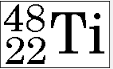
How many protons does this isotope of titanium have?
a)
48
b)
22
c)
26
d)
70
60.
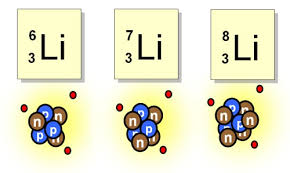
How many neutrons does the isotope of lithium have?
a)
8
b)
3
c)
4
d)
5
61.
which atom has  4 neutrons?
a)
Li-6
b)
Li-7
c)
Li-8
d)
they have the same # of neutrons
62.
What is true about a neutral atom?
a)
The number of protons equal the number of neutrons
b)
The number of protons equal the number of electrons
c)
The number of neutrons equal the number of electrons
d)
The number of protons, neutrons, and electrons are all different
63.
Which description about the proton is accurate?
a)
Positively charged particle with a mass less than 0 amu
b)
A neutrally charged particle with a mass less than 0 amu
c)
Positively charged particle with a mass of 1 amu
d)
A neutrally charge particle with a mass of 1 amu
64.

Atoms that have a different amount of electrons than protons

a)

covalent bonds

b)

isotopes

c)

ionic bonds

d)

ions

65.

Which subatomic particles are the smallest?

a)

Neutrons

b)

Protons

c)

Electrons

d)

Atoms

66.

An element will always have the same number of

a)

electrons

b)

neutrons

c)

protons

d)

Orbitals

67.

Atomic Mass of an atom is the?

a)

amount of neutrons plus electrons

b)

amount of protons plus neutrons

c)

amount of electrons plus protons

d)

amount of protons only

68.
How many valence electrons are in an atom of In?
a)
3
b)
8
c)
4
d)
1
69.
How many valence electrons are found in atoms of Calcium?
a)
4
b)
5
c)
2
d)
3
70.
How many valence electrons are found in atoms of Iodine?
a)
4
b)
7
c)
9
d)
1
71.
What process takes place inside a star to generate energy?
a)
Nuclear fission
b)
Hydrogen Creation
c)
Nuclear fusion
d)
Helium forming
72.
Hydrogen is the primary fuel
a)
Fission
b)
Fusion
c)
Radioactive Decay
73.

The joining of nuclei to form a "heavier" nucleus is referred to as ______________

a)

chemical reaction

b)

fission

c)

fusion

d)

radiation

74.
An atom becomes _______ when it loses electrons.
a)
Positive
b)
Negative
c)
Neutral
d)
Invinsible
75.
A Radium atom wants...
a)
One more electron
b)
One less electron
c)
Two more electrons
d)
Two less electrons
76.
Which particles change the charge in atoms when ions are formed?
a)
Protons
b)
Electrons
c)
Neutrons
d)
Kittens
77.
What is a Rubidium ion's symbol?
a)
Rb-
b)
Rb+
c)
Rb-2
d)
Rb+2