
 Worksheets
Enzyme Practice
Total questions: 20
Worksheet time: 26mins
Name
Class
Date
1.

Enzymes are...
a)
Nucleic Acids
b)
Proteins
c)
Lipids
d)
Carbohydrates
2.

Which of the following binds to an active site of an enzyme?
a)
Substrate
b)
Product
c)
Codon
d)
None of these
3.
An enzyme speeds up a chemical reaction in the cell, but can only be used once.
a)
True
b)
False
4.
Enzymes speed up a chemical reaction by...
a)
destroying products
b)
lowering activation energy
c)
increasing activation energy
d)
allowing reactions to process at their own speed
5.

Which substrate would this enzyme catalyze?
a)
Δ
b)
σ
c)
∅
d)
μ
6.
An enzyme and its substrates are often referred to a ________________________ shape.
a)
misfit
b)
fan & air
c)
balloon & string
d)
lock & key
7.
Any substrate that is acted upon by an enzyme is called a(n)
a)
substrate
b)
reactant
c)
nucleic acid
d)
both a & b
8.

Based on the graph, what temperature does this enzyme work best?
a)
30* C
b)
15* C
c)
47* C
d)
40* C
9.

In the diagram, what is letter E?
a)
substrate
b)
enzyme-substrate complex
c)
product
d)
active site
10.

What is being represented by the letter B in the image?
a)
Substrate
b)
Enzyme
c)
Substrate
d)
Product
11.
If an enzyme becomes over heated what effect, if any, will the heat have on the enzymatic activity?
a)
The enzyme will not store much chemical energy.
b)
The enzyme will not be able to catalyze reactions.
c)
The enzyme will lose its net electrical charge.
d)
The enzyme will lose stored genetic information.
12.
REVIEW: Which of the following best describes the function of nucleic acids?
a)
Nucleic acids are used as the building blocks of proteins.
b)
Nucleic acids inhibit and stop the flow of biochemical reactions.
c)
Nucleic acids contain the genetic code for protein synthesis.
d)
Nucleic acids transmit signals that begin biochemical processes.
13.
REVIEW: A scientist analyzing an unknown substance has determined that it consists of carbon, hydrogen and oxygen. During experimentation, she determines that the substance is soluble in oil but not in water. Which of the following macromolecules is the unknown substance most likely to be?
a)
carbohydrate
b)
nucleic acid
c)
lipid
d)
protein
14.
REVIEW: Which of the four major biological macromolecules can be easily identified by the nitrogen base found in its structure?
a)
Carbohydrate
b)
Protein
c)
Lipid
d)
Nucleic Acid
15.
What is the purpose of an enzyme?
a)
give permission for the reaction
b)
raise activation energy
c)
speed up reactions
d)
control how many reactions occur
16.
Each enzyme only has 1 substrate that will fit its active site. What is this called?
a)
reusable
b)
catalyst
c)
specific
d)
fragile
17.
What 3 letters do enzymes typically end in?
a)
-ose
b)
-ase
c)
-ese
d)
-tic
18.
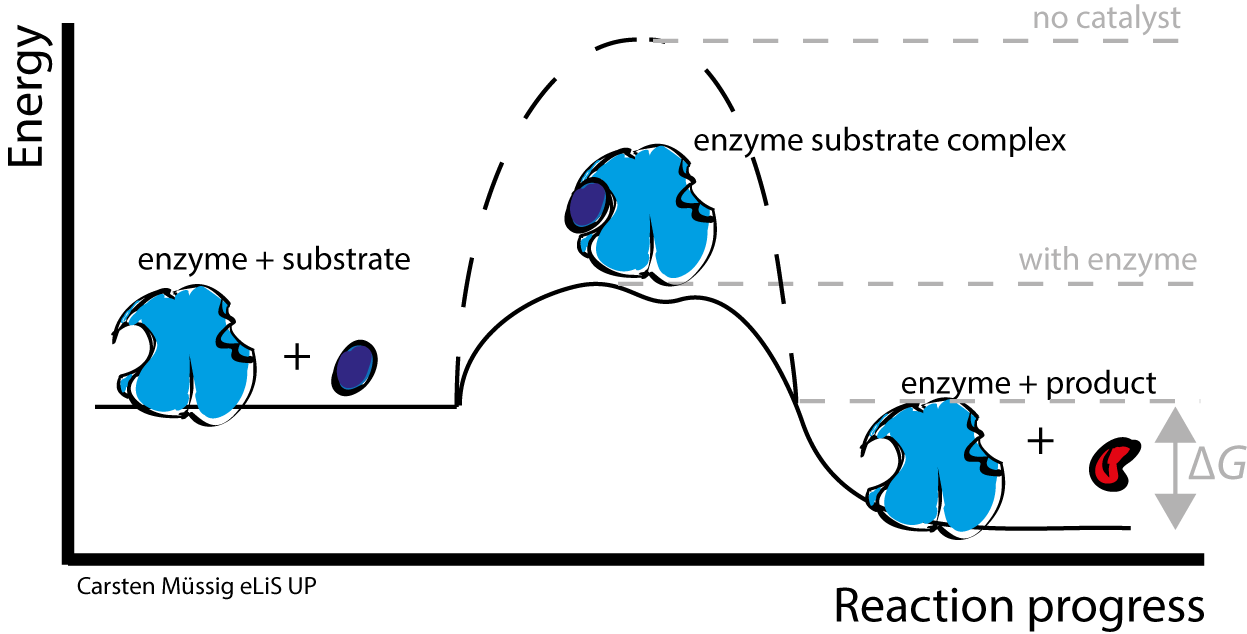
An enzyme speeds up a reaction by
a)
lowering the activation energy.
b)
raising the activation energy.
c)
releasing energy.
d)
absorbing energy.
19.
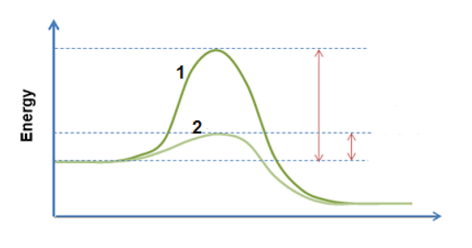
Which line represents an enzyme-catalyzed reaction?
a)
Line 1
b)
Line 2
20.
When a piece of liver is dropped into hydrogen peroxide, the peroxide bubbles vigorously as the hydrogen peroxide (H2O2) decomposes into water (H2O) and oxygen (O2). This rapid change in reaction rate suggests
a)
that liver contains lots of germs
b)
the liver contains an enzyme that breaks down hydrogen peroxide
c)
that liver is a substrate for hydrogen peroxide
d)
that hydrogen peroxide is a powerful enzyme
100 %

