Wayground logo

Free Printable Worksheets

Font size

S
M
L
XL
Worksheets

SPM Physics Quick Challenge 1: Introduction to physics

Total questions: 30

Worksheet time: 10mins

Name
Class
Date
1.

Which of these categories as Scalar quantity

a)

length

b)

acceleration

c)

temperature

d)

velocity

2.

Which pair is correct

a)

Base quantity : time : minutes

b)

Base quantity : temperature : Kelvin

c)

Base quantity : temperature : degree Celsius

d)

Derived quantity : density : kgm

3.

Which statement is correct

a)

meter rule is more sensitive than vernier calliper

b)

Micrometer screw gauge is less sensitive than Vernier calliper

c)

Micrometer screw gauge is more sensitive than Vernier calliper

4.
What piece of equipment (tool) is used to measure mass?
a)
Graduated Cylinder
b)
Meter Stick
c)
Triple-Beam Balance
d)
Beaker
5.
What is the reading of the meniscus?
a)
36mL
b)
45mL
c)
35.0mL
d)
30.5mL
6.

What is meant by cm² ?

a)

Volume

b)

Area

c)

Capacity

7.

Converting from km to m, you what?

a)

Multiply by 1000

b)

Multiply by 10

c)

Divide by 1000

8.

1000cm3 is equal to:

a)

100m

b)

1000cm

c)

1 Litre

9.

Based on what you know , converting from highest to lowest you...

a)

You multiply when going lower.

b)

You divide when going lower.

c)

None of the above.

10.

Name the part of the vernier calipers

a)

Main scale

b)

Depth bar

c)

External jaws

d)

Internal jaws

e)

Sliding jaw

11.

Name the part of the vernier calipers

a)

Slider

b)

Internal jaws

c)

Outside jaws

d)

Depth bar

e)

Main scale

12.

Name the part of the vernier calipers

a)

Main scale

b)

Vernier scale

c)

Beam

d)

External jaws

e)

Fixed jaws

13.

What is the reading on the vernier calipers?

a)

4.47 cm

b)

4.77 cm

c)

4.37 cm

d)

4.37 mm

14.

What is the reading on the vernier calipers?

a)

1.05 cm

b)

1.06 cm

c)

1.16 cm

d)

1.66 cm

15.

The reading of the micrometer is .............................

a)

2.38mm

b)

2.88mm

c)

2.58mm

16.

The reading of the micrometer is .............................

a)

8.05mm

b)

8.55mm

c)

9.00mm

17.
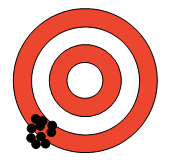
This bullseye demonstrates...
a)
High Accuracy & High Precision
b)
High Accuracy & Low Precision
c)
Low Accuracy & High Precision
d)
Low Accuracy & Low Precision
18.

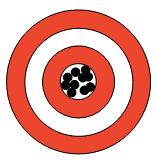
This bullseye demonstrates...

a)

High Accuracy & High Precision

b)

High Accuracy & Low Precision

c)

Low Accuracy & High Precision

d)

Low Accuracy & Low Precision

19.

How close a measurement is to the accepted value is called..

a)

Accuracy

b)

Precision

c)

Significant

d)

Estimate

20.
When a measurement is repeatable and consistent it is said to have...
a)
High precision
b)
Low precision
c)
High accuracy
d)
Low accuracy
21.

Which is the more precise measurement?

a)

4 mL

b)

4.3 mL

c)

4.30 mL

d)

4.300 mL

22.
Which of the following quantity is base quantity ?
a)
voltage
b)
electric current
c)
electric energy
d)
electric power
23.
Which of the following pairs of physical quantity and SI unit is correct ?
a)
Mass - SI unit : Gram
b)
Time - SI unit : Hour
c)
Electric current - SI unit : Volt
d)
Temperature - SI unit : Kelvin
24.
What is base quantities ?
a)
the branch of science concerned with the nature and properties of matter and energy
b)
the branch of science that deals with the identification of the substances of which matter is composed
c)
physical quantities that cannot be defined in terms of other physical quantities
25.
What is derived quantities ?
a)
a tendency to do nothing or to remain unchanged.
b)
combination of two or more base quantities
c)
the quantity of motion of a moving body, measured as a product of its mass and velocity.
26.

Define vector quantity.

a)

Quantity which has magnitude.

b)

Quantity which has both magnitude and direction

c)

Quantities that cannot be defined in term of other physical quantities

d)

Quantities derived from combination of base quantities through multiplication or division or both

27.
Which statement describes a vector?
a)
It has magnitude but no direction
b)
It has direction but no magnitude
c)
It has both direction and magnitude
d)
It has constant magnitude but no
 direction
28.
Which of these is not a vector quantity? 
a)
displacement 
b)
time
c)
velocity 
d)
acceleration
29.
A scalar is a magnitude _____.
a)
With direction.
b)
Without direction.
30.

Diagram below shows the target board in a game.

Which result is consistent but not accurate?

a)
b)
c)
d)