wayground logo

Free Printable Worksheets

Font size

S
M
L
XL
Worksheets

Bus and Marketing Unit 1 Review

Total questions: 78

Worksheet time: 41mins

Name
Class
Date
1.

Something a person must have to survive.

a)

iPhone X

b)

Need

c)

Service

d)

Want

2.

A good example of ____ would be a hairdresser, plumber, or a person that cuts down trees for a living

a)

a service business

b)

a producer

c)

a retailer

d)

a wholesaler

3.
First step in the decision making process
a)
Define the problem
b)
Choose best alternative
c)
Identify the choices
d)
Evaluate Advantages
4.
In economics, people are said to have unlimited
a)
Needs
b)
Wants
c)
Capital
d)
Influence
5.
Not having enough resources to satisfy every need is
a)
cutback
b)
scarcity
c)
choice
d)
competitive advantage
6.
3 Economic Resources are
a)
Natural, human, technical
b)
Natural, human, capital
c)
Natural, human, environmental
d)
Natural, human, coinage
7.

The difference between income earned and expenses incurred by a business is called

a)

Sales

b)

Money

c)

Profit

d)

Time

8.

What is the term for all activities involved in developing and exchanging products?

a)

Corporation

b)

Economics

c)

Entrepreneurship

d)

Business

9.

An action or task that is performed, usually for a fee.

a)

iPhone X

b)

Need

c)

Service

d)

Want

10.

This factor of production is also called natural resources.

a)

Land

b)

Labor

c)

Capital

d)

Entrepreneurship

11.
In what kind of system do people have an important right to make economic choices?
a)
Monopoly
b)
Oligopoly
c)
Free enterprise system
d)
Capitalist
12.

These can be physically weighed or measured

a)

Services

b)

Resources

c)

Consumer

d)

Goods

13.

Anything that people can use to make or obtain what they need or want

a)

Resource

b)

Services

c)

Goods

d)

Product

14.

The procedure for carefully considering alternatives and their consequences before you make the final decision

a)

Competitive analysis

b)

Market research

c)

Buying

d)

Decision-making process

15.

Select which below is NOT part of the decision-making process.

a)

Evaluate your decision.

b)

List the alternatives.

c)

Make a purchase

d)

Determine the pros and cons.

16.

Your needs and wants never end.

a)

True

b)

False

17.

All of the following is a need EXCEPT

a)

a good education

b)

food

c)

water

d)

jewelry

18.

An organized way in which a nation chooses to use its resources to create goods and services.

a)

Competition

b)

Standard of Living

c)

Capitalism

d)

Economic System

19.

The level of material comfort measured by the goods, services, and luxuries available.

a)

Competition

b)

Standard of Living

c)

Capitalism

d)

Economic System

20.

An economic system where the economic resources are privately owned by individuals rather than the government.

a)

Competition

b)

Standard of Living

c)

Capitalism

d)

Economic System

21.

The economic resources a nation uses to make goods and supply services for its population.

a)

Standard of Living

b)

Scarcity

c)

Competition

d)

Factors of Production

22.

This factor of production is also called human resources.

a)

Land

b)

Labor

c)

Capital

d)

Entrepreneurship

23.

This factor of production includes all the tools, equipment, and machinery used to produce goods and services.

a)

Land

b)

Labor

c)

Capital

d)

Entrepreneurship

24.
A group of buyer and sellers of a particular good or service
a)
Supply
b)
Demand
c)
Agency
d)
Market
25.
This part of the market determines DEMAND
a)
buyers
b)
sellers
c)
suppliers
d)
store owners
26.
This part of the market determines SUPPLY
a)
buyers
b)
sellers
c)
consumers
d)
us
27.
For the law of demand, as price rises, what happens to quantity demanded?
a)
it goes up
b)
it goes down
c)
it stays the same
d)
it is not effected
28.
For the law of supply, as price rises, what happens to quantity supplied?
a)
it goes up
b)
it goes down
c)
it stays the same
d)
it is not effected
29.
When quantity supplied and quantity demanded is equal
a)
surplus
b)
shortage
c)
equilibrium
d)
law of demand
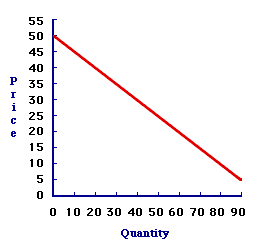
30.
What does this curve represent?
a)
demand
b)
supply
c)
equilibrium
d)
shortage
31.
What does this curve represent?
a)
supply
b)
equilibrium
c)
demand
d)
surplus
32.
Thousands of people leave a small town due to a factory closing down.  Sales at the local grocery store become slow. What causes this change?
a)
Prices or availability of substitutes
b)
Prices or availability of complementary goods
c)
Change in the weather or season
d)
Change in the number of buyers
33.
New technology advances the rate at which furniture can be assembled. Why does this change the supply?
a)
Change in cost of production
b)
Changes in number of producers
c)
Changes in expectations
34.
The market equilibrium price is the price at which
a)
surpluses depress the number of goods supplied
b)
shortages and surpluses will have no effect on the market
c)
the government will not intervene in the market
d)
the quantity demanded is the same as the quantity supplied
35.
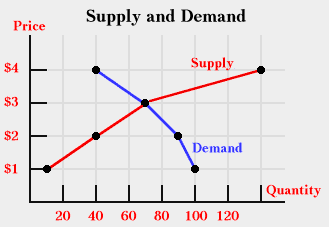
What is the Equilibrium Price?
a)
1
b)
2
c)
3
d)
4
36.
When there is a shortage the price will usually? 
a)
rise
b)
fall
c)
remain the same
d)
equilibrium
37.
Which of the following is likely to increase the demand for peanut butter?
a)
Fewer children in the population
b)
News that insects have destroyed much of the peanut crop and that there will be less peanut butter on the shelves in three months.
c)
A big increase in the price of jelly.
d)
A report from the Surgeon General of the United States that eating peanut butter makes people nutty.
38.
Scarcity is best explained as 
a)
getting everything you want and desire
b)
having unlimited wants, but limited resources
c)
an overabundance of something 
d)
having enough money to buy what you want and need
39.
A resource is best explained as 
a)
Natural resources used to create products
b)
anything used to produce an economic good or service to satisfy a want or need.
c)
how we make choices to best satisfy our wants and needs in a world of scarce resources
d)
the science of choice 
40.
I have to decide between eating a salad for dinner or a hamburger and fries.  I can't have both.  What economic idea is this showing? 
a)
Economics
b)
Tradeoff
c)
Incentives Matter
d)
Opportunity cost 
41.
I have to decide between eating a salad for dinner or a hamburger and fries.  I can't have both.  I decide to go with the salad.  What economic concept is this showing by going with the salad?
a)
Economics
b)
Tradeoff
c)
Incentives Matter
d)
Opportunity cost 
42.
Sam loves science and wants to become a doctor but he is learning how to make clay bricks like his father and grandfather.
a)
Free Market
b)
Traditional
c)
Mixed
d)
Command
43.
Katia is an accountant in a government run business where she was placed after graduation.
a)
Command
b)
Traditional
c)
Free Market
d)
Mixed
44.
Mary Ann runs a car dealership selling only government produced cars.  At the end of the month Mary Ann must give all of the money she made back to the government.
a)
Traditional 
b)
Free Market
c)
Mixed
d)
Command
45.
Joe owns a shoe store.  At the end of the month Joe decides what to do with his profits.
a)
Command
b)
Free Market
c)
Traditional
46.
Nike and Under Armour sell similar products.  This leads to a decrease in price and an increase in quality.
a)
Free Market
b)
Command
c)
Traditional
47.
Sarah would like to become a doctor when she grows up.  Unfortunately, she lives in a country where her job will be decided for her by the government.
a)
Traditional
b)
Free Market
c)
Mixed
d)
Command
48.
Ted is working towards his dream of becoming a lawyer by working at a law firm as a legal clerk.
a)
Free Market
b)
Traditional
c)
Command
49.
Sally works in a private company that has to follow government rules for public safety.
a)
Free Market
b)
Command
c)
Mixed
d)
Traditional
50.
Who or what answers the basic economic questions in a mixed economy?
a)
Individuals and Businesses
b)
Government
c)
Custom
d)
Individuals, Businesses, and Government
51.
Who or what answers the basic economic questions in a traditional economy?
a)
Individuals and Businesses
b)
Government
c)
Custom
d)
Individuals, Businesses, and Government
52.
Who or what answers the basic economic questions in a command economy?
a)
Individuals and Businesses
b)
Government
c)
Custom
d)
Individuals, Businesses, and Government
53.
Who or what answers the basic economic questions in a free market economy?
a)
Individuals and Businesses
b)
Government
c)
Custom
d)
Individuals, Businesses, and Government
54.

Which of the following is NOT one of the questions that ALL economic systems answer?

a)

What will we produce?

b)

How will we produce it?

c)

For whom will it be produced?

d)

When does production start?

55.

In which economic system is ALL property owned by individuals?

a)

Traditional Economy

b)

Command Economy

c)

Market Economy

d)

Mixed Economy

56.

In which economic system is ALL property owned by the government ("for the good of the country")?

a)

Traditional Economy

b)

Command Economy

c)

Market Economy

d)

Mixed Economy

57.

In which economic system is some property owned by the government and some is owned by individuals?

a)

Traditional Economy

b)

Command Economy

c)

Market Economy

d)

Mixed Economy

58.

In which economic system is property collectively owned by the tribe or community?

a)

Traditional Economy

b)

Command Economy

c)

Market Economy

d)

Mixed Economy

59.

In which economic system is creativity not rewarded? You're simply expected to perform your task and meet your quota.

a)

Traditional Economy

b)

Command Economy

c)

Market Economy

d)

Mixed Economy

60.

In which economic system are privately owned businesses limited with by government regulations which are intended to protect consumers?

a)

Traditional Economy

b)

Command Economy

c)

Market Economy

d)

Mixed Economy

61.

In which economic system do children already know what they'll be when they grow up because they will be trained to do what their parents and grandparents have done?

a)

Traditional Economy

b)

Command Economy

c)

Market Economy

d)

Mixed Economy

62.

In which economic system is there virtually no unemployment because the government will definitely give everyone a job to do?

a)

Traditional Economy

b)

Command Economy

c)

Market Economy

d)

Mixed Economy

63.

In which economic system do consumers have an almost endless range of choices because many companies are competing against one another?

a)

Traditional Economy

b)

Command Economy

c)

Market Economy

d)

Mixed Economy

64.

In which economic system do people buy and sell goods and services with NO interference from the government?

a)

Traditional Economy

b)

Command Economy

c)

Market Economy

d)

Mixed Economy

65.

In which economic system do people tend to have a very low standard of living because progress and change are viewed negatively?

a)

Traditional Economy

b)

Command Economy

c)

Market Economy

d)

Mixed Economy

66.

In which economic system are rule-following and obedience to the government strongly enforced?

a)

Traditional Economy

b)

Command Economy

c)

Market Economy

d)

Mixed Economy

67.

In which economic system are people who think outside the box or try to be innovative punished by their communities?

a)

Traditional Economy

b)

Command Economy

c)

Market Economy

d)

Mixed Economy

68.

In which economic system are people who think outside the box or try to be innovative punished by their community?

a)

Traditional Economy

b)

Command Economy

c)

Market Economy

d)

Mixed Economy

69.

In which economic systemS are jobs selected by personal preference, ability, and opportunity?

a)

Traditional Economy

b)

Command Economy

c)

Market Economy

d)

Mixed Economy

70.
An economic choice is a decision  about how to use resources.  Businesses have to make a decision about which goods to produce and how much to make.  This is a picture of a what?
a)
service
b)
good
c)
human resource
d)
capital resource
71.
Businesses also have to make a decision about what kinds of services they wish to offer.  Which is an example of a service?
a)
a cupcake
b)
a hair stylist
c)
pizza
d)
book
72.
Businesses help people in communities meet their wants which is something people would like to have.  Some wants are needs.  What is this an example of?
a)
want
b)
need
73.
Peoples and consumers do not always have enough resources to get everything they want. They must make a choice.  Sometimes they must give up certain things to get other things. This kind of economic decision is called a trade-off.  What people decide to give up in order to get something else is called the ___________.  
a)
economic choice
b)
opportunity cost
74.
A consumer might choose to spend his money on a pair of skates instead of going to the movie. In this case, which one is the opportunity cost?
a)
movie
b)
pair of skates
75.
A consumer might choose to spend his money on some popcorn at the movie and not a bag of M & Ms.  Which one is the opportunity cost?
a)
M & Ms 
b)
popcorn
76.
Scarcity is when there is not enough of something for all of the people who what it.  Only a certain amount of oil is found in the world.  This amount is called the _________.
a)
demand
b)
supply
77.
What do you think will happen to the demand of pumpkins in the fall?
a)
the demand will go down
b)
the demand will go up
78.
This picture if an example of a ________? 
a)
want
b)
need
c)
service