
 Worksheets
UNIT 1: Matter Follow Up Questions/Review
Total questions: 53
Worksheet time: 18hrs 40mins
Which of the following is NOT matter?
a chair
air
light
water
Which of the following is NOT a property of matter?
inertia
occupies space
composed of elements
weightlessness

Which of the following may be heterogeneous? HINT: Look at the concept map from the notes.
elements only
compounds only
mixtures only
elements and compounds
Which of the following is pure?
elements only
compounds only
mixtures only
elements and compounds
Which of the following consists of more than one substance?
elements only
compounds only
mixtures only
elements and compounds
Which of the following are types of matter?
elements only
compounds only
mixtures only
all of these
Which of the following is a type of mixture?
elements only
compounds only
solutions only
elements and compounds
Which of the following is matter?
love
ideas
rock
heat
The tendency of matter to maintain its state of motion is known as
density
inertia
mass
volume
Which of the following is NOT composed of two or more types of atoms?
element
compound
solution
mechanical mixture
Which represents a homogeneous mixture?
Sugar
bowl of chili
Salt Water
Chicken Noodle Soup
Which substance can be decomposed by a chemical change?
Ammonia [NH3]
Iron [Fe]
Argon [Ar]
Helium [He]

1
3
2
4
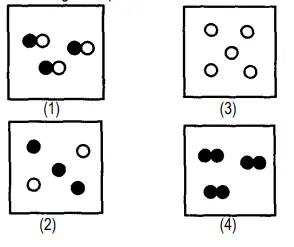
Which diagram represents a compound? *Compounds have to have two or more different atoms chemically combined.
1
3
2
4
A substance that cannot be broken down into simpler substances during a chemical reaction is a[n]
element
compound
mixture
none of these
Which of the following is NOT an element?
oxygen (O2)
nitrogen (N2)
lead (Pb)
sodium chloride (NaCl)
The smallest particle of an element is a[n]
atom
molecule
compound
ion
Water can be broken down into hydrogen and oxygen. This is evidence that water is NOT a[n]
compound
molecule
element
mixture
An example of a substance that can be decomposed by a chemical change is
ammonium [NH4]
argon [Ar]
antimony [Sb]
arsenic [As]
Which substance can not be decomposed by a chemical change?
mercury (II) oxide [HgO]
water [H2O]
potassium chlorate KClO3]
copper [Cu]
Which of the following substances can not be decomposed by chemical change?
sulfuric acid [H2SO4]
water [H2O]
ammonia [NH3]
argon [Ar]
The matter in a container is composed of hydrogen and oxygen. When the contents of the container are added to a fire, the fire goes out. This shows that the hydrogen and oxygen in the container are
mixed to form a solution
mixed to form an emulsion
chemically combined to form a compound
separate elements
A compound consists of
two atoms of the same element chemically combined
two or more atoms of different elements NOT chemically combined
two or more atoms of different elements chemically combined
two or more substances
Which of the following is a mixture?
salt [NaCl]
silver [Ag]
soup [Noodles, chicken broth, celery, etc.]
sugar [C12H22O11]

1. The separation technique shown in the diagram above is
filtration
distillation
chromatography
recrystallization
The separation of substances in a mixture depends on the fact that the substances in the mixture
have different physical properties
are chemically combined
have large particles
show the Tyndall effect

A mixture of sand and salt is separated using the apparatus shown at the right by pouring water through the mixture. What material will be found in the filtrate after pouring water through the mixture?
sand and saltwater
water only
salt only
saltwater only

The liquid portion of a mixture is recovered during distillation by
solar evaporation
recrystallization
chromatography
condensation
The water in a swimming pool is kept free of debris by the process of
simple crystallization
fractional distillation
filtration
chlorination
A filter is able to separate mixtures because it is
porous
homogeneous
heterogeneous
impermeable
The separation of mixtures based on the different boiling points of the components of the mixture is called
chromatography
distillation
filtration
recrystallization
The best method of separation to use for separating starch and water is? *Starch does not dissolve in water.
CHROMATOGRAPHY
DISTILLATION
FILTRATION
SIMPLE CRYSTALLIZATION
The best method of separation to use for separating chlorophyll and the other pigments in a leaf is?
CHROMATOGRAPHY
DISTILLATION
FILTRATION
SIMPLE CRYSTALLIZATION
The best method of separation to use for separating gasoline from crude oil is? *HINT: Crude oil has many substances with different boiling points.
CHROMATOGRAPHY
DISTILLATION
FILTRATION
SIMPLE CRYSTALLIZATION
Which of the following best describes chicken noodle soup?
a. element
b. mixture
c. compound
d. solution
In which classification of matter are the components chemically combined?
homogenous mixture
heterogeneous mixture
element
compound
Which of the following describes a mixture?
formed from two or more substances chemically combined
made up of two or more substances joined in a specific ratio
made up of two or more substances that keep their identities
can be separated only by chemical means
A solution is a(n)
homogeneous mixture
heterogeneous mixture
insoluble solute in a solvent
compound composed of two or more substances
Salt water is a(n)
solution
colloid
suspension
compound
Which of Mr. Simpson's children is the youngest?
Jessa
Jake
Janie Mae
Jase


A(n) ______________ is formed when two or more elements chemically combine.
Compound
Element
Mixture
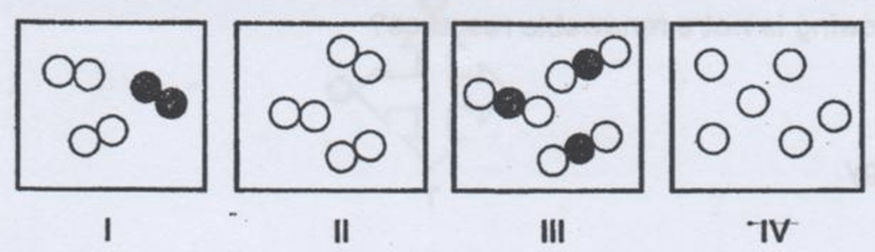
In the diagrams provided, the circles of different colors represent the atoms of different elements. Which diagram represents a mixture?
I
II
III
IV
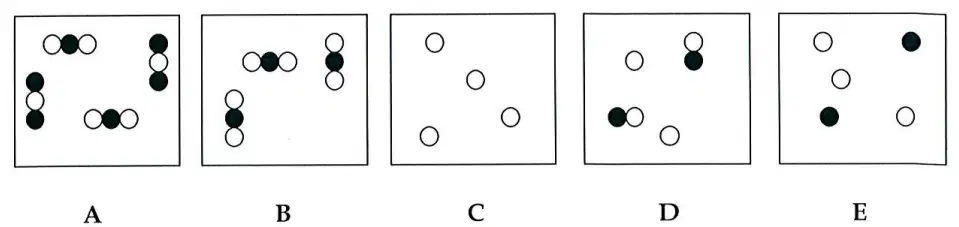
Pure Element - only one type of atom present.
A
B
C
D
E
Pure compound - only one type of compound present.
A
B
C
D
E
Mixture of two elements - two types of uncombined atoms present.
A
B
C
D
E
Sodium (Na) is an very reactive metal that explodes when exposed to water. Chlorine (Cl) is a toxic and corrosive gas. We have to have both of these substances in order to live. Why is that when we eat these two substances as salt (NaCl) we don't choke on toxic gas and explode!?
We are built like Superman and Wonder Woman and we can handle most ANYTHING!
The properties of Na and Cl DON'T CHANGE when they combine to form salt (NaCl).
The properties of Na and Cl CHANGE when they combine to form salt (NaCl).
Na and Cl are separate elements that turn into salt when we eat them.

A student stirs 15 grams of each substance listed below into 200 milliliters of water to form four different mixtures. The student then tries to separate the water from each mixture by pouring the mixture through a kitchen tea strainer. Which mixture can the student separate most easily with the strainer?
Salt and water
Gravel and water
Shampoo and water
Sugar and water

Which of the following substances WILL NOT dissolve in water?
LiCl
RbNO₃
NH₄CH₃COO
BaSO₄
Which of the following substances WILL NOT dissolve in water?
KNO₃
MgSO₄
FeCO₃
(NH₄)₃PO₄
Which of the following substances WILL dissolve in water?
ZnCl₂
AlPO₄
AgBr
BaCO₃

