
 Worksheets
Matter Review
Total questions: 47
Worksheet time: 39mins
Nitrogen chemically combines with hydrogen to make a new substance. This substance is
an element
a compound
a mixture
your best friend
Oxidation is an example of
cool science stuff
a physical property
a chemical property
a financial property
Two or more substances that are together but NOT chemically combined is a
element
compound
mixture
enigma
Hg is
an element
a compound
a mixture
weird
Which of the following is a compound?
Nh
NH3
N
Ni
Volume, density, melting point, boiling point and freezing point are all examples of _______
pure substances
physical properties
matter
chemical properties
If you poured three liquids (that do not mix completely) into a beaker, how could you tell which one is the densest liquid?
a. The liquid that is floating on top is the densest liquid.
b. The liquid that settles to the bottom is the densest liquid
c. The liquid with the deep red color is the densest liquid.
d. There is no way to tell which liquid is densest from the description.
An object with a mass of 15g and a volume of 6cm3 was placed into a container of water. What is the density of the object?
2.5 g/cm3
0.4 g/cm3
2.5 grams
0.4 ml
Ayleen needs to sort the recycling before she takes it out. She has some plastic bottles, and some steel cans. Which of the following is a good way for Ayleen to separate the bottles and the cans?
fill the bottles and cans with water and put them in the freezer
look at the bottles and cans under a magnifying lens
sort them by color
use a magnet to pick up the steel cans
Chellie is picking tomatoes from her garden. She finds a tomato on the ground that is soft and runny. Which sentence best describes what happened to the tomato?
The tomato decayed, which is a chemical change
The tomato moved, which is a chemical change
The tomato deflated like a flat tire, which is a physical change
The tomato ignited like a firecracker, which is a chemical change
Chemical changes occur when molecules of one substance are rearranged to form a different substance. Which of the following is a chemical change?
bending
burning
freezing
shredding
Liz pushes the mower around the yard, cutting the grass. When she stops the mower, she removes the grass catcher and pours the clippings into the compost pile. The grass will eventually become humus that can be mixed into the garden. Finally Liz sweeps the grass clippings off the sidewalk. Which statement is true?
Cutting the grass is a chemical change
Composing the grass is a physical change
Sweeping the sidewalk is a physical change
Pushing the lawnmower is a chemical change

A block of wood, a block of aluminum, a block of stone, and a block of clay all have the same volume. Which of these has the greatest density?
aluminum
clay
stone
wood
Emily is describing the physical properties of an orange and a lemon. Which physical property can she determine without using any measurement instruments?
color
volume
height
density
If you combine sand and iron fillings in a cup, it forms a -
molecule
mixture
solution
atom
If you dissolve sugar in water, it becomes a -
compound
solid
element
solution
What would be the best and fastest way to separate the sugar out of a sugar-water mixture?
Remove the sugar with a syringe
Freeze the mixture
Boil the mixture
Put the mixture on the window sill
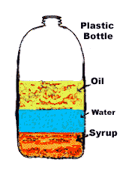


Colloids are
Clear mixtures that have fully dissolved parts
A mixture that will separate into different parts when left to settle
A suspension that appears cloudy and scatters light
A solution that has all parts visible
How are suspensions and colloids different?
Suspensions settle out and colloids do not settle.
Colloids settle out and suspensions do not settle.
Suspensions dissolve and colloids do not.
Colloids dissolve and suspensions do not.

The beaker on the ____ is showing the Tyndall Effect.
left
right

The beaker on the left is a
solution
suspension
colloid

The beaker of the right is a
solution
suspension
colloid

This is an example of a
solution
suspension
colloid
If a mixture has components you CAN NOT see...
solution
compound
homogeneous mixture
heterogeneous mixture
Flammability is a an example of a ____.
physical property
chemical property
physical change
chemical change

