wayground logo

Free Printable Worksheets

Font size

S
M
L
XL
Worksheets

Byzantine/Middle Ages CPA 1 Review

Total questions: 37

Worksheet time: 18mins

Name
Class
Date
1.
The lowest group in the feudal system.
a)
knights
b)
vassals
c)
serfs
d)
students
2.
Which of the following groups DID NOT make up the social structure of feudalism?
a)
Knights
b)
King/Queen
c)
Middle class
d)
Serfs
3.
During feudal times, the majority of people belonged to which social class?
a)
king
b)
nobility
c)
knights
d)
peasants
4.
The Magna Carta's main function was to 
a)
free serfs and peasants
b)
limit the king's power
c)
limit the pope's power
d)
provide money to the king
5.
The first Holy Roman Emporer who supported education and Christianity was 
a)
King John
b)
King Henry
c)
Charlemagne
d)
Constantine
6.
The picture best illustrates
a)
a fief
b)
a farm
c)
a guild
d)
a manor
7.
The land that is granted to a vassal in exchange for his loyalty and service is a 
a)
manor
b)
farm
c)
fief
d)
guld
8.
If I am a wealthy knight and I serve a lord and king, then I am considered a 
a)
hero
b)
peasant
c)
vassal
d)
lucky man
9.

communities of monks

a)

topography

b)

Middle Ages

c)

serfs

d)

monasteries

10.

period of time that lasted from about 500-1500

a)

Middle Ages

b)

Eurasia

c)

Serfs

d)

Chivalry

11.

men who devoted their lives to religion

a)

monks

b)

nuns

c)

missionaries

d)

vassals

12.

Who was the leader of the Franks who created a huge Christian empire?

a)

Benedict

b)

Jesus

c)

Charlemagne

d)

St. Patrick

13.
Which is an important legacy of Justinian’s rule that is still significant today?
a)
Justinian's Code
b)
Justinian's Military Conquests
14.

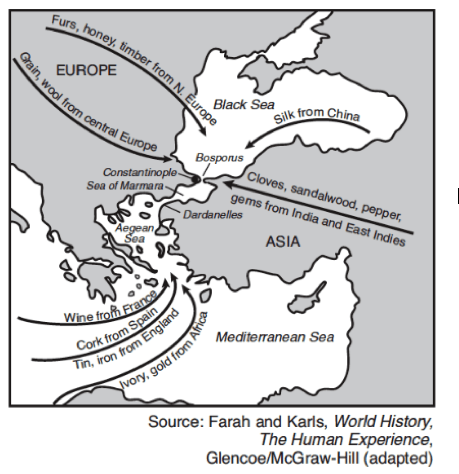
What can you conclude about the city of Constantinople?
a)
Constantinople is a difficult city to travel to
b)
Constantinople is located in Asia.
c)
Constantinople located at the center of major trade routes
d)
Constantinople is on the Mediterranean Sea.
15.
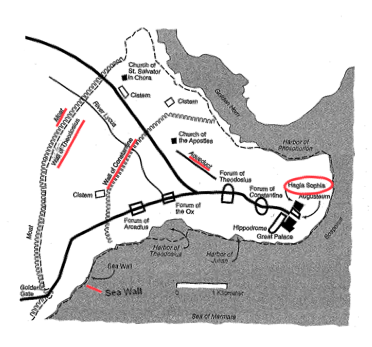
What is this a picture of?
a)
The Hippodrome
b)
The Hagia Sofia
c)
Justinian's Palace
d)
The Forum
16.

What can be assumed about the location of Constantinople?
a)
It would be easy to defend.
b)
It would be easy to conquer.
c)
It would be difficult to travel to.
d)
It would be difficult to defend.
17.
Which great city supported the continuation of “Rome” in the Eastern Roman Empire?
a)
Byzantium
b)
Rome
c)
Athens
d)
Paris
18.

Which of the following practices allowed the Byzantine Empire to flourish?
a)
Isolationism
b)
Diplomacy
c)
Democracy
d)
Protaganism
19.
What are 3 cultural influences that Rome first had on the Byzantine Empire?
a)
Chariot races, oil paintings, and turned outsiders away
b)
Buildings Roman style, emperors spoke Latin, Roman Laws
c)
Polytheism,military ran gov't, and farming main business
d)
Latin language, poor people free bread, Islam main religion
20.

The city of Constantinople was conquered by the —

a)

Mughal Empire

b)

Egyptian Empire

c)

Persian Empire

d)

Ottoman Empire

21.

What made Constantinople an easily fortified site?

a)

It was on a peninsula bordered by natural harbors.

b)

It was an island surrounded by the Aegean Sea.

c)

It was located on top of a mountain.

d)

It was in a valley surrounded by mountains.

22.

Which statement best describes the strategic location of Constantinople?

a)

It was located on an island and therefore free from invasions.

b)

It bordered the Mediterranean Sea.

c)

It was close to the city of Rome.

d)

It was located at the crossroads of the Asian and European continents.

23.

The Byzantine Empire preserved the cultural heritage of which empires?

a)

Egypt and Mesopotamia

b)

China and Persia

c)

Greece and Persia

d)

Greece and Rome

24.

Which statement best describes the economy of the Byzantine Empire?

a)

It was weak.

b)

It was based on farming.

c)

It was a barter economy.

d)

It was prosperous.

25.

Which number represents the city that served as the center of trade for the Byzantine Empire?

a)

1

b)

2

c)

3

d)

4

26.

Justinian was the ruler of the —

a)

Egyptian Empire

b)

Carthaginian Empire

c)

Byzantine Empire

d)

Persian Empire

27.

Under Justinian, the Byzantine Empire –

a)

made peace with the Arab Empire.

b)

expelled the Visigoths from Europe.

c)

founded new colonies in southern Africa.

d)

reclaimed some Roman territory that had been lost.

28.
In 1066 William of Normandy won the nickname "William the Conqueror" and became King of England after which battle?
a)
Battle of  London
b)
Battle of Paris
c)
Battle of Canterbury
d)
Battle of Hastings
29.

Who brought the idea of feudalism to England?

a)

William the Conqueror

b)

King Henry IV

c)

Pope Gregory VII

d)

Charlemagne

30.
Who won the battle of Hastings?
a)
the Normans
b)
the Saxons
c)
the Vikings
d)
the Tudors
31.

What is William the Conqueror known for?

a)

Conquering England after the Battle of Hastings

b)

Beginning Feudalism in England

c)

Giving his nobles land and them in turn giving knights fiefs of land

d)

Discovering America

e)

United Europe under the Holy Roman Empire

32.

What nationality was Charlemagne part of?

a)

Romans

b)

Gauls

c)

Franks

d)

Goths

33.

Where was Charlemagne crowned Emperor?

a)

Rome

b)

Aachen

c)

Paris

d)

Ravenna

34.
Who can send someone to hell through the power of excommunication?
a)
Pope
b)
King
35.
He ruled by divine right? (Chosen by God)
a)
Pope
b)
King
36.
1.  “No freeman is to be taken or imprisoned or disseised of his free tenement or of his liberties or free customs, or outlawed or exiled or in any way ruined, nor will we go against such a man or send against him save by lawful judgement of his peers or by the law of the land. To no-one will we sell or deny of delay right or justice.” - Magna Carta   The Magna Carta established many important rights and limited the king’s power.
What legal concept is being discussed in the passage?

a)
 Innocent until proven guilty
b)
 Freedom of religion
c)
 Trial by jury
d)
 The right to bear arms
37.
Which group made up the largest part of the population in feudal society?
a)
   Nobles
b)
   The king
c)
 Knights
d)
 Peasants