
 Worksheets
Unit 1 Living Things
Total questions: 58
Worksheet time: 50mins
Name
Class
Date
1.

Maintaining a stable internal condition
a)
hibernation
b)
stimulus
c)
homeostasis
2.
Temperature, light, hunger and pain are all examples of
a)
stimulus
b)
response
c)
homeostasis
d)
energy
3.

Fungi
a)
producer
b)
consumer
c)
decomposer
4.
Change of a population over time
a)
natural selection
b)
evolution
c)
genetic variation
5.
This is the smallest unit that carries out all life functions and processes.
a)
tissue
b)
organ
c)
cell
d)
human
6.
What do we call an organism made up of only one cell?
a)
multicellular
b)
unicellular
c)
tissue
7.
To be considered a living thing, how many characteristics of a living thing are needed?
a)
All 6
b)
4 or more
c)
At least 2
d)
At least 1
8.
A cat gives birth to kittens. Which characteristic?
a)
Grows & Develops
b)
Reproduces
c)
Responds to stimulus
9.
A student eats breakfast before school. Which characteristic?
a)
Adapted to environment
b)
Obtains and uses energy
c)
Grows and develops
10.

Type of cell shown?
a)
Eukaryotic
b)
Prokaryotic
c)
Bacterial
d)
Plant
11.

What type of cell is pictured?
a)
Prokaryotic
b)
Eukaryotic
c)
Plant
d)
Animal
12.

Getting goose bumps in order to keep your body warm to maintain an internal balance
a)
response to surroundings
b)
homeostasis
c)
reproduction
d)
made of cells
13.
That boy shot up 5 inches in only one year
a)
homeostasis
b)
reproduction
c)
growth and development
d)
made of cells
14.
A car backfires and you jump. What is the stimulus in this example?
a)
the backfire of the car
b)
You jump
15.
A car backfires and you jump. What is the response in this example?
a)
the backfire of the car
b)
you jumping
16.
To win at the sport, her muscles need to be worked hard everyday.
a)
made of cells
b)
energy use
c)
response to surroundings
d)
made of cells
17.
A bug lands in a spider's web, the web vibrates and the spider reacts.
a)
homeostasis
b)
made of cells
c)
energy use
d)
response to surroundings
18.
My dog became much less clumsy now that he is a year old.
a)
growth and development
b)
energy use
c)
reproduction
d)
homeostasis
19.
A plant makes its food to function and we eat meals to breathe, work and do activities.
a)
homeostasis
b)
made of cells
c)
energy use
d)
growth and development
20.
A tadpole becomes a frog.
a)
reproduction
b)
made of cells
c)
homeostasis
d)
growth and development
21.
Eat a good breakfast and you'll feel better through the morning.
a)
made of cells
b)
energy Use
c)
homeostasis
d)
response to surroundings
22.
When the car pulled into the driveway, my cat ran to hide under the porch.
a)
made of cells
b)
energy use
c)
reproduction
d)
response to surroundings
23.
You look under a microscope and can see the building blocks of all living things.
a)
reproduction
b)
response to surroundings
c)
made of cells
d)
homeostasis
24.
The bee collected nectar from the flowers.
a)
energy use
b)
reproduction
c)
response to surroundings
d)
made of cells
25.
A chicken lays eggs.
a)
energy use
b)
reproduction
c)
response to surroundings
d)
made of cells
26.
Your body will sweat if it gets too hot to maintain a normal temperature.
a)
reproduction
b)
response to surroundings
c)
made of cells
d)
homeostasis
27.
What are the smallest units that carry on the functions of life?
a)
reproduction
b)
made of cells
c)
response to surroundings
d)
energy use
28.

Which domain is capable of living in extreme environments like hot springs, geysers, or very salty waters?
a)
Bacteria
b)
Archaea
c)
Eukarya
29.

Which domain includes all animals and plants?
a)
Archaea
b)
Eukarya
c)
Bacteria
30.

Almost all bacteria are...
a)
Unicellular
b)
Multicellular
31.

Which two kingdoms are entirely multicellular?
a)
Animalia and Plantae
b)
Animalia and Protista
c)
Protista and Plantae
32.
To say that an organism is heterotrophic means...
a)
it cannot reproduce asexually
b)
it cannot make its own food
c)
it cannot breathe oxygen gas
33.
Which kingdoms have some organisms that can make their own food (autotrophic)?
a)
Plantae and Animalia
b)
Fungi and Plantae
c)
Protista and Plantae
34.
Organisms whose cells have NO nucleus are classified as...
a)
Eukaryotic
b)
Prokaryotic
c)
Dead
35.
True or False: All cells have DNA.
a)
True
b)
False
36.
True or False: All living things are made of one or more cells.
a)
True
b)
False
37.

Moss belongs in the kingdom...
a)
Fungi
b)
Plantae
38.

Fungi are a type of...
a)
decomposer
b)
producer
39.
What is the genus name here:
Canis lupus
Canis lupus
a)
Canis
b)
lupus
40.

Choose the correct way to write the scientific name for humans:
a)
homo sapiens
b)
Homosapiens
c)
Homo sapiens
d)
Homo Sapiens
41.

Mold, yeast, and mushrooms all belong to the Kingdom _______.
a)
Archaebacteria
b)
Fungi
c)
Eubacteria
d)
Protista
42.
What is the purpose of a dichotomous key?
a)
to find a common ancestor
b)
to show the evolution of organisms
c)
to show relationships between organisms
d)
to identify organisms
43.
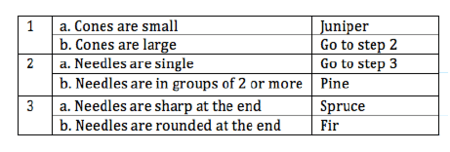
A dichotomous key for trees is provided. Hikers found a tree that has large brown cones and single sharp needles. What species of tree have the hikers found?
a)
Juniper
b)
Pine
c)
Spruce
d)
Fir
44.

A dichotomous key for insects is given. To what order does an insect with two pairs of scaly wings belong?
a)
Coleoptera
b)
Heteroptera
c)
Diptera
d)
Lepidoptera
45.
What step do we always start with when using dichotomous keys?
a)
1
b)
2
c)
3
d)
4
46.
When using a dichotomous key to identify organisms, what do we look at?
a)
physical features
b)
weather patterns
c)
environment
d)
diet
47.
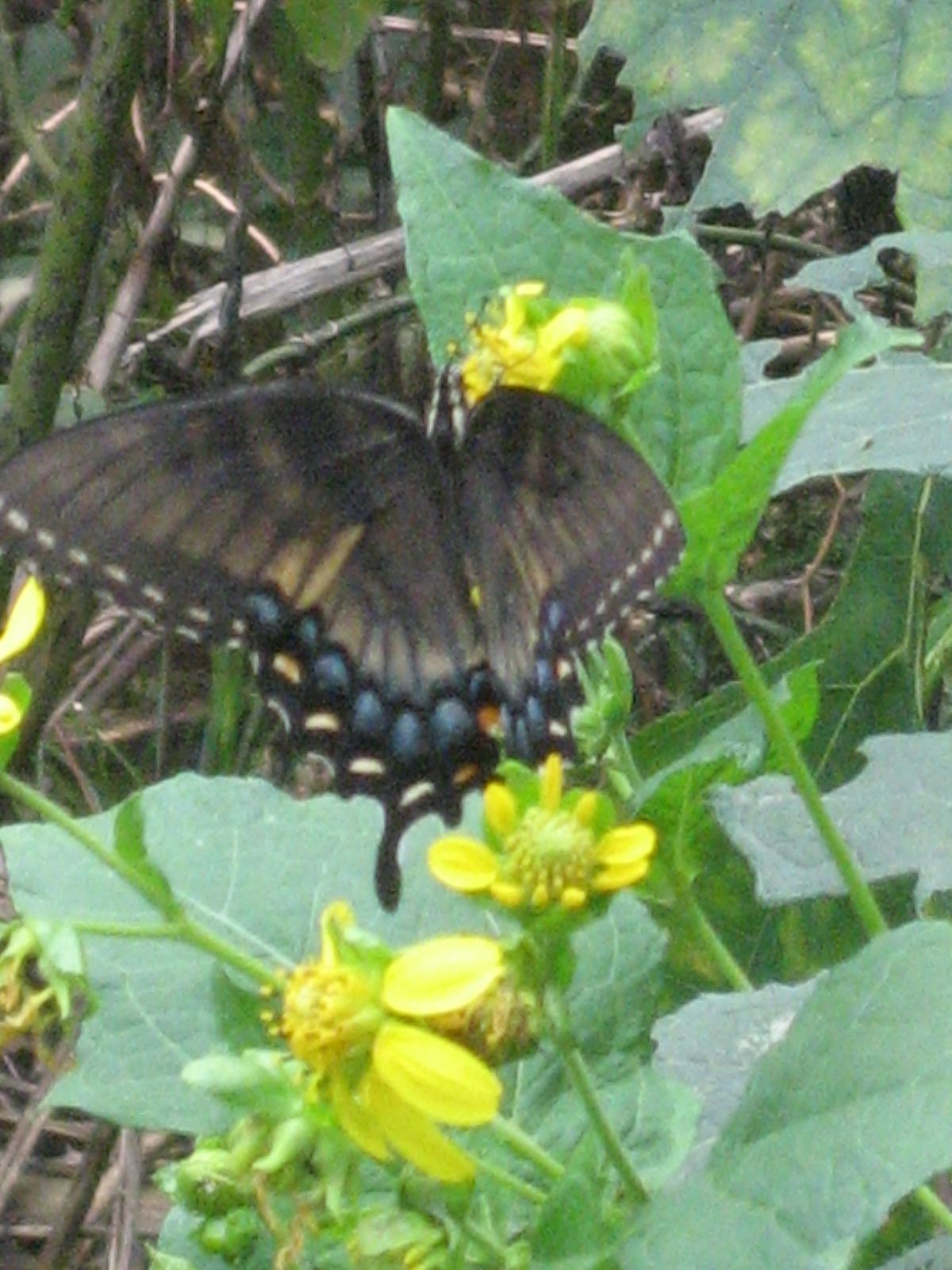
The 8 levels of classification, most broad to most specific.
a)
Domain, Genus, Family, Order, Class, Phylum, Kingdom, Species
b)
Domain, Species, Kingdom, Genus, Phylum, Family, Class, Order
c)
Domain, Kingdom, Phylum, Class, Order, Family, Genus, Species
d)
Order, Kingdom, Species, Domain, Phylum, Family, Class, Genus
48.
Term given to describe the 2 name naming system is:
a)
dichotmous key
b)
binomial nomenclature
c)
2 scientific names
d)
binomial key
49.
The first part of a scientific name is an organism's _______________ and the second part is its ________________.
a)
species, genus
b)
phylum, order
c)
class, spices
d)
genus, species
50.
What is classification?
a)
organizing things into groups according to shared characteristics
b)
making a list of organisms
c)
the process of identifying different types of animals
d)
the study of animals
51.
Which organisms are closely related?
a)
Equus ceballas (horse) & Equus burchellii (zebra)
b)
Cyanea artica (jellyfish) & Asterias rubens (sea star)
c)
Naja naja (cobra) & Crotalus atrox (rattlesnake)
d)
Alligator mississippiensis (alligator) & Crocodylus porosus (crocodile)
52.
The method of naming organisms by using two names is known as
a)
binomial nomenclature
b)
dinomial menoclature
c)
dichotomous naming
d)
the scientific method
53.
Who first proposed binomial nomenclature as a way of classifying organisms?
a)
Carlus Linneaus
b)
Charles Darwin
c)
Albert Einstein
d)
Francis Crick
54.
The science of classifying and naming organisms is
a)
taxonomy
b)
grouping
c)
anatomy
d)
evolution
55.
Organisms are the same ___________ when they can have fertile offspring.
a)
Class
b)
Family
c)
Species
d)
Phylum
56.

What would be the most correct binomial nomenclature for the grizzly bear?
a)
Carnivora ursidae
b)
Ursus Horriblis
c)
Horriblis Ursus
d)
Ursus horriblis
57.
Binomial nomenclature makes it easier for scientists to communicate because ...
a)
everyone speaks latin
b)
everyone uses the same scientific name
c)
everyone knows all the animals
d)
its fun to call organisms by name
58.

Which organism in the table shown is most closely related to the common dolphin?
a)
human
b)
killer whale
c)
giant kelp
d)
bat star
100 %

