
 Worksheets
Practice test on Plate Tectonics
Total questions: 57
Worksheet time: 2hrs 54mins
What process drives the movement of tectonic plates?
movement of ocean currents
gravitational pull of the moon
convection currents in the mantle
magnetic field of the Earth
Which of the following best describes why identical fossils have been found in South America and Africa?
animals could swim the Atlantic
hurricanes blew them over
The continents were once joined as one landmass.
Nomads took them there.
What theory explains how the plates of the Earth are continually moving?
Continental Drift Theory
Theory of Evolution
Plate Tectonic Theory
Big Bang Theory
What type of plate boundary has plates crashing into each other?
divergent
transform
convergent
When plates slide past each other in opposite direction, it is which type of boundary?
divergent
convergent
transform
Which events are most common along tectonic plate boundaries?
earthquakes and erosion
hurricanes and tsunamis
earthquakes and volcanoes
tidal waves and volcanoes

What process is occurring at the mid-ocean ridge?
divergent boundary
convergent boundary
subduction zone
transform boundary
Subduction is when one plate goes under another plate. What causes this plate to go under the other plate?
it is less dense than the top plate
it is more dense than the top plate
the plates are part of the Ring of Fire
volcanoes forced the magma to go underneath
Why do earthquakes occur near the San Andreas fault?
One plate slowly pushes up the other plate
A trench is created as one plate slides under the other plate.
Portions of the plates get stuck and then suddenly loosen and move.
One plate pushes hard enough to reverse the motion of the other plate.
What type of boundary has plates that slide past each other?
convergent
divergent
transform
tension
Where are the tectonic plates located?
outer core
crust
mantle
inner coure
Where is the highest risk of earthquakes in the U.S.?
California
Washington D.C.
Arkansas
Utah

Which of the following aids in the weathering and transportation of rocks?
rain
sunlight
clouds
all of these

Which of the following is NOT evidence of plate tectonics?
fossils
glacial deposits
similar rocks on different continents
current species living on each continent

Which of the following landform occurs at transform boundaries?
Faults
New sea floor
Mountain ranges
Hot Spots

Which type of boundary has plates spreading apart?
Convergent Boundary
Divergent Boundary
Transform Boundary
Tectonic Boundary

On which layer do the plates of the crust move on
The Asthenosphere
The Lithosphere
The Crust
The Core

This term is used to describe the supercontinent when all the plates were together.
Pangaea
America
Lithosphere
Asthenosphere

The observation that the continents fit together like puzzle pieces, and may once have been connected, led Alfred Wegener to propose a theory called
continental plowing.
continental drift.
wandering continents.
shape matching of continents.

Scientists found that the continents were moving apart from each other due to magma rising out of mid-ocean ridges, and they called this
seafloor spreading.
seafloor rising.
changing seafloor.
underwater volcanoes.

The mid-ocean ridge occurs along a
convergent boundary where new crust is formed.
transform boundary where crust is subducted.
divergent boundary where seafloor spreading takes place.
divergent boundary where subduction takes place.
A place where an unusually hot part of the mangle rises through the crust causing volcanic activity is called a
divergent boundary.
hotspot.
convergent boundary.
transform boundary.
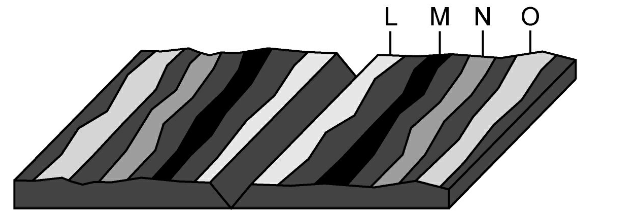


Process by which new ocean crust forms.
Seafloor spreading
Continental drift
Mid-ocean ridge
Rift

This scientist was the first to propose seafloor spreading
William Watts
Harry Hess
Alfred Wegener
Tenzing Norgay

Wegener used matching mountain ranges across different continents as evidence to support his hypothesis of Continental Drift.
true
false
Wegener used the fit of the continents as evidence to support his hypothesis of Continental Drift.
true
false
Wegener used the magnetic striping on the seafloor showing polar reversals as evidence to support his hypothesis of Continental Drift.
true
false
Wegener used matching rock types and ages across different continents as evidence to support his hypothesis of Continental Drift.
true
false
Wegener used evidence of convection currents in the mantle as evidence to support his hypothesis of Continental Drift.
true
false
What discovery revived Wegener's idea of Continental Drift and eventually led to the Theory of Plate Tectonics?
discovery of new fossils on Africa and South America
the discovery of mid-ocean ridges and seafloor spreading
the discovery of radioactive isotopes
none of the above
Who first proposed the idea of seafloor spreading?
Alfred Wegener
Harry Hess
James Hutton
Nicolaus Copernicus
Name a piece of evidence Wegener had to support Continental Drift.
Continents appear to connect
Lizards have identical tails on both Africa and South America.
Present day glaciers match up on different continents
Alternating bands of magnetism are found trapped in rock on either side of the rift/mid-ocean ridge
Name a piece of evidence Wegener had to support Continental Drift.
Ocean currents show that the continents were once connected.
Fossil patterns match where continents appear to connect.
Cities line up where continents appear to connect.
There is a rift in the ocean floor between South America and Africa.
Name a piece of evidence Wegener had to support Continental Drift.
Marks in rock left by glaciers match where continents appear to connect.
Insects are identical where continents appear to connect
Mountains match where continents appear to connect.
The ocean shows the same life where continents appear to connect
Select modern day evidence to support Plate Tectonics.
The age of rock increases further from the mid-Atlantic rift
The age of rock decreases further from the mid-Atlantic rift
The age of rock stays the same from the mid-Atlantic rift
There are ridges on either side of the mid-Atlantic rift
How is the age of oceanic rock often determined?
By tasting the rock. The saltier the older the rock.
By comparing the amount of potassium-40 to Argon-40.
By comparing the location of rock in relation to the continents.
By how much the rock sinks in the ocean.

This image here shows what type of boundary?
Divergent
Convergent: Subduction
Convergent: Collision
Transform
Which of the following is an example of a divergent boundary?
Great Rift Valley
Mt. Everest
Mt. Saint Helen
San Andreas Fault
People did not believe Wegener's theory because he...
could not explain how it was happening.
was not very well liked by his peers.
was a Geologist.
was not as smart as Harry Hess.

