
 Worksheets
Atmosphere Test Review
Total questions: 52
Worksheet time: 40mins
Which layer of the atmosphere aborbs UV light?
troposphere
stratospere
thermosphere
mesosphere

______________ is the most abundant gas in the atmosphere
Oxygen
Carbon
Helium
Nitrogen

Which layer protects Earth from getting hit by most meteoroids?
Troposphere
Stratoshphere
Mesosphere
Thermosphere

As altitude above Earth increases air pressure...
decreases.
increases.
stays the same.

The main layers of the atmosphere are classified by changes in ..
precipitation
temperature

Transfer of energy by electromagnetic waves.
Conduction
Convection
Radiation

Transfer of thermal energy by contact of particles of matter.
Conduction
Radiation
Convection

The transfer of thermal energy by movement of particles within matter.
Conduction
Convection
Radiation
As altitude within the troposphere increases, the amount of water vapor generally
increases, only
decreases, only
remains the same
decreases, then increases
An air temperature of 95ºC most often exists in which layer of the atmosphere?
troposphere
stratosphere
mesosphere
thermosphere
What is the temperature of the mesopause, in degrees Celsius (page 14)?
cannot determine from graph
-100 degrees celcius
-90 degrees celcius
15 degrees celcius
What is the approximate percent of oxygen by volume present in Earth's lower atmosphere?
21%
33%
46%
94%

Which layer can be found at 5 km in altitude?
troposphere
stratosphere
mesosphere
thermosphere
Which layer can be found at 20 mi in altitude?
troposphere
stratosphere
mesosphere
thermosphere
Which layer starts at -55 degrees Celsius?
troposphere
stratosphere
mesosphere
thermosphere
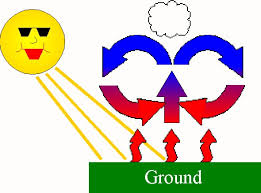
than in hot things.
100 °C = _____ K
173 K
373K
273 K
0 K
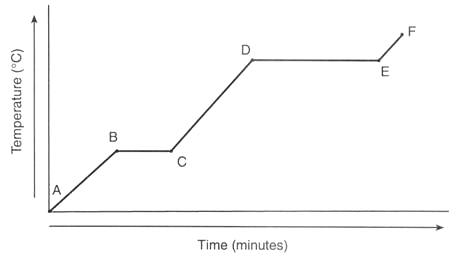
What state/phase is the object likely from points A to B?
Solid
Liquid
Gas
Plasma
What is happening to the particles in the substance between points A and B?
Melting
Freezing
Speeding Up
Slowing Down

Where on the graph are phase changes taking place?
1
2
3
4
5

Which letter represents particles in solid form?
A
B
C
D
E

A substance's heating curve is shown in the graph. What is its boiling point? (Diagram B)
100 C
60 C
80 C
20 C

The barometer measures
wind speed
pressure
wind direction
temperature

The anemometer measures
wind direction
wind speed
pressure
temperature
The weight of the air pushing down or the pressure that a column of air exerts on the air or surface below it is called ________.
air pressure
anemometer
air mass
atmosphere
The short term changes in atmospheric conditions in a place.
Atmospheric instability
Climate
Oscillation
Weather
A measure of the energy of molecules in the air is _____.
air pressure
relative humidity
air temperature
wind
Air moving from areas of high to low pressure is called _____.
air pressure
relative humidity
dew point
wind
The change of state from a gas to a liquid.
Condensation
Evaporation
Precipitation
Sublimation
Warm air _________ because it is _______ dense than the air around it.
rises, less
rises, more
falls, less
falls, more
Cold air _________ because it is _______ dense than the air around it.
rises, less
rises, more
falls, less
falls, more
Which instrument is used to measure air temperature?
thermometer
barometer
anemometer
hygrometer
How does heat energy reach the Earth from the Sun
Convection
Radiation
Conduction
Insulation
In the Northern Hemisphere, winds associated with a low-pressure system blow_____.
a. counterclockwise toward the center
b. clockwise toward the center
c. clockwise outward from the center
d. counterclockwise outward from the center
When lines are closely spaced on a weather map, it indicates ________.
high winds
light winds
variable winds
cyclonic winds
In the Northern Hemisphere, winds associated with a low-pressure system blow_____.
a. counterclockwise toward the center
b. clockwise toward the center
c. clockwise outward from the center
d. counterclockwise outward from the center

