wayground logo

Free Printable Worksheets

NEW

Font size

S
M
L
XL
Worksheets

Q1 REVIEWER PART 1

Total questions: 50

Worksheet time: 27mins

Name
Class
Date
1.
Which of the following causes Earth's tectonic plates to move?
a)
Energy from the Sun
b)
Magnetic Pole Reversal
c)
Convection currents in the mantle
d)
Faults in Mountain Ranges
2.
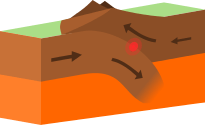
What type of event will occur at this boundary?
a)
Earthquake
b)
Volcano Eruption
c)
Tornado
d)
Mountain Building
3.
What type of plate boundary is this?
a)
Plate
b)
Divergent
c)
Convergent
d)
Transform
4.
A divergent boundary occurs when plates ....
a)
Pull apart
b)
Come together
c)
Slide past each other
d)
subducting
5.

A fossil fern that helped support Alfred Wegener’s hypothesis of Continental Drift.

a)

glossopteris

b)

lystrosaurus

c)

gondwanaland

d)

mesosaurus

6.

   What are the two main types of seismic waves?

a)

body wave and rayleigh wave

b)

love wave and rayleigh wave

c)

surface wave and body wave

d)

primary wave and secondary wave

7.
How is it possible for new crust to be formed without increasing the surface area of the Earth?
a)
Crust is destroyed at the same time it is created
b)
New crust is underwater where it sinks
c)
New crust breaks more easily than old crust
8.
A subduction zone is formed...
a)
when one tectonic plate sinks below another
b)
at every type of convergent plate boundary
c)
at every type of divergent plate boundary
d)
at transform boundaries
9.

Which of these is FALSE about lithospheric plates?

a)

vary in thickness

b)

thickest in the mountain regions

c)

include the crust and upper mantle

d)

have the same thickness everywhere

10.
Which of the following has the layers of Earth in order from outside to inside?
a)
lithosphere, outer core, inner core, asthenosphere 
b)
inner core, outer core, lithosphere, asthenosphere
c)
outer core, asthenosphere, lithosphere, inner core
d)
lithosphere, asthenosphere, outer core, inner core
11.
Which of the following explains how mountains are formed?
a)
Plates collide at divergent boundaries causing the crust to push upward.
b)
Plates collide at convergent boundaries causing the crust to push upward.
c)
Plates slide past each other at transform boundaries causing the crust to push upward.
d)
Plates collide at convergent boundaries causing the mantle to push upward
12.
What is the name of plate B?
a)
Eurasian
b)
North American
c)
South American 
d)
Indo-Australian
13.
What is the name of Plate A
a)
North American Plate
b)
Pacific Plate
c)
Eurasian Plate
d)
South American Plate
14.
What is the name of Plate C?
a)
North American Plate
b)
Nazca Plate
c)
African Plate
d)
Pacific Plate
15.
Why does oceanic crust sub-duct under continental crust?
a)
The oceanic crust is more dense.
b)
The oceanic crust is less dense.
c)
The oceanic crust is hotter.
d)
The oceanic crust is cooler. 
16.
How are ridges formed? 
a)
Two plates collide with one another.
b)
Two plates sink below Earth's surface.
c)
Two plates slide beside each other. 
d)
Two plates move away from one another.
17.
What type of plate boundary is shown in the picture? 
a)
convergent
b)
divergent
c)
transform
18.
What type of boundary does the picture show and what does it form? 
a)
divergent; mountains
b)
divergent; mid ocean ridge
c)
convergent; mid ocean ridge
d)
transform; earthquake
19.
Why do plates move? 
a)
Convection currents in the mantle cause plates to move.
b)
The outer core spins
c)
The inner core is magnetic
d)
The plates are floating on an ocean
20.

The branch of science that deals with the study of earthquakes is called?

a)

Geology

b)

Seismology

c)

Biology

d)

Microbiology

21.

Nickle and iron are found in what layer of the Earth?

a)

core

b)

mantle

c)

crust

d)

biosphere

22.

It is the instrument use to trace seismic waves when an earthquake occurs is known as?

a)

Richter scale

b)

seismograph

c)

microscope

d)

telescope

23.

It is a branch of science that deals with the study of Earth is called?

a)

Zoology

b)

Botany

c)

Geology

d)

Anthropology

24.

He is a scientist who proposed the Continental Drift Theory

a)

Gregor Mendel

b)

Isaac Newton

c)

Alfred Wegener

d)

Harry Hess

25.

Which is TRUE about convection current?

a)

the rising and cooling of molten materials in the crust

b)

the rising and cooling of molten materials in the mantle

c)

the rising and boiling of molten materials in the core

d)

the rising and boiling of molten materials in the crust

26.

Who is a scientist who discovered mantle and the process of seafloor spreading?

a)

Alfred Wegener

b)

Gregor Mendel

c)

Isaac Newton

d)

Harry Hess

27.

The process of seafloor spreading occur in what plate boundary?

a)

transform boundary

b)

convergent boundary

c)

divergent boundary

d)

slide-slip boundary

28.

Why does the Philippines are prone to earthquakes and volcanic eruptions?

a)

because of its geographical position towards "Pacific Ring of Fire" or pacific plate

b)

because of its geographical position towards south american plate

c)

because of its geographical position towards north american plate

d)

both b and c

29.

   Which of the following DOES NOT describe a convection process?

a)

A handle of a metal pot is hot while cookingre

b)

Boiling of macaroni pasta

c)

a sea breeze

d)

ocean water in the surface is warm

30.
Thin layer that has two layer called oceanic and continental.  
a)
Crust
b)
Core
c)
Mantle
d)
Atmosphere
31.
Includes the crust and upper mantle that is divided into several constant moving plates of solid rock that floats on the layer below it. 
a)
Asthenosphere 
b)
Mesosphere
c)
Lithosphere 
d)
Crust
32.
Which layer of the Earth is the only liquid layer?
a)
Outer Core
b)
Inner Core
c)
Mantle
d)
Lithosphere
33.

An underwater mountain system formed by a divergent tectonic plate boundary.

a)

Subduction zone

b)

Hot spots

c)

Mid-ocean ridge

d)

Erosion

34.

Which of the following has a lesser density in a convection cell?

a)

warm fluid materials

b)

Cold fluid materials

c)

Room temperature fluid materials

d)

Hot fluid materials

35.
A ______ is a section of the lithosphere that slowly moves over the asthenosphere, carrying large slabs of continental and oceanic crust.
a)
wedge
b)
plate
c)
chunk
d)
fault
36.
A break in Earth's crust along which rocks move is called a ________.
a)
plate
b)
rift
c)
fault
d)
breach
37.

How does Plate Tectonics explain the movement of plates?

a)

convection in the mantle moves the plates      

b)

great flood & melting of glaciers moves the plates        

c)

rising of magma from the mantle cause the plates to move

d)

rotation & revolution of the Earth move the plates.

38.
_________ are vibrations that travel through Earth carrying the energy released during an earthquake.
a)
Seismic Waves
b)
Rumbles
c)
Plate Tectonics
d)
Convection Currents
39.
What is the name of the single landmass that began to break apart 200 million years ago?
a)
Panthalassa
b)
Laurasia
c)
Gondwanna
d)
Pangaea
40.
The process by which molten material adds new oceanic crust to the ocean floor is called ___________.
a)
Divergent boundary
b)
Sea-floor spreading
c)
Convergent boundary
d)
Renovating 
41.
A _________ is a valley that forms where two plates move apart.
a)
Fissure
b)
Rift valley
c)
Sea-floor spreading
d)
Fault
42.

The San Andreas fault is an example of which type of boundary?

a)

transform

b)

divergent

c)

convergent

d)

universal

43.

Which feature forms at convergent boundaries?

a)

trench

b)

rift valley

c)

mountain range

d)

mid-ocean ridge

44.
Wegener’s proposal of a supercontinent was supported by:
a)
earthquake data
b)
seafloor magnetism
c)
rock, fossil, and climate data.
d)
convection currents in the mantle.
45.
What does the theory of continental drift state?
a)
The continents were once joined in a super-continent and have moved over time
b)
Continents are stationary and do not move
c)
The Earth is broken into lithospheric plates that move due to convection currents
d)
none of the above
46.
What evidence did Wegener use in his theory?
a)
Continents and fossils fitting together/matching-up like puzzle pieces 
b)
glacier scars and evidence from temperature
c)
mountain ranges and coal deposits line up across continents
d)
all of the above
47.
Earth’s tectonic plates sit atop and slide along with of these layers?
a)
lithosphere
b)
asthenosphere
c)
core
d)
crust
48.

These are the magnetized patterns of rocks in the ocean floor.

a)

Deep-ocean trench

b)

magnetic stripes

c)

rift valley

d)

tectonic plate

49.
This is the place where two tectonic plates meet. 
a)
Hot spot
b)
subduction
c)
plate boundary
d)
fault
50.

What theory explains why the tectonic plates have been moving over time?

a)

Continental Drift

b)

Geologic Columns

c)

Plate Tectonics

d)

Pangaea