wayground logo

Free Printable Worksheets

NEW

Font size

S
M
L
XL
Worksheets

Unit 7: Gene Expression & Biotechnology

Total questions: 56

Worksheet time: 40mins

Name
Class
Date
1.

What is the correct order to make a protein?

a)

Protein, DNA, RNA

b)

RNA, DNA, Protein

c)

DNA, RNA, Protein

d)

Protein, RNA, DNA

2.

What enzyme does transcription use?

a)

DNA polymerase

b)

ligase

c)

RNA polymerase

d)

helicase

3.

Which RNA carries the message?

a)

mRNA

b)

rRNA

c)

tRNA

4.
How does RNA differ from DNA?
a)
RNA contains uracil and deoxyribose
b)
RNA contains ribose and thymine
c)
RNA contains uracil and ribose
d)
RNA contains adenine and ribose
5.
How would the DNA sequence GCTATA be transcribed to mRNA?
a)
GCUAUA
b)
CGATAT
c)
CGAUAU
d)
GCUTUT
6.

Where are proteins made?

a)

ER

b)

nucleus

c)

cytoplasm

d)

mitochondria

7.

Which RNA brings amino acids?

a)

rRNA

b)

tRNA

c)

mRNA

8.

Which RNA forms part of the ribosomes?

a)

tRNA

b)

mRNA

c)

rRNA

9.
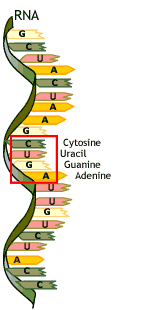
Other than mRNA, what is this image showing?
a)
tRNA
b)
rRNA
c)
DNA
d)
RNA polymerase
10.

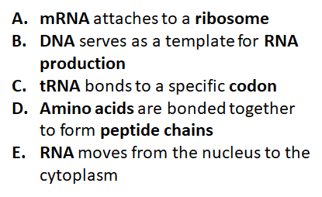
What is the correct order for the following events that occur during protein synthesis?

a)

B,E,A,C,D

b)

B,A,E,C,D

c)

D,A,E,C,B

d)

C,B,A,E,D

11.
_______ is made during transcription and ________ is made during translation.
a)
mRNA / a protein
b)
a protein / mRNA
c)
Ribosome / Nucleus
d)
mRNA / tRNA
12.
The enzyme that unzips the DNA to prepare for replication
a)
helicase
b)
replicase
c)
polymerase
d)
synthase
13.
In what phase of the cell cycle does DNA replication take place?
a)
G1
b)
S
c)
G2
d)
M
14.
Okazaki fragments form on the:
a)
lagging strand
b)
leading strand
c)
base-pairs
d)
5' end
15.

DNA replication results in

a)

2 completely new DNA molecules

b)

2 DNA molecules that each contain a strand of the original

c)

1 new DNA molecule and 1 old

d)

1 new molecule of DNA

16.

The new DNA strand formed after DNA replication is an exact copy of its parent strand

a)

True

b)

False

17.
DNA Replication is
a)
conservative
b)
semiconservative
c)
liberal
d)
dispersive
18.
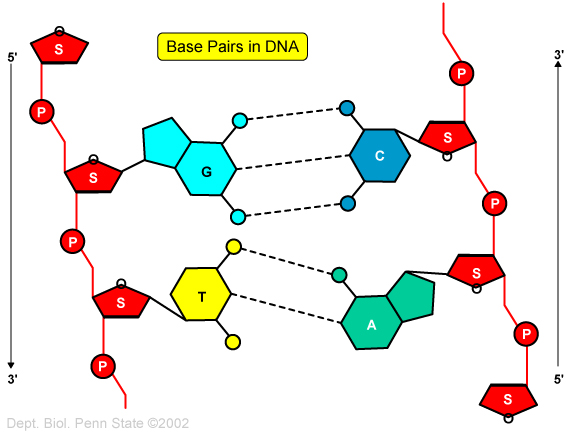
Name this structure
a)
double helix
b)
nucelotide
c)
twisted ladder
d)
hydrogen bond
19.

DNA strand has the following bases AAGCCA what are the bases on the complementary strand

a)

GGCTTA

b)

TTGGGA

c)

CCAGGT

d)

TTCGGT

20.
A process in which DNA has the unique ability to make an exact copy of itself.
a)
Replication
b)
Translation
c)
Transcription
21.
Nitrogenous bases are joined by which type of bond?
a)
polar bonds
b)
ionic bonds
c)
covalent bonds
d)
hydrogen bonds
22.
What does DNA stand for?
a)
Deoxyribonucleic acid
b)
Denitrogenous acid
c)
Deribonucleic acid
d)
Diribonucleic acid
23.
How would the DNA sequence GCTATA be transcribed to mRNA?
a)
GCUAUA
b)
CGATAT
c)
CGAUAU
d)
GCUTUT
24.
Which of the following describes RNA?
a)
RNA is usually double-stranded and contains the base thymine
b)
RNA is usually single-stranded and contains the base uracil
c)
RNA is longer than DNA and uses five bases to encode information
d)
RNA is made in the nucleus of eukaryotic cells and stays there to carry out its functions
25.
Which of the following statements about the genetic code is true?
a)
A codon can specify more than one amino acid
b)
Every codon specifies a different amino acid
c)
Some codons specify the same amino acid
d)
Some codons have no function at all
26.
Which of the following is true of DNA?
a)
It can sometimes leave the nucleus
b)
It never leaves the nucleus
c)
It is portable
d)
It is temporary
27.
WHY must we use RNA if we already have genetic code in DNA?
a)
RNA is portable and can be read by the ribosome
b)
RNA is more accurate than DNA
c)
The cell needs a backup code and uses RNA
d)
DNA and RNA can be used interchangeably 
28.
DNA contains the bases Adenine, Guanine, Cytosine and Thymine.  Which base is replaced in RNA by another base?
a)
Adenine is replaced by Uracil
b)
Thymine is replaced by Uracil
c)
Guanine is replaced by Uracil
d)
Cytosine is replaced  Uracil
29.
How many amino acids would be produced from the mRN CGCUAUAGC?
a)
1
b)
2
c)
3
d)
4
30.
How are DNA and RNA similiar?
a)
They have nucleotides.
b)
They have the same sugar.
c)
They have the same bases.
d)
They are double strands.
31.

Which of the following characteristics is NOT seen in both DNA and RNA?

a)

A single strand

b)

Adenine

c)

Cytosine

d)

A double helix

32.

Which of the following are properties of RNA?

a)

Deoxyribose, uracil, and a globular structure

b)

Deoxyribose, ribose, and uracil

c)

Ribose, uracil, and a linear structure

d)

Deoxyribose, thymine, and a linear structure

33.
The following picture must be
a)
DNA because it's double stranded
b)
RNA because it's single stranded
c)
DNA because it's single stranded
d)
RNA because it's double stranded
34.

I only stay in the nucleus and cannot leave.

a)

DNA

b)

RNA

c)

Both

35.

I have the base T

a)

DNA

b)

RNA

c)

Both

36.

What are the proper complementary base-pairs?

a)

A--T and G--C

b)

G--T and A--C

c)

A--G and C--T

d)

A--C and T--G

37.

What is the DNA compliment of this sequence?

AGGCGA

a)

TCCGCT

b)

AGGCGA

c)

TCCTTA

38.

What is the DNA compliment of this sequence?

GCAATCA

a)

CGTTAGT

b)

CGAAATC

c)

CGTTTAG

39.

What is the DNA compliment of this sequence?

TAATCGGCCA

a)

ATTAGCCGGT

b)

ATTCGACGCT

c)

TAATCGGCCA

40.

Guanine bonds with ______________

a)

Guanine

b)

Cytosine

c)

Thymine

d)

Adenine

41.

T A G G A C T

a)

T A G G A C T

b)

A T C C T G A

c)

A T G G T G A

d)

T T C C A G T

42.

TRANSCRIBE this DNA sequence: TACGTTACT

a)

AUGCAAUGA

b)

ATGCAATGA

c)

AUGGATUGA

d)

TACGTTACT

43.

TRANSLATE this RNA sequence: AUGCAAUGA

a)

Met-Glu-Stop

b)

Met-His-Stop

c)

Thr-Glu-Stop

d)

Thr-Pro-Stop

44.
Choose the nucleotide sequence of the RNA strand that would be complementary to the following strand: 
GTAGTCA
a)
UATUAGA
b)
ACGACTG
c)
CAUCAGU
d)
CATCAGT
45.
In RNA, Uracil pairs with ______. 
a)
cytosine
b)
adenine
c)
guanine
d)
thymine
46.
Which is the mRNA molecule that would be transcribed from this DNA template:
TGGCAAGTACGT
a)
ACCGTTCATGCA
b)
UGGCAAGUACGU
c)
UCCGUUCUUGCU
d)
ACCGUUCAUGCA
47.

How many codons code for phenylalanine?

a)

2

b)

3

c)

4

d)

1

48.

The following codon is translated into which amino acid?


AUG

a)

Methionine

b)

Isoleucine

c)

Histidine

d)

Arginine

49.

The following codon is translated into which amino acid?


AUU

a)

Methionine

b)

Isoleucine

c)

Histidine

d)

Arginine

50.

The following codon is translated into which amino acid?


CAU

a)

Methionine

b)

Isoleucine

c)

Histidine

d)

Arginine

51.

The following codon is translated into which amino acid?


UUU

a)

STOP

b)

Phenylalanine

c)

Valine

d)

Aspartic acid

52.

This is the practice of producing a genetically identical cell or organism

a)

Cloning

b)

Gel Electrophoresis

c)

Genetic Engineering

d)

DNA Fingerprinting

53.

This is the practice of inserting the DNA of another species into an organism's DNA so that the organism gains a new trait.

a)

Cloning

b)

Gel Electrophoresis

c)

Genetic Engineering

d)

DNA Fingerprinting

54.

This is the practice of choosing individuals of a species to mate based on their desirable characteristics

a)

Bacterial recombination

b)

Natural selection

c)

Genetic modification

d)

Selective breeding

55.
When humans use biological processes to solve a problem, they are using______.
a)
biochemistry
b)
biotechnology
c)
molecular biology
d)
gene therapy
56.

A farmer is considering the advantages of cloning a herd of cattle from a single cow. What is one advantage of a cloned herd?

a)

All cattle in the herd would have the most desired traits.

b)

All cattle in the herd would have more genetic variation.

c)

All cattle in the herd would have more resistance to diseases.

d)

All cattle in the herd would have much longer life spans.