wayground logo

Free Printable Worksheets

NEW

Font size

S
M
L
XL
Worksheets

Atmosphere quiz

Total questions: 52

Worksheet time: 48mins

Name
Class
Date
1.
What are the two most common gases found throughout the atmospheric layers?
a)
carbon dioxide and oxygen
b)
ozone and water vapor
c)
nitrogen and oxygen
d)
carbon dioxide and nitrogen
2.
How does the ozone layer help life on Earth?
a)
It produces oxygen for the atmosphere
b)
It protects Earth from meteors
It protects the Earth from meteors
c)
It absorbs damaging ultraviolet radiation from the Sun
d)
It reflects most of the Sun's radiation to keep the planet cool
3.
In which atmospheric layer does all weather occur?
a)
exosphere
b)
stratosphere
c)
thermosphere
d)
troposphere
4.
A student described a layer of the atmosphere in the list.  1. This is the coldest layer.  2. Meteors burn up in this layer. 3. Nitrogen and oxygen are found in this layer.Which layer of the atmosphere is described? 
a)
exosphere
b)
mesosphere
c)
stratosphere
d)
troposphere
trop
5.
When a person climbs a mountain, what happens to the air pressure around him?
a)
It decreases
b)
It increases
c)
It remains constant
d)
It decreases, then increases
6.

Which is the correct sequence of atmospheric layers from the lowest altitude to highest?

a)

mesosphere, troposphere, thermosphere,

b)

troposphere, stratosphere, mesosphere, thermosphere

c)

thermosphere, stratosphere, mesosphere, thermosphere

d)

stratosphere, mesosphere, troposphere, thermosphere
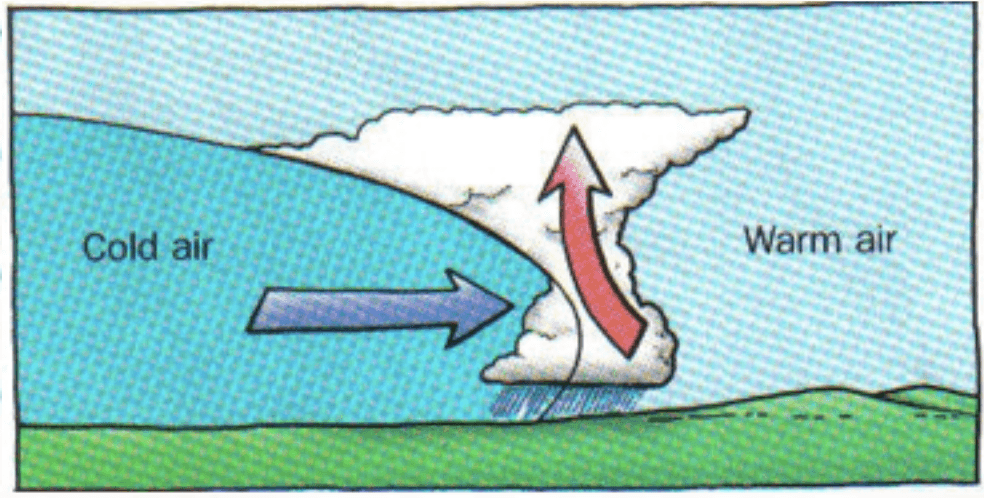
7.

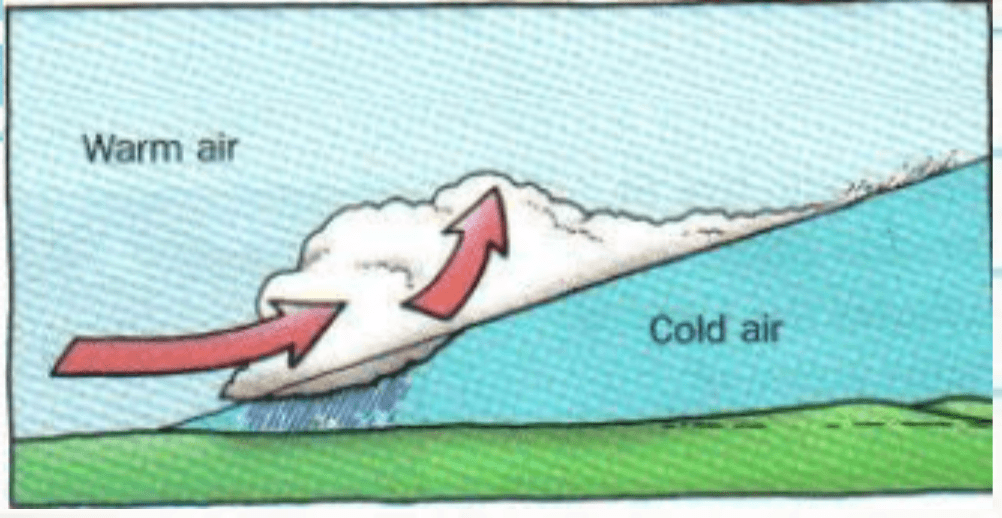
Name that front.

a)

Cold Front

b)

Warm Front

c)

Stationary Front

d)

Occluded Front

8.

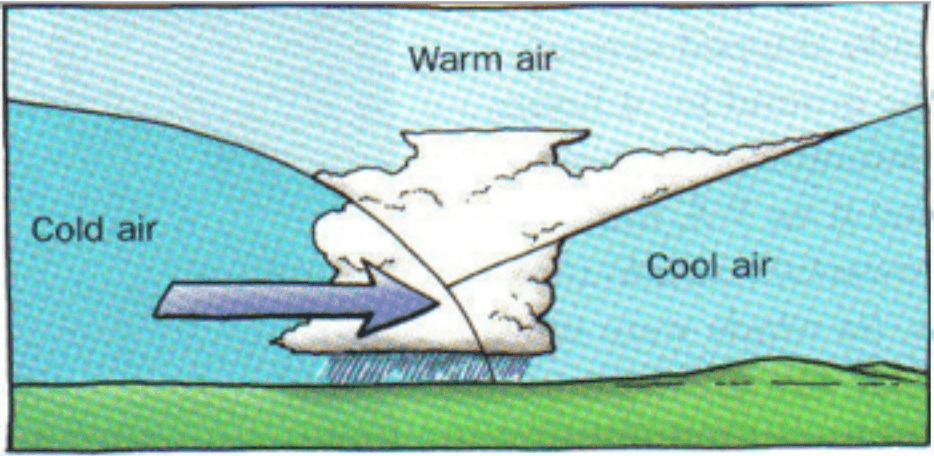
Name that front.

a)

Cold Front

b)

Warm Front

c)

Stationary Front

d)

Occluded Front

9.

Name that front.

a)

Cold Front

b)

Warm Front

c)

Stationary Front

d)

Occluded Front

10.

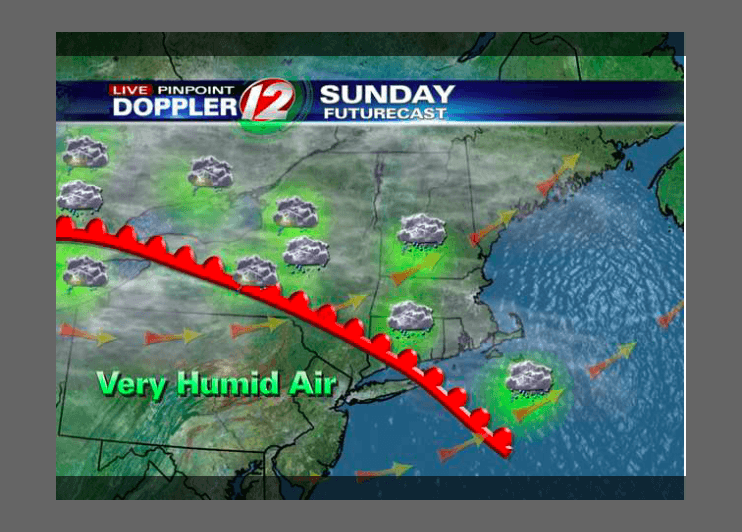
Name that symbol.

a)

Cold Front

b)

Warm Front

c)

Stationary Front

d)

Occluded Front

11.

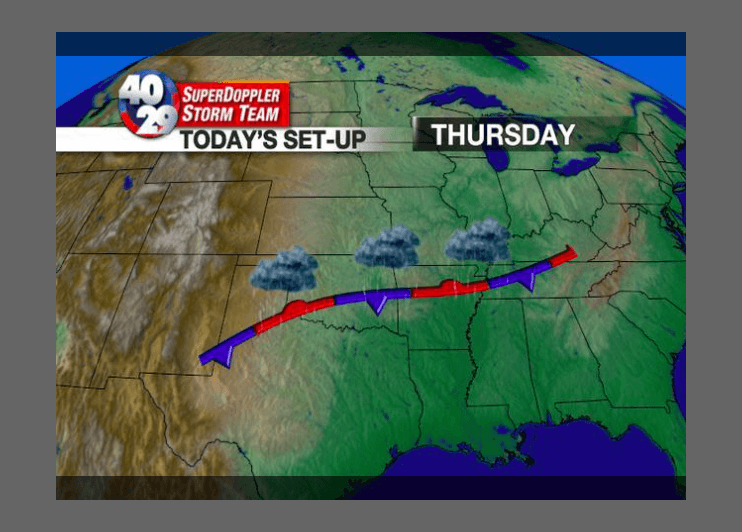
Name that symbol.

a)

Cold Front

b)

Warm Front

c)

Stationary Front

d)

Occluded Front

12.

Name that symbol.

a)

Cold Front

b)

Warm Front

c)

Stationary Front

d)

Occluded Front

13.

Name that symbol.

a)

Cold Front

b)

Warm Front

c)

Stationary Front

d)

Occluded Front

14.
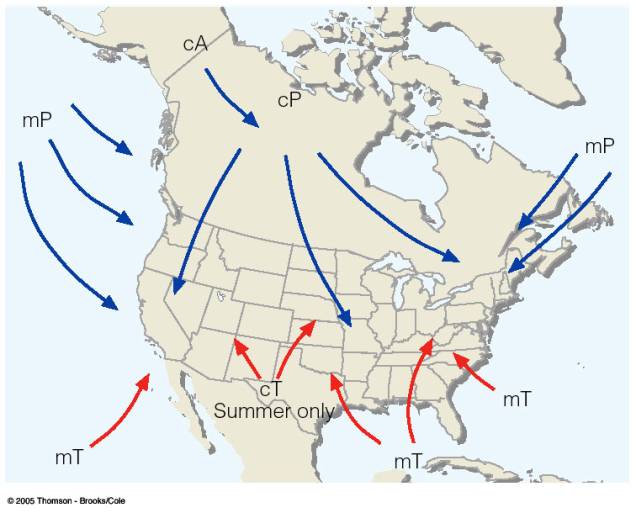
How do we name air masses?
a)
Water and temperature
b)
Air pressure
c)
Humidity and temperature
d)
Cold and warm
15.
Which abbreviation of an air mass can be identified as cold and moist?
a)
cP
b)
mP
c)
cT
d)
mT
16.
Air travels
a)
from high pressure to low pressure
b)
from low pressure to high pressue
17.
Which abbreviation of an air mass can be identified as dry and hot?
a)
cP
b)
mP
c)
cT
d)
mT
18.
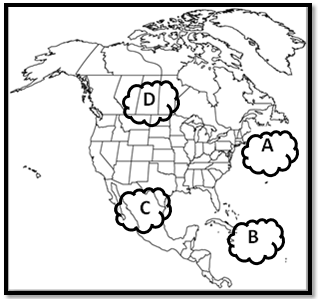
Which type of air would you find at air mass D?
a)
cold, dry
b)
warm, humid
c)
warm, dry
d)
cold, humid
19.
Which type of air would you find at air mass B?
a)
cold, dry
b)
warm, humid
c)
warm, dry
d)
cold, humid
20.
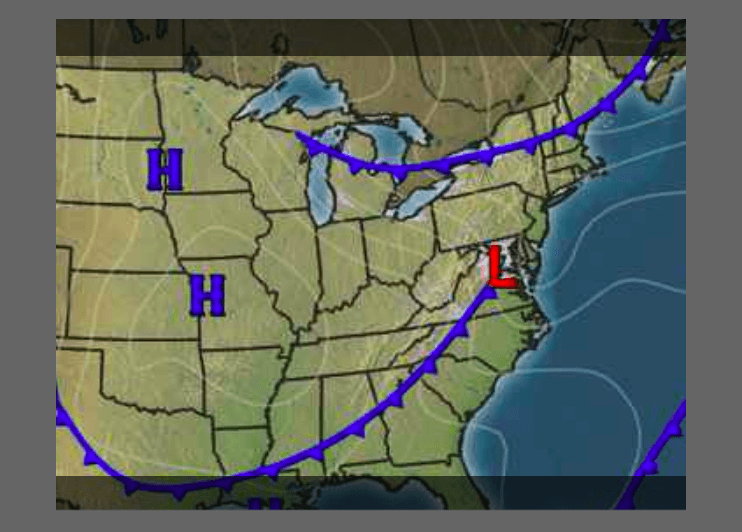
High Pressure is associated with this type of weather...
a)
Cloudy/Overcast Weather
b)
Cold Weather
c)
Warm Weather
d)
Fair Weather
21.
Low Pressure is associated with this type of weather...
a)
Cloudy/Overcast Weather
b)
Cold Weather
c)
Warm Weather
d)
Fair Weather
22.
What is the wind speed at this station
a)
3 knots
b)
15 knots
c)
25 knots
d)
30 knots
23.

What is the wind direction

a)

Northeast

b)

Northwest

c)

Southeast

d)

Southwest

24.
What is an isobar? 
a)
A line on a weather map that connects points of equal air temperature
b)
A line on a map that shows which areas of the United states get more sun 
c)
 A line on a weather map that connects points of equal air pressure
d)
A line of latitude on a map that shows the different zones; tropic, temperate and polar
25.

What is the cloud cover?

a)

sunny

b)

partly cloudy

c)

1/4 cloudy

d)

1/4 clear

26.

What is the pressure?

a)

100

b)

66

c)

-13

d)

1002.5

27.

What is the temperature?

a)

100 degrees

b)

66 degrees

c)

-13 degrees

d)

75 degrees

28.

What type of weather is this area experiencing?

a)

thunderstorm

b)

hail

c)

fog

d)

snow

29.
Name location #1
a)
Polar High 
b)
Polar Low
c)
Polar Front
d)
Polar Easterlies
30.
Name location #2
a)
Westerlies
b)
Polar High
c)
Polar Easterlies
d)
Subtropical High
31.
Name location #3
a)
Westerlies
b)
Polar High
c)
Polar Easterlies
d)
Subtropical High
32.
Name location #4
a)
Westerlies
b)
Polar High
c)
Polar Easterlies
d)
Subtropical High
33.
Name location #5
a)
Westerlies
b)
Northeast trades
c)
Polar Easterlies
d)
Subtropical High
34.
Name location #7
a)
Westerlies
b)
Northeast trades
c)
Intertropical Convergence Zont
d)
Subtropical High
35.
What gas is located in area "A"?
a)
Ozone
b)
Oxygen
c)
Argon
d)
Nitrogen
36.
What gas is located in area "B"?
a)
Ozone
b)
Oxygen
c)
Argon
d)
Nitrogen
37.
What type of heat transfer is at Location "A"?
a)
Heat Transfer
b)
Conduction 
c)
Convection
d)
Radiation
38.
What type of heat transfer is at Location "B"?
a)
Heat Transfer
b)
Conduction 
c)
Convection
d)
Radiation
39.
What type of heat transfer is at Location "C"?
a)
Heat Transfer
b)
Conduction 
c)
Convection
d)
Radiation
40.
What is the name of the layer of the atmosphere at Location #1?
a)
Thermosphere
b)
Troposphere
c)
Mesosphere
d)
Stratosphere
41.
What is the name of the layer of the atmosphere at Location #2?
a)
Thermosphere
b)
Troposphere
c)
Mesosphere
d)
Stratosphere
42.
What is the name of the layer of the atmosphere at Location #3?
a)
Thermosphere
b)
Troposphere
c)
Mesosphere
d)
Stratosphere
43.
What is the name of the layer of the atmosphere at Location #4?
a)
Thermosphere
b)
Troposphere
c)
Mesosphere
d)
Ozone Layer
44.
What is the name of the layer of the atmosphere at Location #5?
a)
Thermosphere
b)
Troposphere
c)
Mesosphere
d)
Ozone Layer
45.
What type of movement is at "Location 1"?
a)
Divergence aloft
b)
Rising air
c)
Convergence aloft
d)
Subsiding air
46.
What type of movement is at "Location 2"?
a)
Divergence aloft
b)
Rising air
c)
Convergence aloft
d)
Subsiding air
47.
What type of movement is at "Location 3"?
a)
Divergence aloft
b)
Rising air
c)
Convergence aloft
d)
Subsiding air
48.
What type of movement is at "Location 4"?
a)
Divergence aloft
b)
Rising air
c)
Convergence aloft
d)
Subsiding air
49.
What type of movement is at "Location 5"?
a)
Surface Divergence 
b)
Cyclonic flow
c)
Surface Convergence 
d)
Anticyclonic flow
50.
What type of movement is at "Location 6"?
a)
Surface Divergence 
b)
Cyclonic flow
c)
Surface Convergence 
d)
Anticyclonic flow
51.
"Location 7" is a Low pressure system, what else can it be called?
a)
Jet Stream
b)
Cyclonic flow
c)
Tradewinds
d)
Anticyclonic flow
52.
"Location 8" is a high pressure system, what else can it be called?
a)
Jet Stream
b)
Cyclonic flow
c)
Tradewinds
d)
Anticyclonic flow