
 Worksheets
Summative Test in Chemistry 8
Total questions: 50
Worksheet time: 26mins

Which of the following statements best explains the ability of liquids to flow and take the shapes of their containers related to the behavior of their particles? You may use the illustration for reference.
Liquid particles are tightly packed and cannot move, which prevents them from changing shape.
Liquid particles are loosely packed and can slide past one another, allowing the liquid to flow and take the shape of its container.
Liquid particles are arranged in a fixed structure, making it impossible for them to adapt to different shapes.
Liquid particles are in a constant state of vibration, which causes them to expand and fill any container completely.

Which of the following statements accurately compares the kinetic energy of particles in a liquid to that in a solid?
The kinetic energy of particles in a liquid and solid is the same.
The particles in a liquid have less kinetic energy than the particles in a solid.
The particles in a liquid have more kinetic energy than the particles in a solid.
The particles in a solid move freely, while the particles in a liquid are tightly packed.

By looking at the picture, how do you explain why do gas particles occupy the entire container?
The gas molecules are stationary and do not move around.
The gas molecules are constantly moving and colliding with the walls of the container.
The gas has a higher density than liquids, causing it to push against the walls.
The gas molecules are attracted to the walls of the container, pulling them inward.

Which of the following statements explains why solids have a definite shape, while liquids take the shape of their container?
In solids, particles are closely packed and vibrate in fixed positions, while in liquids, particles are less tightly packed and can move around more freely.
Solids are made of larger particles than liquids, allowing them to maintain their shape.
Liquids have stronger bonds between particles than solids, which allows them to hold their shape.
Solids can flow like liquids when heated, which is why they have a definite shape.

Based on the picture, how do the arrangement of particles affect the intermolecular forces of the 3 states of matter?
The closer the particles to each other the stronger is the intermolecular forces between them.
The farther the arrangement of particles, the stronger is the intermolecular forces between them.
The arrangement of particles has nothing to do with the intermolecular forces between them.
Gas particles have the strongest intermolecular forces among the 3 states of matter.

Based on the picture of solid liquid and gas, which state of matter has a closely arranged particles with fixed pattern?
Solid
Liquid
Gas
Plasma

Study the picture above, how do you describe the arrangement of particles in gases?
far from each other
Loosely packed but have some order
Tightly packed in a regular pattern
No fixed pattern, constantly moving
In which state of matter do particles move very slowly and have the least amount of energy?
Solid
Liquid
Gas
Plasma

Consider a solid block of ice and a balloon filled with air. How do the arrangements of particles in the solid and gas compare, and how does this affect their volume?
The particles in the solid ice are loosely arranged and can move freely, allowing the ice to take the shape of its container, while the gas in the balloon has tightly packed particles that maintain a fixed volume.
The particles in the solid ice are closely packed and vibrate in fixed positions, while the gas in the balloon has particles that are far apart and move freely, allowing the gas to expand and fill the entire volume of the balloon.
The particles in the solid ice are very closely packed and vibrate in fixed positions, which gives the ice a definite shape and volume, while the gas in the balloon has particles that are spread out and can move freely, allowing the gas to take shape and volume based on the container.
The particles in the solid ice are arranged randomly, while the gas in the balloon has particles that are arranged in a specific pattern, which allows the gas to maintain a definite volume.
On a hot sunny day, you have a sealed syringe filled with air. In this closed container with air inside, how do the arrangement and movement of the gas particles contribute to the syringe's ability to be squeezed or compressed?
Gases have closely packed particles making them more compressible.
Gases have less kinetic energy that is why their particles move less.
Gases have large intermolecular spaces giving them more space for movement.
Gases have fixed shapes, that is why they cannot be compressed.
Imagine dropping a marble into a transparent glass. Would anything happen to the shape or size of the marble? Which of the following statements support the correct concept?
The marble's shape stays the same, but the volume does not no matter what size of a transparent glass you drop it because marble is a solid.
The marble's shape does not stay the same, but the volume stays the same no matter what size of a transparent glass you drop it because marble is a solid.
The marble's shape and volume stay the same no matter what size of a transparent glass you drop it into because the marble is a solid.
The marble's shape does, and the volume does not stay the same no matter what size of a transparent glass you drop it because marble is a solid.
When you placed the cotton with perfume on the table you smelled the fragrance of the perfume even if you were at some distance away. What happened to the particles of the perfume?
The particles of the perfume condense.
The particles of perfume started to move away.
The particles of the perfume come closer to each other.
The particles of the perfume travel slightly apart from each other.
Which of the following statements describes what happens to the particles of a gas if an inflated balloon releases air?
The particles of a gas move a little bit faster.
The particles of a gas move a little bit slow.
The particles of a gas move very slowly.
The particles of a gas move very fast.

Which of the following happens during a phase change in matter?
Changing the state or form of a substance without creating something new.
Changing the chemical makeup of substances.
Starting a reaction that releases energy.
Mixing elements to create compounds.
Which of the following example best shows a phase change?
Burning wood to make ash.
Digesting food in the stomach.
Freezing water to make ice cubes.
Mixing vinegar and baking soda to create bubbles.

Which of the following statements show the behavior of particles when water changes from liquid to water vapor?
Particles maintain a consistent speed and direction.
The movement of the particles becomes completely stationary.
Particles gain energy and exhibit more freedom of movement.
Particles slow down and experience increased restriction in their motion.

How can phase change be explained in terms of the arrangement and motion of particles?
Particles in a solid move freely and are spaced far apart, allowing them to flow easily.
During a phase change, particles in a liquid become tightly packed and stop moving altogether.
Phase change occurs when particles rearrange themselves and change their motion, resulting in different states of matter.
The arrangement of particles remains the same during a phase change, but their temperature increases significantly.
Which of the following activities involves phase change where the physical properties of the substances are altered?
Freezing water into ice.
Shaping clay into different figures.
Rust forming on an iron surface.
Mixing sugar in tea until it dissolves.

What happens to the arrangement of particles when a liquid substance changes to a gas?
Particles become more tightly packed.
Particles become more orderly and structured.
Particles form stronger bonds with each other.
Particles move more freely and become less confined.
How do the particles of water behave in melting ice?
They remain stationary.
They move more slowly and become denser.
They undergo a phase change, transforming into ice crystals.
They gain energy, move more rapidly, and transition into the liquid phase.
How does temperature affect the motion of particles in a substance?
Higher temperatures increase particles motion and energy.
Higher temperatures cause particles to move slower.
Lower temperatures cause particles to move faster.
Temperature has no effect on particles motion.
What happens to the particles when a liquid is cooled and begins to freeze?
The particles lose energy and arrange into a solid structure.
The particles gain energy and move apart.
The particles remain in a liquid state
The particles break apart into gas.
What happens to the arrangement of particles of matter in solid, liquid and gas when the temperature is increased?
Particles are becoming closer together.
Particles move farther apart from each other.
There is no change in the arrangement, it stays the same.
It becomes disordered and then changes back to become ordered.
In what conditions of temperature and kinetic energy will favor the condensation process?
There is an increase in temperature and a decrease in kinetic energy.
There is an increase, both for temperature and kinetic energy.
There is a decrease, both for temperature and kinetic energy.
There is no change, both for temperature and kinetic energy.
What happens to the arrangement of particles in ice cream once its temperature increases?
The particles are freezing.
The particles are getting farther.
The particles are coming closer.
The particles are getting heavier.
Which of the following is TRUE when a substance changes its state from liquid to solid?
The particles of a substance getting smaller.
The particles of a substance become heavier.
The particles of a substance are moving closer.
The particles of a substance changes from soft to hard.
How many neutrons are there in the atom of Europium with an atomic mass of 152 and an atomic number of 63?
89
63
151
152
If an atom has an atomic number of 28, how many electrons does it have?
31
20
59
28
How many protons are there in the atom of Cerium with an atomic mass of 140 and an atomic number of 58?
140
60
58
82
How many electrons does Boron have if the atomic number is 5 and a mass of 11?
11
10
6
5
You cannot leave without me; I am safe and free. My atomic number is 8. So, breathe, breathe so you won't be late.
Carbon
Hydrogen
Oxygen
Nitrogen
I have 79 electrons in my pocket. You will be rich if you have me in your bucket.
Copper
Gold
Nickel
Silver
My former job is to tell your temperature: Inside a small tube, I can rise and fall. But now in a digital world, the nurse won't use me at all.
Magnesium
Mercury
Manganese
Zinc
The element Tin (Sn) was first mined and processed in Turkey around 3,500 BC. It is widely used for plating steel cans used as food containers, metals used for bearing and solders. If Tin has an atomic number of 50 and an atomic mass of 118. Which statement best describes its subatomic particles?
Tin has 50 protons and 50 neutrons
Tin has 50 protons and 50 electrons
Tin has 50 protons and 118 neutrons
Tin has 50 protons and 118 electrons
Iron is the second most abundant element on Earth, if an atom of iron has an atomic number of 26 and a mass number of 56. What are the numbers of protons, neutrons, and electrons in this atom?
26 protons, 30 neutrons, 26 electrons
56 protons, 26 neutrons, 26 electrons
26 protons, 26 neutrons, 56 electrons
30 protons, 26 neutrons, 30 electrons

Based on the data on table 1, which statement about subatomic particles is accurate?
Electrons have the smallest mass and are found outside the nucleus.
Protons have a negative charge and are in the nucleus.
Neutrons have a positive charge and determine the element's chemical properties.
All subatomic particles have the same number of charges.

Which of the following statements are TRUE about the subatomic particles?
I. The charge of electron is opposite to the charge of proton.
II. Proton has approximately the same mass with neutron.
III. Electrons and protons are located within the nucleus.
IV. The mass of an atom is concentrated at the nucleus.
Which two particles would be attracted to each other?
protons and neutrons
electrons and neutrons
electrons and protons
All particles are attracted to each other.

Based on the data in table 1, which subatomic particles are found in the nucleus?
protons and neutrons
electrons and neutrons
electrons and protons
Neutrons only
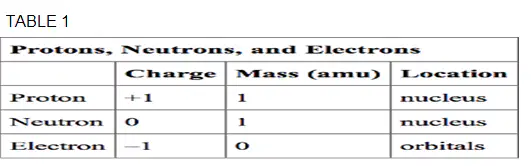
Which particles have approximately the same size and mass?
protons and neutrons
electrons and neutrons
electrons and protons
Neutrons only
If an element is electrically neutral and has 6 protons, how many electrons does it have?
8
6
5
4
Elements are arranged either vertically from top to bottom or horizontally from left to right. What do you call the vertical arrangement of elements in the periodic table?
Group
Period
Atomic mass
Atomic number
How will you arrange the elements K19, H1, Na11 and Li3 based on increasing number of protons?
H, Li, K and Na
H, Li Na and K
K, Na Li and H
K, Li, H and Na
The number of valence electrons of an element can be determined by the periodic table's group (vertical column) in which the element is categorized. If a set of elements belong to group 2, What is their valence electron?
1
2
8
20
The period or horizontal arrangement of elements in the periodic table tells us the number of energy level or electron shell. If Rb and Xe belongs to period 5 in the periodic table, how many electron shell or energy level do they have?
4
5
6
7

From left to right of the Periodic table atomic radius decreases, Based on the arrangement of the elements on the picture, which element would have the biggest atomic Radius?
B
C
Ne
O

Use the picture at the side, based on the arrangement of elements, which has the smallest atomic radius?
B
C
Ne
O

Based on the illustration above, which statements best describes the ionization energy and electron affinity of the elements from left to right of the periodic table?
The ionization energy and electron affinity increase from left to right of the periodic table.
The ionization energy and electron affinity decrease from left to right of the periodic table.
The ionization energy increases while the electron affinity decreases from left to right of the periodic table.
The ionization energy decreases while the electron affinity increases from left to right of the periodic table.

Study carefully the illustration above, which elements are more metallic?
The elements found on the left side of the periodic table are more metallic.
The elements found on the right side of the periodic table are more metallic.
The elements found on the middle of the periodic table are more metallic.
The elements found on the upper right of the periodic table are more metallic.
How does the arrangement of particles change when a liquid substance changes to a gas?
Particles become more tightly packed.
Particles become more orderly and structured.
Particles form stronger bonds with each other.
Particles move more freely and become less confined.

