wayground logo

Free Printable Worksheets

NEW

Font size

S
M
L
XL
Worksheets

Sig Fig and Sci Not.

Total questions: 73

Worksheet time: 2hrs 18mins

Name
Class
Date
1.
Determine the number of Significant Figures in 101.00 mL.
a)
5
b)
4
c)
3
d)
2
2.
Determine the number of Significant Figures in 101320 Pa.
a)
5
b)
4
c)
3
d)
6
3.
Determine the number of Significant Figures in 0.0100 m
a)
5
b)
4
c)
3
d)
2
4.
Determine the number of Significant Figures in 1.0 x 10g.
a)
1
b)
4
c)
3
d)
2
5.
Determine the number of Significant Figures in 10 L.
a)
4
b)
3
c)
2
d)
1
6.
Determine the number of Significant Figures in 0.000204 kg.
a)
4
b)
3
c)
6
d)
1
7.
Convert the following to scientific notation. 
0.000480 
(keep the same number of sig figs)
a)
4.80 x 10⁴
b)
4.80 x 10⁻⁴
c)
4.8 x 10⁻³
d)
4.8 x 10⁻⁴
8.

How would you write 564,000 in scientific notation with 4 sig figs?

a)

5.640 x 10⁻⁵

b)

5.640 x 10⁴

c)

5.640 x 10⁵

d)

5.64000 x 10⁵

9.
Convert to scientific notation with 3 sig figs:
520,000,000  
a)
520 x 106
b)
5.20 x 10⁷
c)
5.20 x 10⁸
d)
0.52 x 10⁹
10.
What is the Volume in the graduated cylinder?
a)
63.5 mL
b)
63 mL
c)
63.55 mL
d)
6 mL
11.
Where do we read the level of liquid?
a)
The highest point the liquid touches
b)
The bottom of the meniscus
c)
Half way between, we make an educated guess and round it
d)
The top of the meniscus
12.
Which is the correct measurement of the red line?  
a)
9 cm
b)
8.5 cm
c)
8.50 cm
d)
8.1 cm
13.

How close a measurement is to the true value is called..

a)

Accuracy

b)

Precision

c)

Significant

d)

Estimate

14.
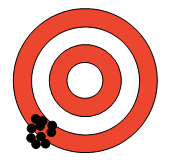
This bullseye demonstrates...
a)
High Accuracy & High Precision
b)
High Accuracy & Low Precision
c)
Low Accuracy & High Precision
d)
Low Accuracy & Low Precision
15.
You place a rock on the electronic balance an it measures a mass of 12.38 g.  The estimated digit is....
a)
b)
2
c)
3
d)
8
16.

Volume?

a)

48 mL

b)

48.2 mL

c)

48.25 mL

d)

4 mL

17.

How would you write 0.0005 in scientific notation?

a)

50 x 105

b)

5 x 10⁻⁴

c)

5 x 10³

d)

.5 x 103

18.

How would you write 5.6 x 10⁻³ in standard form?

a)

0.0056

b)

-5,600

c)

0.00056

d)

-0.0056

19.
Scientific Notation is made up of two number parts. The second part is a power of base 10.
a)
True
b)
False
20.
When writing a number in scientific notation, the first number must be greater than 1, but less than 10.
a)
False
b)
True
21.
An observation that includes NUMBERS
a)
Qualitative
b)
Quantitative
c)
Inference
d)
Prediction
22.
How many significant figures in 4.021
a)
3
b)
23
c)
4
d)
5
23.
How many sig. fig. are in the number below:
705000
a)
2
b)
3
c)
5
d)
6
24.
2.12 + 3.5
a)
5
b)
5.6
c)
5.62
d)
5.620
25.

25 * 5

a)

125

b)

120

c)

100

d)

130

26.

Express the following in standard notation:

8.025 x 10⁻⁸

a)

.00000008025

b)

.000000008025

c)

802,500,000,000

d)

80,250,000,000

27.

Solve:

(9.0 x 10⁻⁶) / (3.0 x 10⁻³)

a)

27 x 10-9

b)

3.0 x 10⁻³

c)

3.0 x 10⁻⁹

d)

27 x 10-3

28.

Find the sum

4.20 x10² + 5.1 x10²

a)

9.3 x 10⁴

b)

9.3 x 10²

c)

5.5 x 10

d)

20.4 x 10⁴

29.
What does mm stand for?
a)
meters
b)
millimeters
c)
metric
d)
mass
30.
What is the next highest measurement after millimeters?
a)
Meters
b)
Centimeters
c)
Kilometers
d)
Decimeters
31.
Which is the proper order from least to greatest?
a)
Kilometer, Meter, Centimeter, Millimeter
b)
Centimeter, Meter, Millimeter, Kilometer
c)
Millimeter, Centimeter, Meter, Kilometer
d)
Kilometer, Centimeter, Millimeter, Meter
32.
Something that takes up space and has mass.
a)
volume
b)
matter
c)
mass
d)
density
33.
What is the correct SI unit for mass?
a)
Kilograms
b)
newtons
c)
pounds
d)
grams
34.

The SI unit for time is the __?__.

a)

hours (h)

b)

liter (L)

c)

gram (g)

d)

second (s)

35.
How many significant figures does 10.1 cm have?
a)
1
b)
2
c)
3
d)
4
36.
How many significant figures does 1.90 × 10⁸ have?
a)
3
b)
4
c)
6
d)
8
37.
Calculate
12.34 + 1.234 + 0.1234
a)
13.6974
b)
13.697
c)
13.70
d)
13.7
38.
Calculate
12.34 × 1.234 × 0.1234
a)
1.87908
b)
1.879
c)
1.9
d)
1.8790809
39.
What is the volume of 150 grams of lead if it has a density of 11.3 g/cm3? (All calculations should have the correct sig figs)
a)
13.3 g
b)
13 cm3
c)
1695 g
d)
1700 cm3
40.
What is the density of a rock if its mass is 36g and its volume is 12.0 cm3(All calculations should have the correct sig figs)
a)
432 g/cm3
b)
0.33 g/cm3
c)
48 g/cm3
d)
3.0 g/cm3
41.
If an object has a density of 21.45 g/cm3, what will be the density of the object if you cut it in half? (All calculations should have the correct sig figs)
a)
21.45 g/cm3
b)
10.725 g/cm3
c)
2 g/cm3
d)
42.9 g/cm3
42.
Describe the accuracy and precision of the image
a)
Accurate and Precise
b)
Accurate and not precise
c)
Not Accurate and Precise
d)
not accurate and not precise
43.

The students measured length during a science experiement, they got 12.00 cm. But the actual measurement was 14.25 cm. What was the percent error?

a)

15.79%

b)

18.75%

c)

2.25%

d)

18%

44.
How would you write 4.3756 x 10in standard form?
a)
437,560,000
b)
0.00043756
c)
43,756
d)
4,3756
45.

UNDERSTANDING: If the exponent is a negative number...

a)

you will get a large number

b)

you will get a small number

46.

UNDERSTANDING: If the exponent is a positive number...

a)

you will get a large number

b)

you will get a smaller number

47.
This bullseye demonstrates...
a)
High Accuracy & High Precision
b)
High Accuracy & Low Precision
c)
Low Accuracy & High Precision
d)
Low Accuracy & Low Precision
48.
A series of steps used by scientists to solve a problem or answer a question. 
a)
scientific method
b)
recipe
c)
data collection
d)
metric system
49.
A testable explanation to a problem that has not yet been tested. 
a)
data
b)
theory
c)
hypothesis
d)
fact
50.
This variable in an experiment is the one being changed by the scientist. 
a)
dependent variable
b)
independent variable
c)
data
d)
control group
51.
Testing a hypothesis often involves a(n):
a)
answer
b)
experiment
c)
problem
d)
safety check
52.
What is a hypothesis?
a)
A hypothesis is the right answer to an experiment.
b)
A hypothesis is the wrong answer to an experiment.
c)
A hypothesis is an educated guess.
d)
I don't know.
53.
The summary at the end of an experiment that explains the results. 
a)
conclusion
b)
procedures
c)
materials
d)
responding variable
54.
The name of the information that you get from your experiment (you organize it into charts and graphs).
a)
observations
conclusion
b)
data
c)
variables
d)
hypothesis
55.
Dependent variable means
a)
the scientist controls what to test
b)
educated guess
c)
ask a question
d)
what is being measured
56.
What is a factor that the experimenter has full control over and changes to see what happens?
a)
Dependent Variable
b)
Independent Variable
c)
Control group 
d)
Hypothesis
57.
Convert from meters to cm:  9 meters
a)
900 cm
b)
90 cm
c)
0.9 cm
d)
0.09 cm
58.
Convert 17 m to cm:
a)
0.17 cm
b)
0.017 cm
c)
1,700 cm
d)
170 cm
59.
Convert 8 kilometers to meters
a)
800 m
b)
80,000 m
c)
8,000 m
d)
.008 m
60.
1000 grams = _____ kilograms
a)
0.0001
b)
1,000,000
c)
10
d)
1
61.
1 L = _______ mL
a)
1
b)
10
c)
100
d)
1000
62.
285 kg = ____ g
a)
285,000
b)
285
c)
2,850
d)
28,500
63.
Which is longer: 4599 km or 46 m?
a)
They are equal
b)
46m
c)
4599km
64.
How many significant figures does the following number have: 0.002040
a)
6
b)
4
c)
3
d)
2
65.
Round 1009 to three sig figs
a)
100
b)
101
c)
1010
d)
1000
66.
Round 0.010229 to four sig figs
a)
1022
b)
1023
c)
0.01023
d)
0.01022
67.
convert 0.08 km to m
a)
80
b)
8
c)
0.8
d)
800
68.
What is this tool called?
a)
Beaker
b)
Flask
c)
Graduated Cylinder
d)
Measuring Cup
69.
The base unit of metric length.
a)
Meter
b)
Liter 
c)
Kilogram
d)
milligram
70.
The basic unit of metric volume is called a_____.
a)
Kilogram
b)
milligram
c)
Liter
d)
milliliter
71.
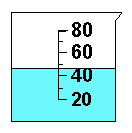
What is the volume of liquid in this graduated cylinder?
a)
40.0 mL
b)
40.3 mL
c)
43.0 mL
d)
44.0 mL
72.
What type of graph is this?
a)
Bar Graph
b)
Line Plot
c)
Pictograph
d)
Tally Chart
73.

What kind of information might go on the X axis?

a)

Independent Variable

b)

Dependent Varaible