wayground logo

Free Printable Worksheets

Font size

S
M
L
XL
Worksheets

Six Weeks Test Review

Total questions: 90

Worksheet time: 3hrs 35mins
Name
Class
Date
1.
How do you calculate slope using a graph?
a)
rise over run
b)
run over rise
c)
look at the y intercept
d)
look at the x intercept
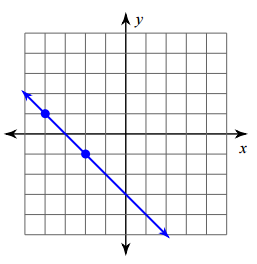
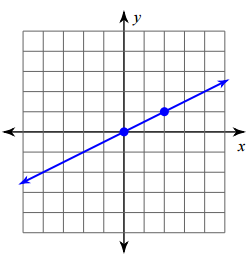
2.
Find the slope of the line.
a)
1/2
b)
-1/2
c)
2
d)
-2
3.
Find the slope of the line.
a)
-2
b)
2
c)
-1
d)
1
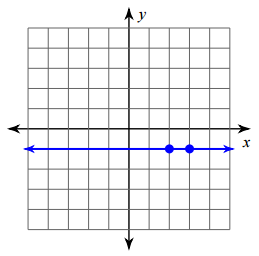
4.
Find the slope of the line.
a)
Undefined
b)
0
c)
1
d)
-1
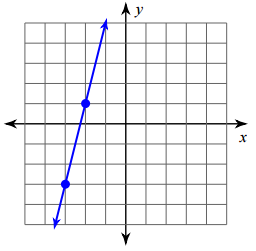
5.
Find the slope of the line.
a)
1/4
b)
-1/4
c)
-4
d)
4
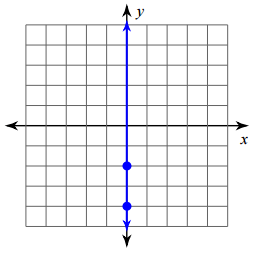
6.
Find the slope of the line.
a)
Undefined
b)
0
c)
1
d)
-1
7.
Find the slope of the line that passes through the points (2, 4) and (6, 12)
a)
1/2
b)
-1/2
c)
2
d)
-2
8.
What type of slope does the following graph have?
a)
Postive
b)
Negative
c)
Zero Slope
d)
Undefined
9.
What is the slope in the picture?
a)
Positive
b)
Negative
c)
Zero
d)
Undefined
10.
What is the slope in the picture?
a)
Positive
b)
Negative
c)
Zero
d)
Undefined
11.
Find the slope.
a)
-2
b)
2
c)
1/2
d)
-1/2
12.
Find the slope.
a)
2/5
b)
-2/5
c)
5/2
d)
-5/2
13.
Find the slope from the table.
a)
1/4
b)
-1/4
c)
-4/1
d)
4/1
14.
Determine the slope.
a)
m=3/2
b)
m=6
c)
m=-3/2
d)
m=1/6
15.
Distance and direction of an object's change in position from a starting point
a)
displacement
b)
distance
c)
motion
d)
reference point
16.
 Jermaine runs exactly 2 laps around a 400 meter track. What is the displacement?
a)
800
b)
400
c)
0
d)
200
17.
Scott travels north 5 miles and then goes west 3 miles before coming straight back south 2 miles. What is his distance?
a)
10
b)
7
c)
8
d)
6
18.
David walks 3 km north, and then turns east and walks 4 km. What is the distance?
a)
7 km
b)
3 km
c)
4 km
d)
1 km
19.
Bill runs 400 meters to Andy's house, turns around, and runs 400 meters back home.  What is Bill's distance?
a)
0 meters
b)
400 meters
c)
800 meters
d)
1600 meters
20.
Bill runs 400 meters to Andy's house, turns around, and runs 400 meters back home.  What is Bill's displacement?
a)
0 meters
b)
400 meters
c)
800 meters
d)
1600 meters
21.
A car drives 84 meters forward.  It's displacement and distance would be the same.
a)
True
b)
False
22.
The unit for distance is:
a)
m
b)
s
c)
m/s
23.
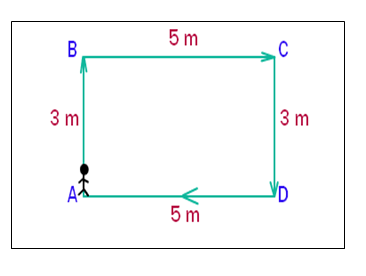
Sara walks from Point A to Point B. Which is true?
a)
Distance and displacement are EQUAL
b)
Distance is less than displacement
24.
Find the distance Sara walks from A to B,  B to C then C to D?
a)
11m
b)
3m
c)
5m
25.
What two measurements are necessary for calculating speed?
a)
Mass and time
b)
Temperature and mass
c)
Mass and distance
d)
Distance and time
26.
A measurement of how fast an object is moving
a)
Velocity
b)
Speed
c)
Vector
d)
Acceleration
27.

Which of the graphs shows that one of runners started 10 yards further ahead of the

other?

a)
b)
c)
d)
28.

In which of the following graphs below are both runners moving at the same speed?

a)
b)
c)
d)
29.

Match the description to the graph:

"The car is stopped."

a)
b)
c)
d)
30.

Match the description to the graph:

"The car is traveling at a constant speed."

a)
b)
c)
d)
31.

Match the description to the graph:

"The car is coming back."

a)
b)
c)
d)
32.

Segment O-A The bus is _________________.

a)

at rest

b)

returning (to original position)

c)

moving forward

33.

Segment A-B The bus is _________________.

a)

at rest

b)

returning (to original position)

c)

moving forward

34.

Segment B-C The bus is _________________.

a)

at rest

b)

returning (to original position)

c)

moving forward

35.

Segment C-D The bus is _________________.

a)

at rest

b)

returning (to original position)

c)

moving forward

36.

Segment D-E The bus is _________________.

a)

at rest

b)

returning (to original position)

c)

moving forward

37.

Segment E-F The bus is _________________.

a)

at rest

b)

returning (to original position)

c)

moving forward

38.

Which of the graphs shows that one of runners started in the same place?

a)
b)
c)
d)
39.

Which of the graphs shows that one of runners ended the race 10 yards ahead of the other?

a)
b)
c)
d)
40.

In which of the following graphs below did one runner overtake (run past) the other?

a)
b)
c)
d)
41.
How long did it take this object to travel 10 m?
a)
0 s
b)
10 s
c)
15 s
d)
20 s
42.
What is happening in this graph from point A to B?
a)
The object is accelerating.
b)
The object is not moving.
c)
The object is decelerating.
d)
The object is moving at a constant speed.
43.
What is happening in this graph from point B to C?
a)
The object is going down a hill.
b)
The object is returning to its starting location.
c)
The object is slowing down.
d)
The object is staying still.
44.
At 60 seconds, how far had this object traveled? 
a)
0 m
b)
10 m
c)
20 m
d)
40 m
45.
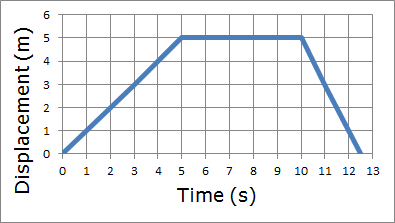
According to the graph how far does the person travel in the first 5 seconds?
a)
2 m
b)
10 m
c)
0 m
d)
5 m
46.

What is the speed of segment A?

a)

0.5 m/s

b)

2 m/s

c)

3 m/s

d)

0 m/s

47.

What is the speed of segment B?

a)

0.5 m/s

b)

2 m/s

c)

3 m/s

d)

0 m/s

48.

What is the speed of segment C?

a)

0.5 m/s

b)

2 m/s

c)

3 m/s

d)

0 m/s

49.

What is the speed of segment D?

a)

0.5 m/s

b)

2 m/s

c)

3 m/s

d)

0 m/s

50.

What is the total distance traveled?

a)

20 m

b)

30 m

c)

40 m

d)

50 m

51.

What is the total time traveled?

a)

20 s

b)

30 s

c)

40 s

d)

50 s

52.

What is the average speed for the entire trip?

a)

1.33 m/s

b)

4 m/s

c)

5 m/s

d)

7 m/s

53.

What is the motion of segment A?

a)

Moving towards observer constant speed

b)

Moving away from observer constant speed

c)

Moving towards observer changing speed

d)

Not moving

54.

What is the motion of segment C?

a)

Moving towards observer constant speed

b)

Moving away from observer constant speed

c)

Moving towards observer changing speed

d)

Not moving

55.

What is the motion of segment D?

a)

Moving towards observer constant speed

b)

Moving away from observer changing speed

c)

Moving towards observer constant speed

d)

Not moving

56.
What is the velocity?
a)
not moving
b)
increasing
c)
positive
d)
negative
57.
Is the speed constant or non-constant?
a)
constant
b)
non-constant
58.
What is the velocity?
a)
0 m/s
b)
positive m/s
c)
negative m/s
d)
decreasing
59.
Is the speed constant or non-constant?
a)
constant
b)
non-constant
60.
What is the velocity?
a)
positive
b)
negative
c)
decreasing
d)
increasing
61.
Is the speed constant or non-constant?
a)
constant
b)
non-constant
62.
Is the speed constant or non-constant?
a)
constant
b)
non-constant
63.
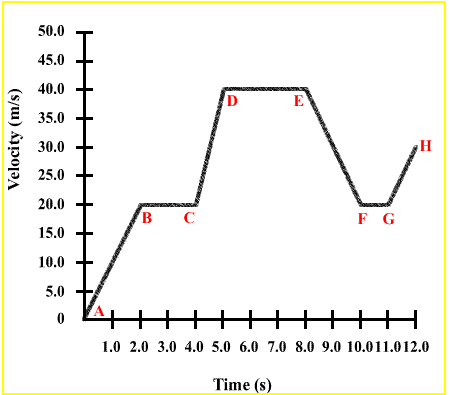
Which section of the graph shows increasing velocity?
a)
AB
b)
BC
c)
DE
d)
EF
64.
Which section of the graph shows decreasing velocity?
a)
CD
b)
DE
c)
EF
d)
GH
65.
Which section of the graph shows constant velocity?
a)
AB
b)
BC
c)
EF
d)
GH
66.
Which section of the graph shows acceleration?
a)
AB
b)
BC
c)
EF
d)
FG
67.
Which section of the graph shows deceleration?
a)
AB
b)
BC
c)
EF
d)
GH
68.

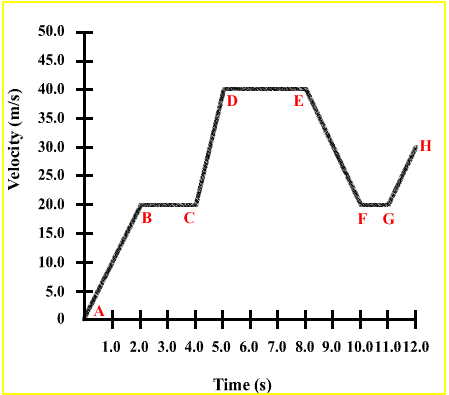
If the area under a velocity - time graph is the distance traveled, what is the distance traveled from t = 0 to t= 2?

a)

d = 8m

b)

d = 4m

c)

d = 2m

d)

d = 0m

69.

If the area under a velocity - time graph is the distance traveled, what is the distance traveled from t = 2 to t= 3?

a)

d = 7m

b)

d = 5m

c)

d = 3m

d)

d = 0m

70.

If the area under a velocity - time graph is the distance traveled, what is the distance traveled from t = 3 to t= 4?

a)

d = 7m

b)

d = 5m

c)

d = 3m

d)

d = 1m

71.

If the area under a velocity - time graph is the distance traveled, what is the distance traveled from t = 0 to t= 4?

a)

d = 12m

b)

d = 10m

c)

d = 8m

d)

d = 6m

72.

What's the slope of line AB?

a)

s = 1 kmh\frac{km}{h}  

b)

s = 9km4h\frac{9km}{4h} 

c)

s =  0 kmh0\ \frac{km}{h}  

d)

s = 4km7h-\frac{4km}{7h} 

73.

What's the slope of line BC?

a)

s = 1 kmh\frac{km}{h}  

b)

s = 94 kmh\frac{9}{4}\ \frac{km}{h} 

c)

s = 0 kmh\frac{km}{h}  

d)

s = 47 kmh-\frac{4}{7}\ \frac{km}{h} 

74.

What's the slope of line CD?

a)

s = 1 kmh\frac{km}{h}  

b)

s = 94 kmh\frac{9}{4}\ \frac{km}{h} 

c)

s = 0  kmh\frac{km}{h}  

d)

s = 47 kmh-\frac{4}{7}\ \frac{km}{h} 

75.

What's the slope of line EF?

a)

s = 1  kmh\frac{km}{h}  

b)

s = 94 kmh\frac{9}{4}\ \frac{km}{h} 

c)

s = 0  kmh\frac{km}{h}  

d)

s = 47 kmh-\frac{4}{7}\ \frac{km}{h} 

76.

During which segments of the trip was there no motion?

a)

BC

b)

DE

c)

BC and DE

d)

None of the above

77.

During which segment of the trip was there the greatest speed?

a)

AB

b)

BC

c)

CD

d)

EF

78.

Which segment of motion was steeper?

a)

EF

b)

DE

c)

CD

d)

AB

79.

What is the direction of motion from t = 2 to t = 5?

a)

positive

b)

negative

c)

up

d)

all the above

80.

What happened at t = 5?

a)

The motion of direction was switched from negative to positive.

b)

nothing

c)

speeding up

d)

slowing down

81.

Sophia run 3 blocks north, then 4 blocks west to school. What is her distance?

a)

5 blocks

b)

6 blocks

c)

7 blocks

d)

8 blocks

82.

Sophia run 3 blocks north, then 4 blocks west to school. What is her displacement?

a)

5 blocks

b)

6 blocks

c)

7 blocks

d)

8 blocks

83.

If the distance traveled occurs only on the x-axis, which equation is needed to solve the question?

a)

Δx = x2 x1\Delta x\ =\ x_2\ -\ x_1

b)

Δy =y2 y1\Delta y\ =y_2\ -\ y_1

c)

D = (Δx)2+(Δy)2D\ =\ \sqrt{\left(\Delta x\right)^2+\left(\Delta y\right)^2}

d)

None of the above.

84.

If the distance traveled occurs only on the y-axis, which equation is needed to solve the question?

a)

Δx = x2 x1\Delta x\ =\ x_2\ -\ x_1

b)

Δy =y2 y1\Delta y\ =y_2\ -\ y_1

c)

D = (Δx)2+(Δy)2D\ =\ \sqrt{\left(\Delta x\right)^2+\left(\Delta y\right)^2}

d)

None of the above.

85.

If the distance traveled occurs on both the y-axis and x-axis, which equation is needed to solve the question?

a)

Δx = x2 x1\Delta x\ =\ x_2\ -\ x_1

b)

Δy =y2 y1\Delta y\ =y_2\ -\ y_1

c)

D = (Δx)2+(Δy)2D\ =\ \sqrt{\left(\Delta x\right)^2+\left(\Delta y\right)^2}

d)

None of the above.

86.

Distance is a scalar?

a)

True

b)

False

87.

Displacement is a vector?

a)

True

b)

False

88.

Speed is a scalar...

a)

True

b)

False

89.

Velocity is a vector

a)

True

b)

False

90.

Vectors have both Magnitude and Direction

a)

True

b)

False