
NEW
Font size
S
M
L
XL
 Worksheets
Circuits Summary
Total questions: 28
Worksheet time: 18mins
Name
Class
Date
1.
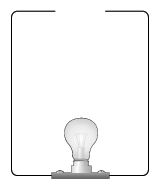
This circuit won't work. What essential part is missing from this circuit?
a)
resistance
b)
source of electric current
c)
conductor
d)
ammeter
2.
The force that pushes the electricity through a circuit is called...
a)
resistance
b)
voltage
c)
current
d)
switch
3.
The flow of electricity through a conductor is called...
a)
resistance
b)
voltage
c)
current
d)
source of electric current
4.
The best conductors for electricity are made of...
a)
wood
b)
plastic
c)
rubber
d)
metal
5.
What slows down the flow of electricity in a circuit?
a)
resistance
b)
voltage
c)
current
d)
source of electric current
6.

Which circuit (s) are parallel?
a)
A
b)
A and B
c)
B and C
d)
C
7.

Which one will still function if one light bulb goes out?
a)
A-Series
b)
B-Parallel
c)
A-Parallel
d)
B-Seriese
8.
If I add more light bulbs to a series circuit what happens?
a)
The current speeds up and the lights get brighter
b)
The current slows down and the lights dim lower
c)
The current speeds up and the lights dim lower
d)
The current slows down and the lights get brighter
9.
A series circuit has ____ path(s) that the electric current can take.
a)
One
b)
Two
c)
Three
d)
Four
10.
In a parallel circuit, if one connection is broken, all of the connections stop working.
a)
True
b)
False
11.

What kind of circuit is this?
a)
series
b)
parallel
12.
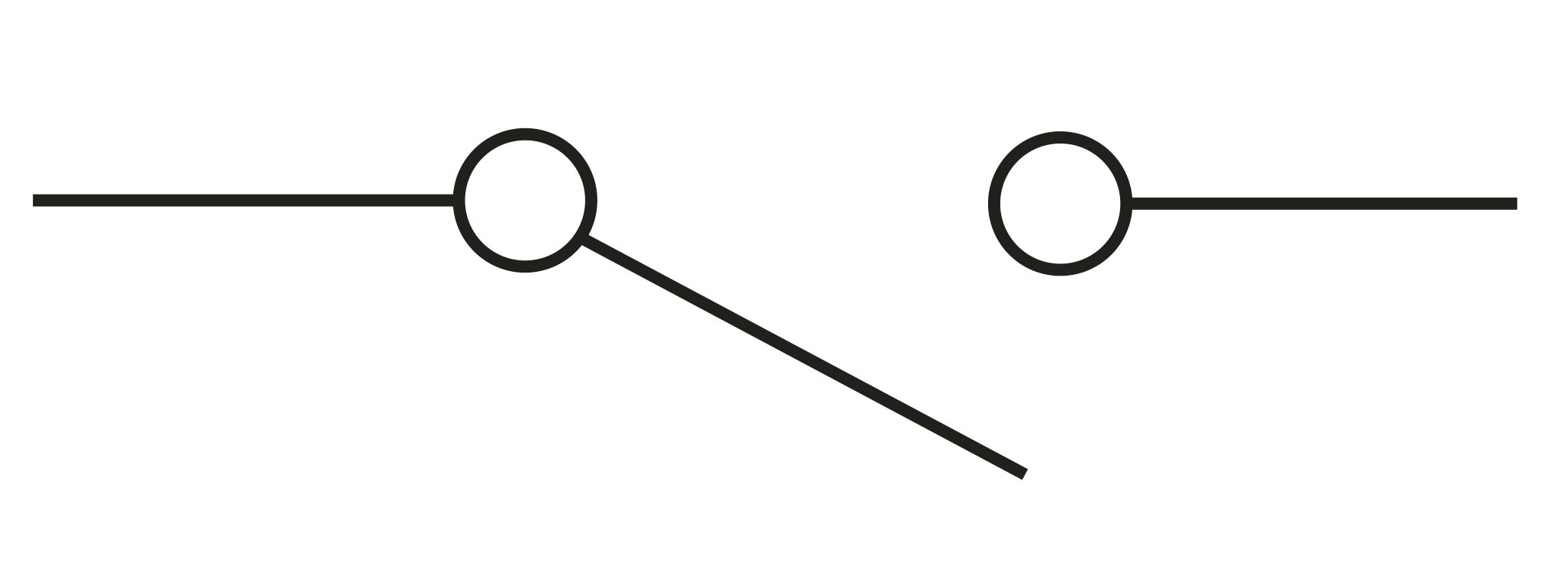
this is the symbol for a _____?
a)
switch
b)
light
c)
battery
d)
wires
13.
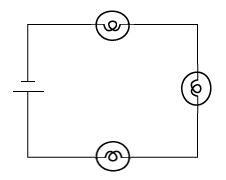
The picture shows an electrical circuit. This circuit is a series circuit because:
a)
It has 3 light bulbs.
b)
The same current flows through all three light bulbs.
c)
It uses a single battery.
d)
The electrical current has more than one path to flow through
14.

A complete, unbroken path that charges can flow through is called an __________________.
a)
conductor
b)
electric circuit
c)
electric current
d)
insulator
15.

Resistance in a circuit is equal to voltage divided by ____________.
a)
joules
b)
current
c)
power
d)
amperage
16.

_________________ found that current, voltage, and resistance are always related.
a)
Isaac Newton
b)
Albert Einstein
c)
Georg Ohm
17.
When all parts of the circuit are connected it is a ______ circuit.
a)
open
b)
closed
18.

Will this configuration of a complete circuit light a bulb?
a)
yes
b)
no
19.

Will this configuration of a complete circuit and light a bulb?
a)
yes
b)
no
20.
In a Series circuit the more lightbulbs you add the brighter they get
a)
False
b)
True
21.
What is current measured in?
a)
Ω (Ohms)
b)
V (Volts)
c)
A (Amps)
d)
W (Watts)
22.
What is resistance measured in?
a)
Ω (Ohms)
b)
V (Volts)
c)
A (Amps)
d)
W (Watts)
23.
What is Resistance?
a)
The flow of electrons
b)
Electric potential difference
c)
A battery
d)
The ability to reduce the flow of electrons
24.
What types of charges attract?
a)
Positive and Positive
b)
Positive and Neutral
c)
Negative and Neutral
d)
Positive and Negative
25.
The mathematical relationship among Voltage, Current, and Resistance
a)
Faraday's Law
b)
Tesla's Law
c)
Edison's Law
d)
Ohm's Law
26.
If the Voltage is increased and the resistance stays the same, Current will
a)
Increase
b)
Decrease
c)
Stay the same
d)
X
27.
If the Voltage stays the same and Resistance is increased, Current will
a)
Increase
b)
Decrease
c)
Stay the same
d)
X
28.

What is this symbol?
a)
resistor
b)
switch
c)
battery
d)
bulb
Reset

