
NEW
Font size
 Worksheets
Microscope and Scientific Method
Total questions: 40
Worksheet time: 22mins
What comes after your conclusion?
reflect on your work and decide if hypothesis was supported or not, if supported, share your results, and maybe develop theories
record data from the experiment
create your initial hypothesis
make an observation
What do you do after you come up with your hypothesis?
Publish your conclusion and change the world
Design an experiment to test your hypothesis
Do a victory dance
Tell your teacher it's time to go since you've finished all you can possibly do today
A series of steps used by scientists to solve a problem or answer a question.
The scientific method
A recipe on how to bake cookies
The Magic Eight Ball
Whatever the teacher says
The steps of an experiment are called ___.
steps
observations
variables
procedures
The information / measurements we gather during our experiment
steps
procedure
data
hypothesis
The results and what you learned during an experiment is called
conclusion
data
observation
hypothesis
The things we need to set up and then complete an experiment are called:
materials
data
conclusion
observation
Things that we notice in an experiment using what we see, hear, smell ,taste are called
data
procedure
observations
materials
Sadie was collecting measurements of the heights of the plants she grew in her science experiment. The measurements that Sadie wrote down are:
data
hypothesis
just guesses
the ingredient list to make an awesome salad
The purpose of a controlled experiment is to allow a scientist to isolate and test-
a single variable at a time
several variables all at the same time
no variables at all
What's a variable?
How does the control group differ from an experimental group in a scientific experiment?
the control group is what stays the same and it is what the results of the different variables are then compared against
the control group loses control
the control group is not tested or measured
the control group contains more than one experimental variable
In which step do you write whether or not your hypothesis (guess) is supported or not and why?
Conclusion
Procedures
Experiment
Observations

Number 8
Base
Stage
Eyepiece Tube
Arm

Number 3
Eyepiece Lens
Objective Lenses
Disk Diaphragm
Base
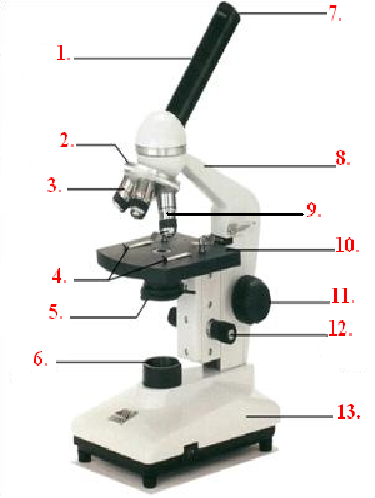
Number 10
Stage
Objective Lenses
Diaphragm
Base

Number 5
Focus Knob
Eyepiece Lens
Disk Diaphragm
Objective Lens

Number 13
Arm
Light
Base
Stand

Number 11
Focus Knob
Eyepiece Tube
Stage clips
Tuning Knob

Number 4
Stages
Arms
Stage Clips
Ocular Lens
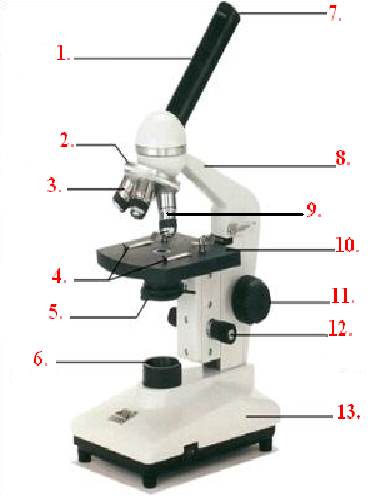
Piece 7
Eyepiece Lens
Objective Lens
Base
Arm
Joe tells Gabby his theory about why sea turtles nest on the beach instead of in the ocean. He says, “The turtle eggs would sink to the bottom of the ocean, and the baby turtle would drown. I know this because my uncle is a fisherman, and he told me this information. Gabby tells Joe that his theory is not scientific. Why does Joe’s idea not meet the requirements to be a scientific theory?
Joe’s idea is already a scientific law.
Joe’s idea is not supported by scientific evidence.
Joe’s idea is a good guess that can be tested by experiments.
Joe and his uncle are not scientists.
In 1897, Joseph Thomson discovered that atoms contained electrons. He proposed a change in the atomic theory of that time, and the theory was modified because of his discovery. Since Thomson’s discovery, atomic theory has been further modified. What is the best explanation for why scientific theories are modified?
Theories more than ten years old are usually out of date.
Scientists want to prove that the work of other scientists is wrong.
New evidence that supports a change prompts scientists to modify earlier theories.
So much information is available today that it is harder to focus research and disprove theories.
The law of universal gravitation states that both mass and distance of objects affect the gravitational force between them. Gravitational force increases as the mass of the objects increase. Gravitational force decreases as distance between the objects increases. Why are these statements considered scientific law, and not scientific theory?
The statements tells what happens, and not why it happens.
The statements involve mass and distance measurements.
The statements explain the attractive force between two objects.
The statements predict what will happen under certain conditions.
Which of these describes a natural phenomenon or relationship that always occurs under specific conditions
theory
law

This picture shows that the microscope:
only flips images upside down
only flips images over backwards
flips the image upside down and backwards
doesn't flip the image at all
When properly carrying a mocroscope you should have hands on:
the stage and arm
the base and the arm
the body tube and the base
the eyepiece and the stage
What is the scientific term for "making an image larger"?
resolution
rotation
magnification
magnetize


When you look through the microscope, you are looking through both the eye piece (10x magnification) and the different objective lenses. What is the TOTAL magnification when looking through the Low power objective lens?
10x
40x
100x
400x
When you look through the microscope, you are looking through both the eye piece (10x magnification) and the different objective lenses. What is the TOTAL magnification when looking through the Medium power objective lens?
10x
40x
100x
400x
When you look through the microscope, you are looking through both the eye piece (10x magnification) and the different objective lenses. What is the TOTAL magnification when looking through the High power objective lens?
10x
40x
100x
400x
Which of the following is a proven description of HOW things are or happen, but does not explain the reason why?
Scientific Theory
Scientific Law
Hypothesis
Which of the following is the cornerstone of scientific discovery because is is simple, true, universal, and absolute?
Scientific Theory
Scientific Law
Hypothesis
Which of the following is based on the proven hypothesis of many different scientists?
Scientific Theory
Scientific Law
Hypothesis
Which of the following is an explanation of WHY things are the way they are?
Scientific Theory
Scientific Law
Hypothesis
Which of the following is an explanation that has NOT been proven yet?
Scientific Theory
Scientific Law
Hypothesis
During the Popcorn lab, what were the two variables that we tested against the control?
Peanut butter and Jelly
Oil and water
plain seed and heat
Butter and Salt
In the Popcorn Lab, which test tube served as our control?
The one with no seed
The one with a seed and water
The one with only a seed and nothing else added.
The one with a seed and oil

