wayground logo

Free Printable Worksheets

Font size

S
M
L
XL
Worksheets

Human Impact On The Environment

Total questions: 21

Worksheet time: 24mins
Name
Class
Date
1.
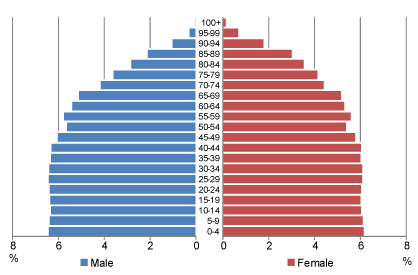
According to the population pyramid of this country, its population is most likely...
a)
growing slowly.
b)
growing rapidly.
c)
decreasing.
d)
not changing.
2.
In recent years, the human population has 
a)
increased exponentially
b)
decreased exponentially
c)
decreased slowly
d)
increased slowy
3.
Which of the following is likely to be affected by a population of 7 billion?
a)
amount of land for agriculture
b)
amount of clean water
c)
number of people who are unemployed
d)
all of the above
4.
According to the United Nations, at what number is world population expected to plateau?
a)
9-11 billion
b)
13-15 billion
c)
20-25 billion
d)
never
5.
What kind of growth is this country experiencing?
a)
Exponential Growth
b)
Stable Growth
c)
Declining Growth
6.
Countries with high growth rates usually have an age structure that has
a)
an even distribution over all ages
b)
more older people than young people
c)
more younger people than older people.
d)
more middle-aged people than younger people.
7.

Using Figure 5–6, describe the type of growth Mexico is experiencing.

a)

Mexico is experiencing a rapid growth rate because there are more children than adults.

b)

Mexico is experiencing no growth because people are living longer.

c)

Mexico is experiencing slowed growth because there are fewer adults.

d)

Mexico is experiencing a rapid decline because there are more children than adults.

8.
Which human activity would preserve nonrenewable resources?
a)
deforestation
b)
removing carnivores from a forest 
c)
recycling
d)
heating homes with fossil fuels  
9.
Increased industrialization will most likely
a)
decrease available habitats 
b)
increase environmental carrying capacity 
c)
increase the stability of ecosystems 
d)
decrease global warming
10.
Which human activity is correctly paired with its likely future consequence?
a)
overfishing in the Atlantic — increase in supply of flounder and salmon as food for people 
b)
development of electric cars or hybrid vehicles — increased rate of global warming 
c)
use of fossil fuels — depletion of underground coal, oil, and natural gas supplies 
d)
genetically engineering animals — less food available to feed the world’s population
11.
Increase in which gas is primarily responsible for increased global warming?
a)
Carbon dioxide
b)
Water vapor
c)
Methane
d)
Nitric oxides
12.
Which of the following historical events most likely triggered the largest increase in the human population? 
a)
the Black Death plague, which occurred in the mid-1300s
b)
the domestication of wheat crops, which began around 8000 B.C
c)
the fall of the Roman Empire, which occurred around A.D. 800
d)
the Industrial Revolution, which began in the late 1700s
13.
What is the most dramatic result of deforestation?
a)
land is no longer green and full of life
b)
pictures from space show deforestation
c)
loss of habitat for approximately 70% of the worlds species
d)
people can't explore rainforests
14.
What are some reasons deforestation occurs?
a)
clearing land for agriculture, ranching, and mining
b)
just wanting to destroy things
c)
Population moving from rural areas to cities
d)
to make room for infrastructure
15.
Increased industrialization will most likely
a)
decrease available habitats 
b)
increase environmental carrying capacity 
c)
increase the stability of ecosystems 
d)
decrease global warming
16.

Refers to the increasing changes in the measures of climate over a long period of time - including precipitation, temperature, and wind patterns.

a)

climate change

b)

deforestation

c)

global warming

d)

invasive species

17.

An organism (plant, animal, fungus, or bacterium) that is not native and has a negative effect on an ecosystem.

a)

deforestation

b)

climate change

c)

global warming

d)

invasive species

18.

Climate change

a)
b)
c)
d)
19.

Invasive species

a)
b)
c)
d)

all of the above

20.

Deforestation

a)
b)
c)
d)
21.

Water pollution

a)
b)
c)
d)

none of the above