wayground logo

Free Printable Worksheets

NEW

Font size

S
M
L
XL
Worksheets

Energy of Particles

Total questions: 42

Worksheet time: 36mins

Name
Class
Date
1.

What is potential energy?

a)

moving energy

b)

stored energy

c)

renewable energy

d)

non renewable energy

2.
According to the Law of Conservation of Energy, energy cannot be _________ or ____________. 
a)
destroyed, destroyed
b)
created, saved
c)
created, destroyed
d)
lost, found
3.
Which direction will the heat flow while this person holds a hot cup of tea?
a)
from the cup to her hand
b)
from her hand to the cup
c)
no heat is transferred
4.
Heat transfers from an area of ____temperature to an area of ___ temperature.
a)
high to low
b)
low to high
c)
high to high
5.
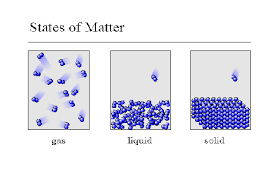
Which state of matter has tightly packed molecules?
a)
solid
b)
liquid
c)
gas
6.
Define a liquid.
a)
Indefinite shape, indefinite volume
b)
Definite shape, definite volume
c)
Found in stars
d)
Definite volume, indefinite shape
7.
Particles (molecules) in a ______________________ have more energy than the other states of matter.
a)
gas
b)
solid
c)
liquid
8.
At higher temperatures
a)
particles in an object have less energy
b)
particles in an object move faster
c)
a gas contracts
9.
What is happening when my ice cream changes from a solid to a liquid?
a)
freezing
b)
melting
c)
burning
d)
evaporation
10.
Particles of a liquid
a)
are tightly packed together and stay in a fixed position.
b)
have no viscosity.
c)
decrease in volume with increasing temperature.
d)
are free to move around one another but still touch.
11.
What term describes a solid changing to a gas?
a)
Deposition
b)
Sublimation
c)
Evaporation
d)
Freezing
12.
Which has a greater distance between particles?
a)
Solid
b)
Liquid
13.
Matter changes state when...
a)
energy is added or removed
b)
energy is added
c)
energy is removed
d)
there is no energy
14.
As molecules gain energy, they move _____ and spread apart, and vise versa.
a)
faster
b)
slower
c)
less
d)
inside
15.
As temperature decreases, the molecules collide more, move faster, and spread out. 
a)
true
b)
false
16.
What does “high concentration area” mean?
a)
Spread out
b)
Tightly packed together
c)
Uncrowded
d)
Spacious
17.
Kinetic energy is energy due to...
a)
interactions between objects or particles
b)
motion
c)
elasticity
d)
mass
18.

How does heat transfer when you hold an ice cube in your hand?

a)

from the cold ice cube to your warm hand

b)

the cold ice cube makes your hand cold

c)

from your warm hand to the cold ice cube

d)

very carefully

19.

Heat transfer is really neat. It always moves from..

a)

hot to cold

b)

cold to hot

c)

big to little

d)

stop singing

20.

Two isolated objects, at different temperatures, are put in contact with each other. Which of the following is/ are true when the system reaches thermal equilibrium?


I. The cool object gains the same amount of heat lost by the warm object.

II. Both objects will have the same final temperature

III. Both objects lose the same amount of heat

a)

I only

b)

II only

c)

I and II only

d)

II and III only

21.

Temperature is defined as the ______________ kinetic energy of molecules in a substance.

a)

average

b)

square root

c)

total

22.

Your hands get warmer when holding a cup of hot chocolate. What is the reason for this?

a)

The cold leaves your hands and travels to the air.

b)

The heat from the chocolate travels through the cup to your hands.

c)

The heat from the air enters the hot chocolate and then your hands.

23.

The flow of heat energy is from ___________ to __________.

a)

cool objects to warm objects

b)

warm objects to cool objects

c)

neither; heat doesn't flow

24.

A measure of how hot or cold something is; specifically a measure of how fast particles in an object are moving.

a)

Thermometer

b)

Temperature

c)

Absolute Zero

d)

Specific Heat

25.
What type of energy is in this picture?
a)
Kinetic
b)
Potential
c)
Chemical
d)
Sound
26.
On a roller coaster, where is maximum potential energy?
a)
At the bottom of a big hill
b)
When going around a corner
c)
When going upside down
d)
At the top of a big hill
27.
On a roller coaster, where is maximum kinetic energy?
a)
At the bottom of a big hill
b)
When going around a corner
c)
When going upside down
d)
At the top of a big hill
28.

What is energy?

a)

the ability to do work

b)

the movement of electrons

c)

UPS global services

29.
What happens when my glass of water is sitting in the sun and disappears into a gas?
a)
evaporation
b)
burning
c)
melting
d)
freezing
30.
Which form of matter does not take the shape of its container?
a)
liquid
b)
gas
c)
solid
d)
air
31.
How is a gas defined?
a)
Indefinite shape, indefinite volume
b)
Definite shape, definite volume
c)
Found in stars
d)
Definite volume, indefinite shape
32.
What term describes a solid changing to a gas?
a)
Deposition
b)
Sublimation
c)
Evaporation
d)
Freezing
33.
What term describes a liquid changing to a solid?
a)
Deposition
b)
Sublimation
c)
Evaporation
d)
Freezing
34.
Particles (molecules) in a ______________________ have more energy than the other states of matter.
a)
gas
b)
solid
c)
liquid
35.
______________________ takes place when a liquid changes to a solid.
a)
freezing
b)
melting
c)
boiling
d)
sublimation
36.
Molecules are closest together in a 
a)
Solid
b)
Liquid
c)
Gas
37.
a)
It remains the same.
b)
It changes greatly.
c)
It changes minimally.
d)
Unable to tell.
38.
The state of matter that has no definite size or shape is
a)
Solid
b)
Liquid
c)
Gas
39.
When a gas changes directly to a solid, the process is known as what?
a)
Sublimation
b)
Condensation
c)
Deposition
d)
Evaporation
40.

Water can be a solid, liquid, and a gas.

a)

True

b)

False

41.
Define a liquid.
a)
Indefinite shape, indefinite volume
b)
Definite shape, definite volume
c)
Found in stars
d)
Definite volume, indefinite shape
42.

Which of the following is a correct ranking of the states of matter from greatest amount of kinetic energy to least amount of kinetic energy?

a)

Ice, water, steam

b)

Steam, water, ice

c)

Water, steam, ice

d)

Water, ice, steam