Wayground logo

Free Printable Worksheets

Font size

S
M
L
XL
Worksheets

Cells Unit

Total questions: 26

Worksheet time: 26mins

Name
Class
Date
1.
Which of the following is the smallest unit of life that can carry out all life functions?
a)
the mitochondria
b)
the vacuoles
c)
the nucleus
d)
the cell
2.
Which structures are found in every living cell?
a)
cell membrane and cytoplasm
b)
chloroplasts and mitochondria
c)
a cell wall and nucleus
d)
chloroplasts and cell wall
3.
Which cell structure is found in plant and animals cells and controls what can come into or leave a cell?
a)
cell membrane
b)
cytoplasm
c)
nucleus
d)
vacuole
4.
What is the function of the cell nucleus found in both plant and animal cells?
a)
to produce energy
b)
to control cell activity
c)
to remove waste products
d)
to allow molecules to enter the cell
5.
What is one basic function of the vacuoles?
a)
circulating oxygen
b)
producing food
c)
controlling cell processes
d)
storing water
6.
All cells need energy to function.  Which cell organelle is responsible for producing energy in the cell?
a)
chloroplasts
b)
mitochondria
c)
nucleus
d)
vacuoles
7.
What is the function of a cell wall?
a)
to protect and support the cell
b)
to perform different functions in each cell
c)
to prevent water from passing through it
d)
to prevent oxygen from entering the cell
8.
Cells with a nucleus and membrane-bound organelles are called ____________________.
a)
prokaryotes
b)
eukaryotes
c)
bacteria
d)
protists
9.
Which of the following is not part of the cell theory?
a)
cells must contain DNA 
b)
all living things are made from cells
c)
cells can only come from other cells
d)
cells are the basic unit of life
10.
Every living organism is made up of one or more cells
a)
True
b)
False
11.
Which of the following are NOT found in animal cells
a)
chloroplasts and cytoplasm
b)
chloroplasts and cell wall
c)
cell wall and cell membrane
d)
mitochondria and nucleus
12.
Which of the following are NOT found in animal cells
a)
chloroplasts and cytoplasm
b)
chloroplasts and cell wall
c)
cell wall and cell membrane
d)
mitochondria and nucleus
13.

The fluid that surrounds the organelles is... (hint... "The Jello in the cell models you created!"

a)

chloroplast

b)

cytoplasm

c)

vacuole

d)

cell wall

14.
If you were some bad guy trying to sneak into an animal cell, who would be there to stop you?
a)
nucleus
b)
mitochondria
c)
cell membrane
d)
cell wall
15.

What do a dandelion plant and a desert lizard have in common?

a)

Both have cell walls surrounding their organelles

b)

Both composed of cells, as stated by the cell theory

c)

Both are mobile and often change locations

d)

Both use sunlight to make energy

16.
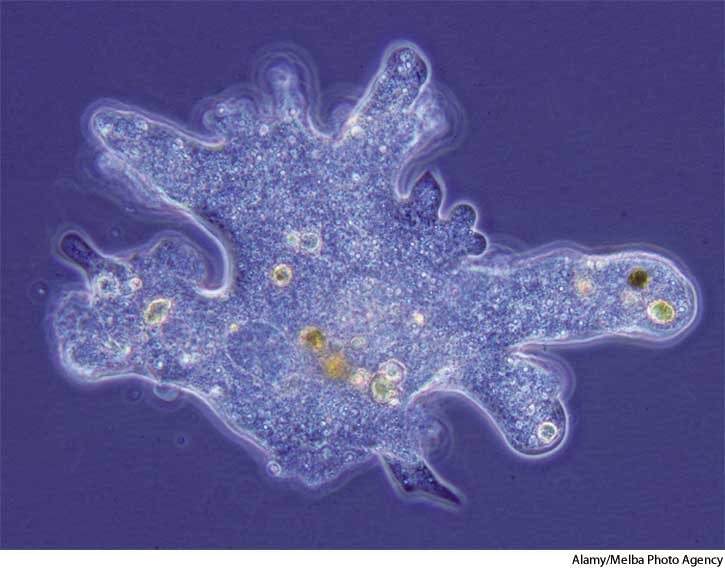
An Amoeba is a unicellular, animal-like protist that lives in ponds and streams. According to cell theory, where did this cell come from?
a)
another pre-existing amoeba cell.
b)
energy from sun that allowed the protist to reproduce.
c)
a multicellular organism.
d)
the nonliving environment.
17.

Which of the following is NOT a part of the cell theory.

a)

All non-living things are made of cells

b)

All cells come from pre-existing cells

c)

Cells are the basic unit of structure and function of all living things

18.
Rocks are not living because
a)
they never move
b)
they aren't needed for humans
c)
they are not made of cells
d)
they don't break down
19.
What is one way in which all living things on Earth are alike?
a)
All living things have hair.
b)
All living things are made of cells and come from other cells.
c)
The cells of all living things have chloroplast.
d)
All living things can move. 
20.
Which is NOT part of the Cell Theory
a)
New cells are produced from existing cells
b)
All living things are composed of cells
c)
Only eukaryotic cells have a nucleus
d)
Cells are the basic unit of structure & function in living things
21.

Which part is A?

a)

body tube

b)

eyepiece

c)

objective lens

d)

stage clip

22.

Which part is B?

a)

body tube

b)

eyepiece

c)

objective lens

d)

diaphragm

23.

What part is E?

a)

Diaphragm

b)

Eyepiece

c)

base

d)

Light source

24.
This experiment was conducted by the scientists:
a)
Stanley Miller and Harold Urey
b)
Harold Urey and Albert Einstine
c)
Harrison Ford and Denzel Washington
d)
James Watson and Francis Crick
25.

The electrical sparks in the Miller/Urey experiment represented what on Early Earth?

a)

heat waves

b)

lightening

c)

volcano

d)

hurricane

26.

All of the following were gasses present on Early Earth except...

a)

Ammonia

b)

Methane

c)

Oxygen

d)

Hydrogen