wayground logo

Free Printable Worksheets

NEW

Font size

S
M
L
XL
Worksheets

Stars

Total questions: 56

Worksheet time: 38mins

Name
Class
Date
1.

In the diagram given, what happens as we move to the left?

a)

Stars Get Larger

b)

Stars get Colder

c)

Stars get hotter

d)

Nothing

2.
Which star is the coldest?
a)
Yellow Star
b)
Red Star
c)
Orange Star
d)
Blue Star
3.
Which category is our Sun located in?
a)
White Dwarfs
b)
Supergiants
c)
Main Sequence
d)
Giants
4.

The category that contains the most stars is...

a)

Main Sequence

b)

Supergiants

c)

Giants

d)

Blue Giants

5.
What is found on the x axis of an H-R diagram?
a)
Luminosity
(or brightness)
b)
Temperature
c)
Star Size
d)
Distance
6.

Which star has the lowest temperature?

a)

A

b)

B

c)

C

d)

D

7.
What stage of the life cycle of a star is this? 
a)
Main Sequence
b)
Red Giant
c)
Black Hole
d)
Neutron star
8.
This is an image of the formation of a star, also known as a .... 
a)
Main Sequence
b)
Planetary System
c)
Supernova
d)
Stellar Nebula
9.

What characteristics are used to classify stars?

a)

Flammability, weight, and reactivity

b)

Temperature/color and brightness

c)

Conductivity, luster, and density

d)

Malleability, distance, and viscoscity

10.

Which star is hotter than Deneb

a)

Procyon

b)

Sun

c)

Regel

d)

Banard's Star

11.

Which star is brighter than the sun?

a)

Sirius B

b)

Procyon B

c)

Van Maanan's Star

d)

Aldebaran

12.

Which star is brighter than Alpha Centauri B, but dimmer than the sun?

a)

Pollux

b)

Spica

c)

Tau Ceti

d)

Mira

13.

Which star is considered a giant star?

a)

Mira

b)

Zeta Arindani

c)

Barnard's Star

d)

Betelgeuse

14.

Which star is considered a supergiant?

a)

Sirius B

b)

Sun

c)

Betelgeuse

d)

Van Maanan's Star

15.

Which star is considered a dwarf star?

a)

Altair

b)

Procyon B

c)

Deneb

d)

Sirius

16.

What is the Hertzsprung-Russel Diagram?

a)

A map which tells the approximate location of stars in the Milky Way galaxy and their distance from Earth.

b)

A table that alphabetically lists stars by name and includes dates of when the star was first charted.

c)

A chart which organizes stars into categories based on the amount of Hydrogen they burn.

d)

A graph used to classify stars according to their luminosity, color, temperature, and stage.

17.

Knowing the color of a star also tells us its __________

a)

age

b)

location

c)

temperature

d)

name

18.
Planets orbit the Sun in a shape called a(n)
a)
circle
b)
ellipse
c)
focus
d)
perihelion
19.
An ellipse is drawn around two points called
a)
aphelion
b)
perihelion
c)
foci
d)
axis
20.
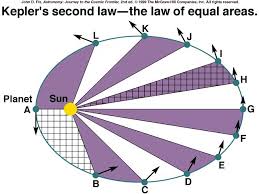
Where is the planet moving faster
a)
Position A to B
b)
Position B to C
c)
Position H to I
d)
Position I to J
21.

What is true about the area between points A, B and the Sun, and the area between points H, I and the Sun?

a)

The area between A, B and the Sun is the largest and takes the most amount of time to travel

b)

The area between H, I and the Sun is the largest and takes the most amount of time to travel

c)

Takes the same amount of time to travel

d)

There is not enough information to determine the areas

22.
What has an eccentricity of zero
a)
a straight line
b)
a large ellipse
c)
a circle
d)
a small ellipse
23.
What is the smallest terrestrial planet?
a)
Mars
b)
Venus
c)
Mercury 
d)
Earth
24.
Earth and the other planets closest to the Sun are made mostly of _______
a)
gas
b)
metal
c)
water
d)
rock
25.

Kepler's 2nd Law deals with

a)

the shape of the planets' orbits

b)

the speed/area the planet travels

c)

the length of time it takes the planet to orbit the sun

d)

Gravity between planets

26.
When a planet is closest to the sun, this is called 
a)
perihelion
b)
aphelion
c)
barycenter
d)
orbit
27.

Kepler's 3rd Law states that:

a)

Planets orbit the sun in elliptical paths.

b)

As planets orbit the sun, they cover equal areas in equal times.

c)

The farther a planet is from the sun, the longer it will take to make a complete orbit.

d)

Gravity between planets are equal

28.
Which of Kepler's Laws is illustrated here?
a)
1st Law
b)
2nd Law
c)
3rd Law
29.
What is the eccentricity of a straight line?
a)
1
b)
0
c)
0.5
d)
A straight line does not have eccentricity.
30.

What happens to the shape of an ellipse as the foci move further apart?

a)

The ellipse becomes flatter.

b)

The ellipse becomes rounder.

c)

The ellipse becomes equal

d)

Nothing. The ellipse stays the same

31.
What is the eccentricity of Earth's orbit?
a)
0.017--nearly circular.
b)
0.927--nearly flat
c)
0--a perfect circle
d)
1--a flat line
32.
Which ellipse has the highest eccentricity?
a)
Top
b)
Middle
c)
Bottom
33.
Which ellipse has the lowest eccentricity?
a)
Top
b)
Middle
c)
Bottom
34.
A planet moves fastest during its orbit around the Sun at the when 
a)
it is closest to the sun and gravity has a stronger pull
b)
it is farthest from the sun and gravity has a stronger pull
c)
it is closest to the sun and gravity has a weak pull
d)
it is farthest from the sun and gravity has a weak pull
35.
If a planet is closer to the sun, its orbit will be _____ than one farther away. 
a)
longer
b)
slower
c)
bigger
d)
shorter
36.
Kepler's 2nd Law states that a planet's velocity is ____ when farther from the sun.
a)
fastest
b)
slowest
c)
unchanged
d)
the same
37.
The measure of how stretched out an ellipse is, is referred to as
a)
Gravity
b)
Weight
c)
Mass
d)
Eccentricity
38.
Which planet has the smallest astronomical unit (distance from sun)?
a)
Earth
b)
Mercury
c)
Mars
d)
Jupiter
39.

Which planet is used as a point of reference for all (AU) measurements?

a)

Mercury

b)

Earth

c)

Pluto

d)

Mars

40.
An object that orbits other objects in space is called a
a)
GPS
b)
Rover
c)
Asteroid
d)
Satellite
41.

Which planet has the least eccentric orbit?

a)

venus

b)

earth

c)

neptune

d)

pluto

42.

What is an astronomical unit (A.U.)?

a)

the time it takes light to travel one year

b)

the distance between the Earth and the Moon

c)

the distance between the Earth and the Sun

d)

the distance between the Earth and the Neptune

43.
What do we use astronomical units to measure?
a)
distances in our solar system
b)
How far our solar system is from others in our galaxy.
c)
The distances between galaxies. 
d)
The distance from one side of the universe to the other. 
44.

Why do we use light years and astronomical units to measure distances in space?

a)

Scientists want to sound smart.

b)

Hubble discovered these units and wanted to use them.

c)

Space is too small to use km, it wouldn't make sense.

d)

Space is too big, vast, enormous to use traditional units, like miles.

45.

Calculate the eccentricity for the following orbit.

a)

1.6

b)

0.05

c)

0.6

d)

.5

46.
During which month is the earth moving the slowest? 
a)
July 
b)
March
c)
January
d)
September
47.
During what month is the earth moving the fastest around the sun? 
a)
July
b)
March
c)
January
d)
September
48.

What is the formula for calculating eccentricity?

a)

Eccentricity=Distance between center and focus 1/length of semi-major axis

b)

Eccentricity=length of major axis/Distance between foci

c)

Eccentricity=distance between foci

d)

Eccentricity=length of major axis

49.
The core of a red giant collapses and the outer layers of hydrogen, helium and other elements are ejected into a cloud called...
a)
a black hole.
b)
a planetary nebula.
c)
a neutron star.
d)
a super giant.
50.
As the core of the red giant collapses it condenses into a super bright and dense star called...
a)
a brown dwarf.
b)
a red super giant.
c)
a white dwarf.
d)
a black hole.
51.
Stars can take different paths due to having different _____________
a)
temperature
b)
mass
c)
brightness
d)
color
52.
After the main sequence, a low mass star becomes a
a)
black dwarf
b)
protostar
c)
red giant
d)
supergiant
53.

After a supergiant, a high mass star explosion is called a...

a)

supernova

b)

red giant

c)

black hole

d)

planetary nebula

54.
A star's energy source comes from?
a)
From Nuclear Fusion of Hydrogen into Helium
b)
From Nuclear Fusion of Helium into Hydrogen 
c)
From Nuclear Fission of Helium into Hydrogen
d)
From Nuclear Fission of Hydrogen into Helium 
55.

I can expect platinum to be fused in a...

a)

Super Giant

b)

Red Giant

c)

White Dwarf

d)

Black Hole

56.

After our sun uses up its hydrogen...

a)

Planetary Nebula

b)

Super Nova

c)

Red Giant

d)

White Dwarf