Wayground logo

Free Printable Worksheets

Font size

S
M
L
XL
Worksheets

Early Humans and the Stone Aqe

Total questions: 101

Worksheet time: 1hrs 3mins

Name
Class
Date
1.

In order to express ideas, early humans

a)

wrote letters

b)

painted in caves

c)

played music

d)

posted on Facebook

2.
another word for farming
a)
agriculture
b)
technology
c)
specialization
d)
shrine
3.
people who hunt animals and gather wild plants, seeds, fruits, and nuts to survive
a)
hunter gatherers
b)
monarchy
c)
Bronze Age
d)
agriculture
4.

Scientists believe that the earliest humans (homo sapiens) evolved in and migrated from which continent?

a)

Europe

b)

North America

c)

Asia

d)

Africa

5.
Which statement best describes hunters and gatherers?
a)
They were experts at using their environment to meet their basis needs. 
b)
The tools they made from metal helped them to survive.
c)
They domesticated animals to help with daily activities. 
d)
They developed ways to bring water to their crops. 
6.
What was the main role women played in Paleolithic society?
a)
Women gathered wild plants for food. 
b)
Women hunted animals for food.
c)
Women planted seeds for food. 
d)
Women domesticated animals for food. 
7.
Which of the following describes how the earliest humans (paleolithic) lived? 
a)
by hunting and gathering food
b)
by herding sheep and other live stock
c)
alone or in pairs
d)
in farming villages along streams and rivers
8.
Which of the following would you most likely find in the Paleolithic Era?
a)
jewelry made of smooth stones
b)
farms
c)
 cave paintings
d)
domesticated animals
9.
What does Paleolithic mean?
a)
old stone age
b)
new stone age
10.

What does nomadic mean?

a)

people stayed in one place to farm

b)

people moved around in search of resources

11.
What does Neolithic mean?
a)
Old stone age
b)
New stone age
12.
What were 2 things that were considered the first tools of the Paleolithic people?
a)
simple weapons and fire
b)
farming tools and mud bricks
13.

True or false: Domesticated animals were a characteristic of Paleolithic society.

a)

true

b)

false

14.
What big change occurred between the Paleolithic and Neolithic Era?
a)
people moved around more to find food, shelter, and water.
b)
people stayed in one place to begin farming and corral animals.
15.
What was the most common reason in which ancient people chose to migrate, or move from place to place?
a)
They needed to find employment and an income
b)
To find resources such as food and shelter
c)
To explore the world.
d)
They needed to find better transportation.
16.
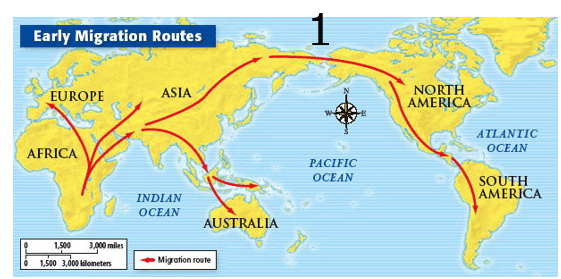
The map shows the migration routes of early humans. What made it possible for them to move from Asia to North America?
a)
They constructed large ships to sail across at #1. 
b)
They crossed the land bridge at #1. 
c)
They swam the short distance at #1. 
d)
They built a bridge out of wood at #1.
17.

What was the main role women played in Paleolithic society?

a)

Women gathered wild plants for food.

b)

Women hunted animals for food.

c)

Women planted seeds for food.

d)

Women domesticated animals for food.

18.
Which statement best explains the greatest effect the emergence of agriculture had on early societies?
a)
The population steadily decreased.
b)
People were not able to specialize in just one trade. 
c)
Agriculture made it harder to find food. 
d)
The population steadily increased. 
19.
What is the greatest change between the Paleolithic and Neolithic cultures? 
a)
the shelters people used
b)
the way people got food for themselves
c)
the tools people used
d)
the clothes people wore 
20.
What kind of images are shown in the Paleolithic wall paintings?
a)
Animals and religious rituals
b)
Natural forces
c)
Animals and humans
d)
Supernatural forces
21.
Because of farming, people were able to _________ their own food.
a)
chop
b)
eat
c)
produce
d)
store
22.
Domestication means
a)
process of changing plants and animals
b)
hunting animals
c)
farming
d)
the first tools
23.
Migrate means
a)
to stay in one place
b)
to hunt animals
c)
to farm
d)
to move from place to place
24.
Domestication of plants and animals also enabled people to use ________ __________ to make __________.
a)
plant fibers and cloth
b)
cave paintings and artwork
c)
animal skins and cloth
d)
language and cloth
25.
In Greek, Neolithic means, "New Stone"
a)
True
b)
False
26.
The hand axe was made of 
a)
stone
b)
basalt
c)
iron 
d)
flint
27.

Excavations at the town of Catalhoyuk in Turkey shows that the people who lived there possibly entered their houses this way--

a)

through underground tunnels

b)

by ladders

c)

by boats

d)

through the holes on the roof

28.

What sharp stone was most used by early people to make arrowheads, scrapers and knives?

a)

marble

b)

flint

c)

magma

d)

limestone

29.

Which of the following was NOT found with Otzi, the human body found preserved in a glacier?

a)

grains of wheat in a container

b)

a copper axe

c)

a fur hat

d)

a spear

30.

Early humans that means “wise man” and like modern humans

a)

Homo Sapien

b)

Homo Erectus

c)

Homo Habilis

d)

Homo Neanderthalis

31.

Which came first?

a)

People moved to follow animal herds

b)

People settled in communities with farming

32.

What was the agricultural revolution?

a)

The transition of early humans from hunter-gatherers to living in settled communities based around farming

b)

The transition of early humans from hunter-gatherers to farming wild foods

c)

The transition of early humans from hunter-gatherers to domesticating dogs

d)

The transition of early humans from hunter-gatherers to settling in cities

33.

The time when human beings first domesticated plants and animals and no longer relied entirely on hunting and gathering.

a)

Ice Age

b)

Agricultural Revolution

c)

Neolithic

d)

Paleolithic

34.

What material were the first tools made from?

a)

Stones and bones

b)

Stones and metal

c)

Bones and glass

d)

Metal and wood

35.

What does Mesolithic mean?

a)

Middle Stone Age

b)

Between Stone Age

c)

Mixed Stone Age

d)

Last Stone Age

36.
What effect did farming have on people in the Stone Age?
a)
It allowed them to build permanent settlements
b)
It allowed them to travel
c)
It allowed them to paint caves
d)
It allowed them to hunt for animals
37.
The study of the past by looking at what people left behind ______________________________. 
a)
paleontology
b)
archaeology 
c)
anthropology
d)
species
38.
What is fossil
a)
a map 
b)
something an archaeologists finds 
c)
The remains of an animal or plant that died and  left a bone or imprint long ago.
39.
What is an artifact
a)
something a paleontologist finds 
b)
Any object made by  humans left behind
c)
The remains of an animal or plant that died and  left a bone or imprint long ago.
d)
a book
40.
Is this a fossil or artifact?
a)
Fossil
b)
Artifact
41.
Is this a fossil or artifact?
a)
Fossil
b)
Artifact
42.
Is this a fossil or artifact?
a)
Fossil
b)
Artifact
43.
Is this a fossil or artifact?
a)
Fossil
b)
Artifact
44.
Is this a fossil or artifact?
a)
Fossil
b)
Artifact
45.
Is this a fossil or artifact?
a)
Fossil
b)
Artifact
46.
The following describes which Stone Age era? -  Hand axe
-  Spears for hunting
-  Cave art for expressing ideas
-  The beginning of language
a)
Neolithic
b)
Paleolithic
c)
Mesolithic
d)
Bronze Age
47.
___ are a group of people who wander and follow herds of animals which they hunt.
a)
Warriors
b)
Nomads
c)
Cave People
d)
Climate
48.
According to the text, which of the following statements best summarizes why people learned how to make clothes and build shelters after migrating out of Africa?
a)
They needed to trade cloth with other merchants.
b)
They needed more protection to survive in colder areas.
c)
They needed less protections to survive in warmer areas.
d)
They needed to trade living spaces with others.
49.
A relative who lived in the past is an
a)
ancestor
b)
descendant
c)
parent
d)
child
50.
How did the domestication of plants and animals IMPACT the lives of hunter gatherers?
a)
they continued to be nomadic
b)
they did not change their way of life
c)
they settled down and became farmers
d)
they lived separately far away from others
51.
The process of changing plants and animals to make them more useful to humans.
a)
migrate
b)
culture
c)
tools
d)
domestication
52.
What is the scientific name for modern humans?
a)
Homo sapiens
b)
Homo erectus
c)
Homo habilis 
53.
Which of the following happened first?
a)
the Neolithic Era
b)
the Ice Age
c)
the Paleolithic 
54.
Which of the following contributed most to early people's ability to produce food?
a)
hunting of wild herds
b)
the end of the Ice Age
c)
the ability to make fire
55.
The regions of the world that was likely occupied last by early humans was
a)
South America
b)
North America
c)
Southern Asia
56.
Which of the following best describes the advancements of the New Stone Age?
a)
using tools
b)
gathering food
c)
using seeds to grow crops
57.
Which of the following statements best summarizes why people learned how to make clothes and build shelters after migrating out of Africa?
a)
They needed cloth with other merchants
b)
They needed more protection to survive in colder areas
c)
They needed less protection to survive in warmer areas
58.

In addition to the 4 elements, what and/or who do scholars believe some people prayed to?

a)

animals

b)

rocks

c)

ancestors

d)

sand

59.

Besides being a source of food, how did large animals benefit people?

a)

they talked to the gods

b)

they had the ability to find water

c)

they pulled large tools

d)

they carried heavy loads

60.

What did people make from the fibers of domesticated plants & wool from animals?

a)

window shades

b)

clothing

c)

houses

d)

fertilizer

61.

What were people able to get from the sheep & goats they kept?

a)

wool

b)

food

c)

milk

d)

more sheep & goats

62.

With food more reliable, what could people now focus on?

a)

finding more food

b)

growing more food

c)

things other than finding food

d)

stealing more food

63.
What does B.C. mean?
a)
Before Common
b)
Before Christ
c)
Before Christmas
d)
Batman Character
64.
What does A.D. mean?
a)
After Death
b)
Anno Domini
c)
After Dinosaurs
d)
Anna Dominos
65.
Which set of dates is in the correct chronological order?
a)
1900, 1800, 1700, 1600
b)
1600, 1800, 1700, 1900
c)
1700, 1800, 1900, 1600
d)
1600, 1700, 1800, 1900
66.
What does B.C.E. mean?
a)
Before Christ Exercises
b)
Before Chronic Eons
c)
Before Common Era
d)
Back Comes Earth
67.
What order is used when placing events on a timeline?
a)
Chronological Order
b)
Alphabetical Order
c)
Reverse Order
d)
No specific order
68.
What does C.E. mean?
a)
Christ Era
b)
Common Era
c)
Crazy Exercise
d)
Christmas Excitement
69.
Which set of dates is in the correct chronological order?
a)
100 BC, 200 BC, 300 BC, 400 BC
b)
200 BC, 300 BC, 400 BC, 100 BC
c)
400 BC, 300 BC, 200 BC, 100 BC
d)
300 BC, 400 BC, 200 BC, 100 BC
70.
What is the term for the amount of time between two events on a timeline?
a)
Span
b)
Interval
c)
Chronological Order
d)
Circa
71.
What century would the year 1815 be in?
a)
18th Century
b)
19th Century
c)
17th Century
d)
20th Century
72.
How many years are there in a decade?
a)
1 year
b)
10 years
c)
100 years
d)
1,000 years
73.
How many years are there in a century?
a)
1 year
b)
10 years
c)
100 years
d)
1,000 years
74.
The system of labeling years with A.D. and B.C. is based upon the birth of what historical figure person?
a)
George Washington
b)
Julius Caesar
c)
Ben Franklin
d)
Jesus
75.
Which set of events is in the correct chronological order?
a)
300 BC, 200 BC, 200 AD, 300 AD
b)
300 AD, 200 AD, 200 BC, 300 BC
c)
200 BC, 300 BC, 200 AD, 300 AD
d)
200 AD, 300 AD, 200 BC, 300 BC
76.
What span of time is used on this timeline? 
a)
1850s
b)
1850-2000
c)
1865-1968
d)
1850-1950
77.
What interval is being used?
a)
25 years
b)
150 years
c)
50 years
d)
no interval used
78.
Which event on this timeline happened FIRST? 
a)
Last use of hieroglyphic writing
b)
Rosetta Stone is carved
c)
Settlers in Nile Valley
d)
Development of hieroglyphic writing
79.
Timelines are read from
a)
right to left
b)
left to right
c)
upside down
d)
not read
80.
Timelines must be in _____________ order
a)
newest to oldest
b)
guess
c)
no
d)
chronological
81.
Which timeline is labeled correctly?
a)
A
b)
B
c)
C
82.
Choose the timeline that correctly labels the following events.
1500 B.C.E. Hinduism is founded in India 
2085 B.C.E.   Judaism is founded by Abraham

30 C.E.  Christianity is founded by followers of Christ 
610 C.E.  Islam is founded by followers of the Prophet Mohammed
a)
A
b)
B
c)
C
83.
Did King Hammurabi rule ancient Mesopotamia BEFORE or AFTER Pharaoh Thutmose I ruled ancient Egypt? 
a)
Before
b)
After
84.

What is the earliest known hominid group?

a)

Homo Habilis

b)

Homo Erectus

c)

Ardipithicus Ramidus

d)

Australopithecus Afarensis

85.

What is the scientific name for today's human beings?

a)

homo erectus

b)

homo habilis

c)

home sapiens

d)

australopithecus

86.

The Swiss Army Knife of the Stone Age is the

a)

spear

b)

hand axe

c)

copper knife

d)

arrow head

87.

People in the Stone Age did not live long because

a)

They had physically exhausting and hard lifestyles

b)

They were attacked and eaten by predators

c)

A minor cut could cause fatal infections, they died of disease and infections because they did not know about medical knowledge of how these things worked.

d)

They actually lived very long lives, the early hunter gatherers lives lasted over 100 years on average.

88.

Early humans put what on the tip of their spears to kill animals they were hunting?

a)

fire

b)

a mixture of different berries, spices, and herbs

c)

vegetable poison

d)

magic spells

89.

Which was NOT one of the roles of women during the Stone Age?

a)

cooking food

b)

hunting wild animals

c)

taking care of young

d)

gathering plants and berries

90.

Historians believe that people first lived in

a)

Asia

b)

Africa

c)

Europe

d)

North America

91.

In the New Stone Age, what geographical feature would be the most important for a settlement?

a)

river

b)

mountain

c)

desert

d)

ocean

92.
people who hunt animals and gather wild plants, seeds, fruits, and nuts to survive
a)
hunter gatherers
b)
monarchy
c)
Bronze Age
d)
agriculture
93.
training to become a certain type of worker
a)
specialization
b)
shrines
c)
systematic agriculture
d)
surplus
94.
period of time when humans began to use bronze
a)
Bronze Age
b)
Paleolithic Era
c)
Neolithic Era
d)
Ice Age
95.
period of time with significantly colder temperatures
a)
Ice Age
b)
Bronze Age
c)
Paleolithic Era
d)
Neolithic Era
96.
How did agriculture affect how humans spent their time?
a)
They lived day to day.
b)
People can only grow certain crops
c)
People had time to do other things
97.
when people focus working on a single job or activity
a)
surplus
b)
specialization
c)
technology
d)
practice
98.
having more than what is needed
a)
prehistory
b)
surplus
c)
Bronze Age
d)
agriculture
99.
What made it possible to feed large groups of people?
a)
specialization
b)
rice paddies
c)
New farming methods and tools
d)
Crop rotation
100.
What did communities do with their surplus products?
a)
They traded with other communities.
b)
They threw them away.
c)
Made other products out of it.
101.
How were the houses in Catal Huyuk different from other houses in the world?
a)
They have storage for food.
b)
The houses face a courtyard.
c)
The houses were permanent while other houses were temporary shelters.