wayground logo

Free Printable Worksheets

Font size

S
M
L
XL
Worksheets

Aircraft Mechanical Science

Total questions: 73

Worksheet time: 1hrs 12mins

Name
Class
Date
1.

What is motion?

a)

A change in position.

b)

A change in force.

2.

When your position changes, you're in ____________.

a)

motion

b)

force

3.

What is speed?

a)

A measure of how fast something moves.

b)

A measure of how you move.

4.

Forces can be applied in different directions.

a)

TRUE

b)

FALSE

5.
How is gravity affected by mass?
a)
the larger the mass of the object, the greater the gravity
b)
small objects have no gravity
c)
gravity is not affected by mass of objects, whether large or small
6.
What is the standard unit force is measured in?
a)
Newtons
b)
pounds
c)
grams
d)
meters
7.
The measure of the pull of gravity on an object is ___________________.
a)
motion
b)
weight
c)
speed
d)
friction
8.
Calculate the net force of the object in the image shown.
a)
20N
b)
35N
c)
5N
d)
25N
9.
Which direction will the object move?
a)
Right
b)
Left
c)
Up
d)
Down
10.
If a dolphin can swim 100 meters in 5 seconds, what is the dolphin's speed?
a)
25 m/s
b)
20 m/s
c)
20 meters
d)
500 m/s
11.
This motion graph represents:
a)
constant speed
b)
acceleration
c)
body at rest
d)
slowing down
12.
This motion graph represents:
a)
constant speed
b)
acceleration
c)
body at rest
d)
slowing down
13.
How do you calculate Average Speed?

a)
speed x time
b)
distance/speed
c)
total distance/total time
d)
total speed x total time
14.
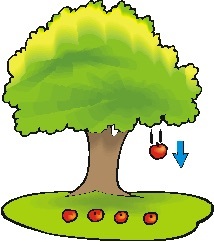
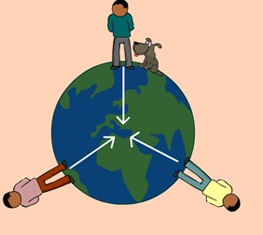
The FORCE that PULLS things down or back to EARTH.
a)
Speed
b)
Gravity
15.
A Newton is a unit of...
a)
force
b)
inertia
c)
acceleration
d)
velocity
16.
Force depends on
a)
Force
b)
mass
c)
acceleration
d)
mass and acceleration 
17.
F = mass x ____
a)
force
b)
velocity
c)
acceleration
18.
The relationship between force, mass, and acceleration is explained in Newton's ____ Law of Motion.
a)
1st
b)
2nd
c)
3rd
d)
4th
19.
Newton's 2nd Law of Motion gives us the formula, ____
a)
F = mv
b)
F = ma
c)
F = dt
d)
F = vt
20.
The energy of moving parts is called_____.
a)
Sound energy
b)
Light energy
c)
thermal energy
d)
Mechanical energy
21.

What is the force on a 1000 kg elevator that is falling freely at 9.8 m/sec2

a)

102.04 n

b)

9,800 n

c)

980 n

d)

103 n

22.
Which of the following is the unit for centripetal force?
a)
J
b)
m/s2
c)
kg⋅m/s
d)
N
23.
Calculate the amount of centripetal force it takes for a softball pitcher to rotate a ball with a velocity of 3 m/s if the ball weighs .12 kg and her arm is .65 meters long.
a)
.38
b)
1.23
c)
.55
d)
1.66 N
24.
Velocity
a)
Vector
b)
Scalar
25.
Force
a)
Vector
b)
Scalar
26.
The stress force that pushes the crust where two plates are moving apart
a)
tension
b)
compression
c)
shearing
27.
The stress force that pushes the crust where two plates are moving apart
a)
tension
b)
compression
c)
shearing
28.
The stress force that pulls plates past one another sideways is called
a)
shear
b)
compression
c)
tension
29.
What type of stress is this?
a)
compression
b)
shearing
c)
tension
30.
What type of stress is this?
a)
compression
b)
shearing
c)
tension
31.
The type of stress that squeezes and shortens a body is __
a)
compression.
b)
tension.
c)
shear.
d)
deposition.
32.
Stretching is another term for tension.  
a)
True
b)
False
33.
Compression is an example of a pulling force.
a)
True
b)
False
34.
What is torsion?
a)
a twisting or turning force
b)
a force that makes a straight material become curved
c)
a pushing force that squeezes
d)
a pulling force that stretches a material
35.
What is compression?
a)
a twisting or turning force
b)
a force that makes a straight material become curved
c)
a pulling force that stretches a material
d)
a pushing force that squeezes a material 
36.
What is tension?
a)
a twisting or turning force
b)
a force that makes a straight material become curved
c)
a pulling force that stretches a material
d)
a pushing force that squeezes a material 
37.

What is the name of the force that twists materials?

a)

Compression

b)

Tension

c)

Torsion

d)

Shear

38.

What is the name of the force slices material a part?

a)

Compression

b)

Tension

c)

Torsion

d)

Shear

39.

What is the name of the force that stretches materials?

a)

Compression

b)

Tension

c)

Torsion

d)

Shear

40.
The amount of matter in an object is 
a)
pressure
b)
weight
c)
mass
d)
force
41.
A person would weigh less on on the Moon than on the Earth because . . .
a)
Moon has more mass, and therefore more gravity
b)
Moon has less mass, and therefore more gravity
c)
Moon has more mass, and therefore less gravity
d)
Moon has less mass and therefore less gravity
42.
What does this tool measure?
a)
weight
b)
meters
c)
mass
d)
force
43.
What does this tool measure?
a)
weight
b)
meters
c)
mass
d)
force
44.
What best describes the mass and weight of a person as they move around the universe?
a)
mass and weight changes
b)
Mass and weight stays constant
c)
weight remains constant, mass changes
d)
Mass stays constant, weight changes
45.
The force of gravity on Jupiter is a little more than 2 times the gravitational force on Earth. If an object has a mass of 50 kg and a weight of 490 N on Earth, what would be the object's approximate mass and weight on Jupiter?
a)
50 kg and 490 N
b)
100 kg and 490 N
c)
50 kg and 980 N
d)
100 kg and 980 N
46.
What is gravity?
a)
A force
b)
Energy
c)
A push
d)
All of them
47.
The scientific unit of weight is
a)
Kg
b)
N
c)
pounds
d)
Kgm/s
48.
The scientific unit for mass is
a)
Kg
b)
N
c)
pounds
d)
ounces
49.
If an object mass =30 Kg on the Earth, what would be it's weight on Earth?
a)
30 N
b)
300 kg
c)
3000N
d)
300 N
50.

What is missing

a)

H

b)

m

c)

D

d)

n

51.
A golf ball accelerates off a tee at 15m/s2, changing its velocity from 0m/s to 50 m/s down the fairway. How long did it take the golf ball to accelerate?
a)
750 seconds
b)
35 seconds
c)
0.3 seconds
d)
3.3 seconds
52.
How fast is the car traveling at 30 seconds?
a)
5m/s
b)
10m/s
c)
20m/s
d)
30m/s
53.
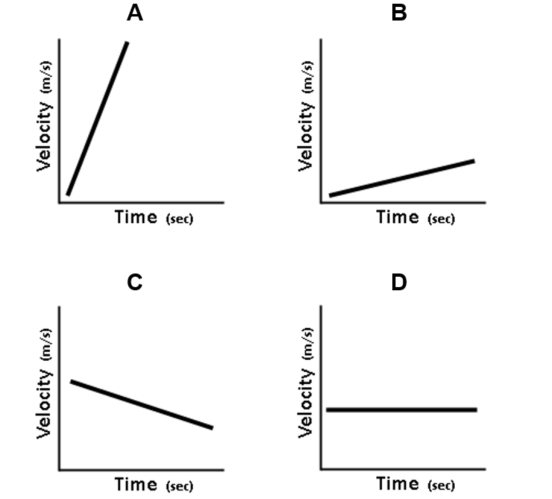
Which graph represents the greatest acceleration?
a)
A
b)
B
c)
C
d)
D
54.

final speed minus initial speed, divided by time

a)

acceleration

b)

speed

c)

relative motion

55.
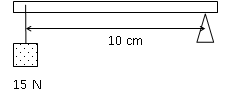
What is the moment acting on the seesaw?
a)
1.6Nm
b)
15Nm
c)
16N
d)
4Nm
56.
What is the moment produced by the 15 N?
a)
15 Nm (clockwise)
b)
150 Nm (anti - clockwise)
c)
1.5 Nm (anti - clockwise)
d)
0.15 Nm (clockwise)
57.

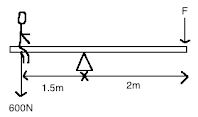
A boy of weight 600N sits on the see-saw as shown at a distance of 1.5m from the pivot. What is the force F required at the other end to balance the see-saw?

a)

450 N

b)

350 N

c)

4.5 N

d)

200 N

58.

Center of gravity is usually located where

a)

more weight is concentrated

b)

less weight is concentrated

c)

less mass is concentrated

d)

more mass is concentrated

59.

The point through which the whole weight of the body acts is called

a)

Inertial Point

b)

Center of gravity

c)

Centriod

d)

Central point

60.

Centre of gravity can be calculated by dividing


a)

 Total Moment Total Arm\frac{Total\ Moment\ }{Total\ Arm}  

b)

 WeightMomentArm\frac{Weight}{MomentArm}  

c)

 Total Momentby TotalWeight\frac{Total\ Momentby\ }{TotalWeight}  

d)

 Mass×MomentArmMass\times MomentArm  

61.

State of a body when external forces are applied to it.

a)

Normal force

b)

Elasticity

c)

Tension

d)

Push or pull

62.

Force with which objects tend to return to its original state after being stretched or compressed by an external force.

a)

Push or pull

b)

Tension

c)

Elasticity

d)

Friction

63.

Is the force usually exerted by a surface on an object that is resisting against it.

a)

Friction

b)

Normal force

c)

Elasticity

d)

Tension

64.

The SI unit for time is the __?__.

a)

hours (h)

b)

liter (L)

c)

gram (g)

d)

second (s)

65.

What SI unit is used to measure length?

a)

meters

b)

liters

c)

centimeters

d)

kilograms

66.

Average speed is measured in

a)

meters per second (m/s)

b)

miles per day (m/d)

c)

kilograms per second (k/s)

d)

newtons per meters (n/m)

67.

Acceleration is measured in

a)

m/d3

b)

g/n

c)

m/s2

d)

k/j2

68.
The ____________ on the rope was so tight it almost snapped.
a)
strain
b)
string
c)
constrict
d)
restrain
69.

Stress Formula

a)


ForceCross Sectional Area (CSA)\frac{Force}{Cross\ Sectional\ Area\ \left(CSA\right)}

b)

CSAForce\frac{CSA}{Force}

c)

Total LoadExtension\frac{Total\ Load}{Extension}

d)

AreaExtension \frac{Area}{Extension\ }

70.

What is the SI unit for Stress

a)

Newton per Square Meter (N/m)

b)

Pascal (Pa)

c)

Newton

d)

Meter Per Second Square (m/s2)

71.

Formula for Elasticity

a)

StrainStress\frac{Strain}{Stress}

b)

ForceStrain\frac{Force}{Strain}

c)

StrainExtension of Area\frac{Strain}{Extension\ of\ Area}

d)

Stress (Nm2)Strain\frac{Stress\ \left(\frac{N}{m^2}\right)}{Strain}

72.

Factor of Safety Formula is

a)

 Stress Tensile Strength\frac{Stress\ }{Tensile\ Strength}  

b)

 Tensile Strength Permissable tensile Stress\frac{Tensile\ Strength\ }{Permissable\ tensile\ Stress}  

c)

 Strength Cross Sectional Area\frac{Strength\ }{Cross\ Sectional\ Area}  

d)

 Original AreaOriginal Stress\frac{Original\ Area}{Original\ Stress}  

73.

when forces cause material to slip in opposite direction either side of a surface inside the body.

a)

Stress

b)

Double Shear

c)

Single Shear

d)

Strain