wayground logo

Free Printable Worksheets

NEW

Font size

S
M
L
XL
Worksheets

Unit 1B - Test Review

Total questions: 46

Worksheet time: 12hrs 30mins

Name
Class
Date
1.

Underline the hypothesis and italicize the conclusion in each statement.

a)

If your dog eats Purina, then he’ll stay happy and healthy.

b)

If your dog eats Purina, then he’ll stay happy and healthy.

c)

If your dog eats Purina, then he’ll stay happy and healthy.

d)

If your dog eats Purina, then he’ll stay happy and healthy.

2.

Refer to the following statement: "If a polygon is a quadrilateral, then it is a trapezoid."


What is the converse of this statement?

a)

If a polygon is not a quadrilateral, then it is not a trapezoid.

b)

If a polygon is not a trapezoid, then it is not a quadrilateral.

c)

If a polygon is a trapezoid, then it is a quadrilateral.

d)

A rectangle is also a quadrilateral.

3.

Refer to the following statement: "If a polygon is a quadrilateral, then it is a trapezoid."


What is the inverse of this statement?

a)

If the polygon is not a quadrilateral, then it is not a trapezoid.

b)

If the polygon is not a trapezoid, then it is not a quadrilateral.

c)

If the polygon is a trapezoid, then it is a quadrilateral.

d)

A rectangle is also a quadrilateral.

4.

Refer to the following statement: "If a polygon is a quadrilateral, then it is a trapezoid."


What is the contrapositive of this statement?

a)

If a polygon is a trapezoid, then it is a quadrilateral.

b)

If a polygon is not a quadrilateral, then it is not a trapezoid.

c)

If a polygon is not a trapezoid, then it is not a quadrilateral.

d)

A rectangle is also a quadrilateral.

5.

The statement "an angle is a right angle if and only if its measure is 90o" is an example of what type of statement?

a)

Conditional

b)

Conjecture

c)

Biconditional

6.

Reasoning based on specific examples and patterns used to form conjectures is called ______________ reasoning.

a)

Inductive

b)

Deductive

7.
What are the missing numbers in this pattern?
12, 15, ___, 21, ____, 27
a)
18,23
b)
18, 24
c)
17, 25
d)
17, 24
8.
a)
1
b)
15
c)
20
d)
12
9.
Where would the next red square be?
a)
bottom left
b)
top right
c)
top left
d)
bottom right
10.
Used to prove that a conjecture is false.
a)
Counterexample
b)
Inductive Reasoning
c)
Concluding statement
d)
Conjecture
11.
If an animal is furry, then it is a hamster. What would be an appropriate counterexample?
a)
goldfish
b)
frog
c)
elephant
d)
cat
12.
The product of two negative numbers is greater than the sum of the two numbers. What is an appropriate counterexample?
a)
-3 and -3
b)
True. There is no counterexample
c)
-1 and -1
d)
4 and 6
13.
If it is a fraction, then it is a number between zero and one. What is an appropriate counterexample?
a)
2/3
b)
4/5
c)
1/2
d)
3/2
14.
If it is an angle, then it is acute. What is an appropriate counterexample?
a)
70⁰
b)
45⁰
c)
120⁰
d)
True. There is no counterexample.
15.
If it is a number, then it is either positive or negative. What is an appropriate counterexample?
a)
10
b)
-2
c)
0
d)
True. There is no counterexample.
16.
True or False: a counterexample is an example that makes a definition or conjecture incorrect
a)
True
b)
False
17.
Identify the hypothesis and conclusion of the conditional statement:
If you give me twenty dollars, then I will be your best friend.
a)
Hypothesis: I will be your best friend
Conclusion: you give me twenty dollars
b)
Hypothesis: you give me twenty dollars
Conclusion: I will be your best friend
c)
Hypothesis: if you have to pay for friends
Conclusion: then you probably should reevaluate your life
d)
Hypothesis: you will not have to pay twenty dollars
Conclusion: if you have lots of friends
18.

What is the hypothesis of the given Conditional Statement?

a)

Jimmy will go to Orlando

b)

Jimmy goes on vacation

c)

Jimmy will not go to Orlando

d)

Who is Jimmy?

19.
What is the conclusion to the statement?
a)
You like fried chicken
b)
You only like fried chicken from KFC
c)
You like KFC
d)
You hate KFC
20.
What is the converse to this statement?
a)
If it isn't dark outside, then it is not night.
b)
If it is night, then it is dark outside
c)
If it is not night, then it is not dark outside.
d)
It is night.
21.
What is the hypothesis of this conditional?
a)
Sally goes to the park.
b)
Sally will fall off the swing.
c)
Parks don't have swings that Sally goes to.
d)
If Sally falls off the swing, she goes to the park.
22.
What is the conclusion to this?
a)
Clarkson will be the coolest
b)
Clarkson will not be the coolest
c)
Clarkson gives us Mountain Dew
d)
Clarkson will not give us Mountain Dew
23.
What is the next number in this pattern?
a)
49
b)
55
c)
57
d)
63
24.
Find the next item in the pattern:
-3, 6, -12, 24, ...
a)
36
b)
-36
c)
48
d)
-48
25.
When taking the converse we ___________ the hypothesis and conculsion
a)
negate
b)
switch
c)
highlight
d)
switch and negate
26.
For the inverse we _________ the hypothesis and conclusion
a)
switch
b)
negate
c)
switch and negate
27.
For the contrapositive we _________ the hypothesis and conclusion
a)
switch
b)
negate
c)
switch and negate
28.
This symbol, ∧, means?
a)
and
b)
or 
c)
not 
d)
implies
29.
This symbol, ∨, means?
a)
and
b)
or
c)
not
d)
implies
30.

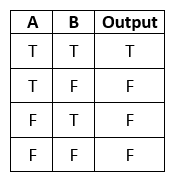
What type of logic is this table showing:

a)

AND

b)

OR

c)

NOR

d)

XOR

31.

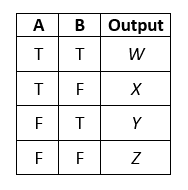
Use the logic condition to find the value of X:


A and not B

a)

True

b)

False

32.

Use the logic condition to find the value of X:


Not A or B

a)

True

b)

False

33.

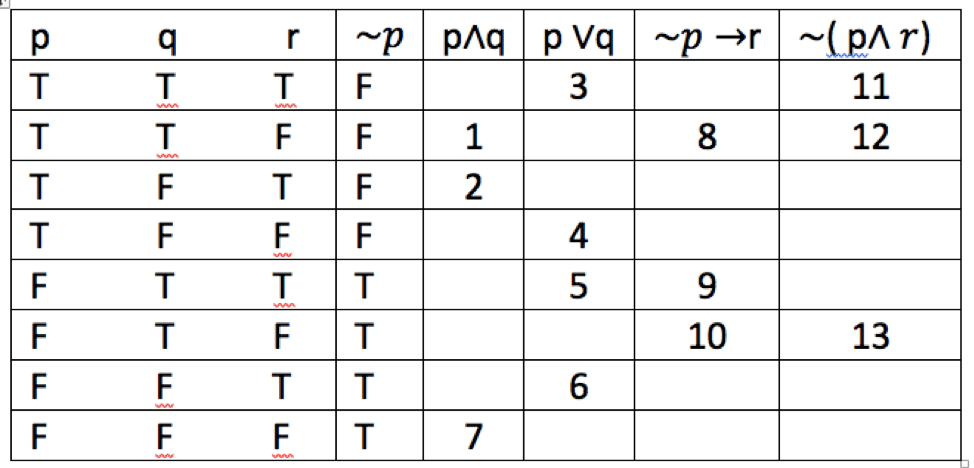
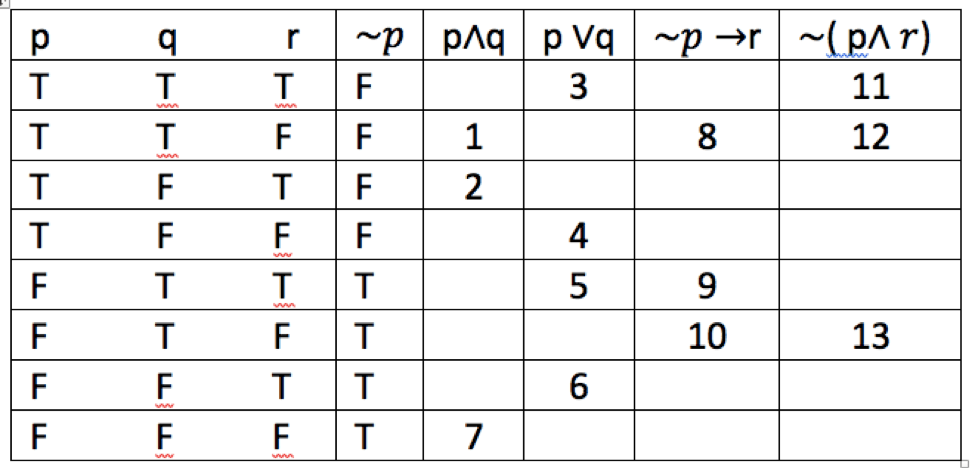
What is the truth value for #1?

a)

True

b)

False

34.

What is the truth value for # 2?

a)

True

b)

False

35.

What is the truth value for # 3?

a)

True

b)

False

36.

What is the truth value for # 4?

a)

True

b)

False

37.

What is the truth value for # 5?

a)

True

b)

False

38.

What is the truth value for # 6?

a)

True

b)

False

39.

Identify the shaded area...

a)

ABA\wedge B

b)

ABA\vee B

40.

Identify the shaded area...

a)

ABA\wedge B

b)

ABA\vee B

41.

Identify the shaded area...

a)

AB\sim A\wedge B

b)

ABA\wedge\sim B

c)

ABA\vee\sim B

d)

AB\sim A\vee B

42.

The diagram shows the sports played by 80 students.


How many students play football.

a)

66

b)

4

c)

18

d)

49

43.

The diagram shows the sports played by 80 students.


How many students play Hockey and Rugby?

a)

36

b)

5

c)

41

d)

44

44.

The diagram shows the sports played by 80 students.


How many students don't play any of the three sports?

a)

79

b)

1

c)

74

d)

6

45.

The diagram shows the sports played by 80 students.


How many students play Rugby or Hockey but not Football?

a)

75

b)

8

c)

13

d)

44

46.

The diagram shows the sports played by 80 students.


How many students don't play Football?

a)

14

b)

13

c)

76

d)

75