
NEW
Font size
S
M
L
XL
 Worksheets
Concepts 2 and 3
Total questions: 28
Worksheet time: 22mins
Name
Class
Date
1.
What 3 subatomic particles make up atoms?
a)
Isotopes, protons, covalent bonds
b)
quarks, quirks, compounds
c)
protons, neutrons, isotopes
d)
protons, neutrons, electrons
2.
The nucleus of an atom usually contains:
a)
protons and neutrons
b)
electrons
c)
electrons and protons
d)
isotopes
3.
The electrons involved in chemical bonds are called ___________ electrons.
a)
valence
b)
ionic
c)
Van Der Waals
d)
covalent
4.
Water helps living things by:
a)
regulating temperature change
b)
serving as a buffer
c)
acting as a reactant in photosythesis
d)
all choices are correct
5.
Life on Earth is based on the element:
a)
helium
b)
gold
c)
carbon
d)
water
6.
The major macromolecules of life are:
a)
lipids, proteins, carbohydrates, nucleic acids
b)
nucleic acid and water
c)
lipids and fats
d)
DNA
7.
What is the smallest unit of matter that cannot be broken down by chemical means?
a)
Atom
b)
Element
c)
Ion
d)
Isotope
8.
What are the six elements that all life is made up of?
a)
Hydrogen, Phosphorus, Oxygen, Nitrogen, Sulfur and Carbon
b)
Sulfur, Potassium, Helium, Oxygen, Neon and Carbon
c)
Hydrogen, Titanium, Carbon, Nitrogen, Lithium and Iron
d)
Oxygen, Chlorine, Iron, Nitrogen, Hydrogen and Calcium
9.
This biomolecule is used to make energy for our cells. The simplest is glucose, a monosaccharide.
a)
Carbohydrates
b)
Lipids
c)
Nucleic Acids
d)
Proteins
10.
These biomolecules are fats, oils, waxes and steroids. They are also a result if we eat too many carbohydrates and why we don't melt in water.
a)
Carbohydrates
b)
Lipids
c)
Nucleic Acids
d)
Enzymes
11.
Examples of these biomolecules are DNA and RNA...
a)
Nucleic Acids
b)
Carbohydrates
c)
Lipids
d)
Proteins
12.
Nucleic Acids are made up of smaller subunits called....
a)
Nucleotides
b)
Lipids
c)
Monosaccharides
d)
Subunits
13.
These biomolecules are the main building blocks of you. They are large and complex and special ones do jobs all over your body as catalysts.
a)
Proteins
b)
Carbohydrates
c)
Lipids
d)
Nucleic Acids
14.

The chemical compound of water is
a)
HO
b)
H2O
c)
H3O
d)
HO2
15.

Water is a universal solvent
a)
True
b)
False
16.

Pure water has a
a)
Neutral pH
b)
Negative pH
c)
Positive pH
d)
Both Negative and Positive pH
17.

A Compound that is being dissolved is called a
a)
Solution
b)
Solute
c)
Solvent
d)
Suspension
18.
A solvent is...
a)
substance into which the solute dissolves
b)
a compound being dissolved
c)
a substance that does not dissolve
d)
None of the above
19.

A water strider can skate along the top of a pond because:
a)
covalent bonds result in water cohesion
b)
hydrogen bonds result in water cohesion (surface tension)
c)
water striders have adapted to take advantage of water cohesion
d)
low surface tension of water
20.

Why can water have no net charge but have slight charges in different parts of the molecule?
a)
The oxygen end is slightly negative and the hydrogen end is slightly positive
b)
The hydrogen end is slightly negative and the oxygen end is slightly positive
c)
The hydrogen and oxygen ends change in polarity
d)
Because it is hydrophobic
21.

Attractions between water molecules are called
a)
Covalent bonds
b)
Ionic bonds
c)
Polar bonds
d)
Hydrogen bonds
22.

Which of the following is LEAST likely to dissolve in water?
a)
nonpolar fats and oils
b)
polar sugar molecules
c)
salt made of a positive sodium ion and a negative chloride ion
d)
all of the substances will dissolve easily in water
23.
Which types of compounds dissolve easily in water?
a)
Polar and Nonpolar
b)
Polar and Ionic
c)
Nonpolar and Ionic
d)
Covalent and Nonpolar
24.
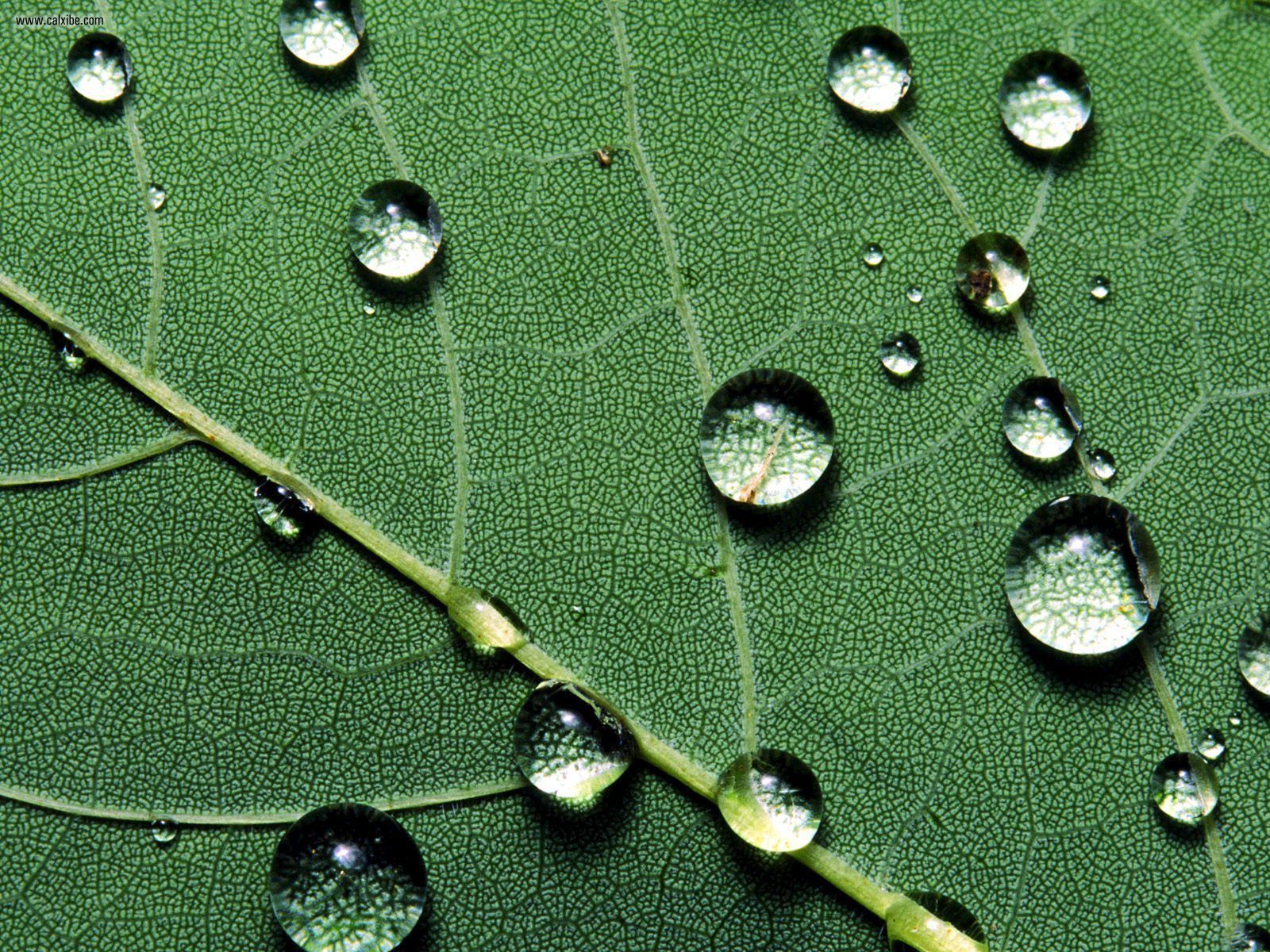
Refer to the picture of water sticking to a leaf; this is occurring because of:
a)
Adhesion
b)
Cohesion
25.
The function of energy storage goes with which macromolecule-
a)
Carbohydrates
b)
Lipids
c)
Proteins
d)
Nucleic Acids
26.
The following examples Fats, Oils, Phospholipids, and Waxes belong to which macromolecule?
a)
Carbohydrates
b)
Lipids
c)
Proteins
d)
Nucleic Acid
27.
The monomer Modnosaccarides belongs to which macromolecule?
a)
Carbohydrates
b)
Lipids
c)
Proteins
d)
Nucleic Acids
28.
The monomer amino acid belongs to which macromolecule?
a)
Carbohydrates
b)
Lipids
c)
Proteins
d)
Nucleic Acid
Reset

