wayground logo

Free Printable Worksheets

Font size

S
M
L
XL
Worksheets

American Revolution

Total questions: 116

Worksheet time: 3hrs 41mins
Name
Class
Date
1.
The Sons of Liberty were:
a)
the children of our Founding Fathers.
b)
a professional dance team.
c)
Patriots who protested taxes.
d)
the writers of the Declaration of the Independence.
2.
The Daughters of Liberty were known for:
a)
their delicious apple pies.
b)
their dramatic protests.
c)
the beautiful clothes they made for the wealthy colonists.
d)
making goods that normally would be made in England and imported into the colonies.
3.
What is another name for British soldiers?
a)
Redcoats
b)
Patriots
c)
Minutemen
d)
Continental Soldiers
4.
What did we call colonists who did NOT want independence from England?
a)
Minutemen
b)
Traitors
c)
Militia
d)
Loyalists
5.
"No ________ without representation"
a)
voting
b)
taxation
c)
rights
d)
liberty poles
6.
What was the purpose of the Boston Tea Party?
a)
to punish merchants for selling imported tea.
b)
to see who could throw a barrel further.
c)
to frame the Native Americans.
d)
to protest taxes
7.
Who were the Minutemen?
a)
Patriots who were ready to fight at a minutes notice
b)
British soldiers who were ready to fight at a minutes notice
c)
Sons of Liberty who were ready to fight at a minutes notice
d)
Hessians who were ready to fight at a minutes notice
8.
Which side had more resources and training at the beginning of the war?
a)
British
b)
Colonists
9.
Who won the American Revolution?
a)
The British
b)
The American Colonists
10.
Who fired "the shot heard round the world?"
a)
the British
b)
the minutemen
c)
it is a mystery!
11.
How many people died at the Boston Massacre?
a)
2
b)
6
c)
3
d)
5
12.
What country joined the colonists to help them win the war?
a)
Germany
b)
France
c)
Netherlands
d)
Africa
13.

Which of the following best describes what the Continental Congresses were?

a)

a series of meetings planned to respond to England

b)

a provisional government designed to negotiate peace

c)

a local Pennsylvania legislature debating England's taxes

14.

Which of the following was NOT an outcome of the 2nd Continental Congress?

a)

created Continental Army

b)

wrote Declaration of Independence

c)

elected Washington President

d)

print paper money

15.

Who wrote the Declaration of Independence?

a)

George Washington

b)

Sam Adams

c)

John Adams

d)

Thomas Jefferson

16.

Which (original) Enlightenment thinker influenced the writing of the Dec of Independence?

a)

Carl Marx

b)

John Locke

c)

Thomas Paine

d)

Thomas Jefferson

17.

"Unalienable rights" are similar to which of the following ideas?

a)

right to rebel

b)

natural rights

c)

popular sovereignty

18.

The idea that the power to rule comes from the people is known as

a)

right to rebel

b)

natural rights

c)

popular sovereignty

19.

The idea that the people must overthrow an unjust government is known as

a)

right to rebel

b)

natural rights

c)

popular sovereignty

20.

What impact does Thomas Paine have on the American Revolution?

a)

he persuades the colonists to rebel

b)

he persuades the colonists to remian loyal

c)

he persuades the colonists to immigrate to England

21.

What was the first battle of the American Revolution?

a)

Guilford Courthouse

b)

Trenton

c)

Yorktown

d)

Lexington & Concord

22.

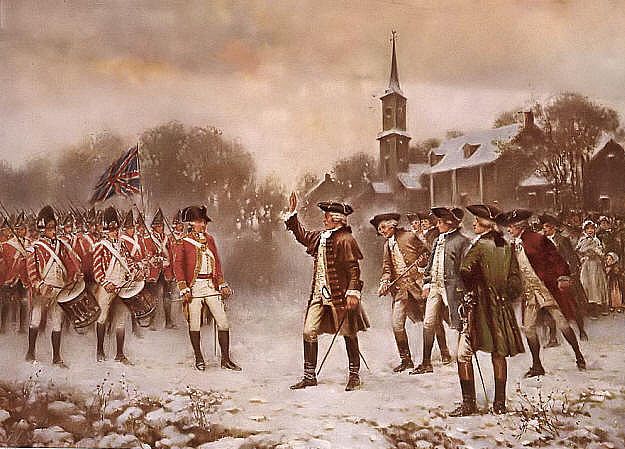
Which battle is shown in this image?

a)

Guilford Courthouse

b)

Yorktown

c)

Trenton

d)

Lexington & Concord

23.
The main American strength when the war began was
a)
an army of well-trained militia volunteers.
b)
a large and powerful navy.
c)
an able and inspiring leader in George Washington
d)
a large supply of guns and bullets.
24.
Compared to the Continental Army, British troops were all of the following except
a)
better fed.
b)
better led.
c)
better trained.
d)
better equipped.
25.
Many African Americans joined the Continental Army hoping that
a)
independence would lead to the end of slavery.
b)
they could return to Africa after the war.
c)
Congress would give them land for their service.
d)
Britain would grant them their freedom.
26.
American victories at Trenton and Princeton
a)
forced the British to abandon New York and New Jersey.
b)
showed that the Americans could beat the British and their allies.
c)
convinced Spain to side with the United States.
d)
proved that Washington could not trust his men to fight.
27.
After 1776, Washington's basic military strategy was to
a)
starve the British out of New York City.
b)
defeat the British in one large battle.
c)
avoid battles at all costs to keep his army safe.
d)
fight a defensive war and tire the British out.
28.
The Battle of Saratoga was a turning point in the war because it
a)
brought France into the war as an American ally.
b)
ended General Burgoyne's career.
c)
liberated Georgia from British control.
d)
forced the British to leave Canada.
29.
The American cause in the South was kept alive by
a)
Hessian mercenaries.
b)
Loyalists.
c)
guerrilla troops.
d)
foreign volunteers.
30.
In the Treaty of Paris, the Americans won their independence and
a)
the right to strip Loyalists of their property.
b)
a pledge that future conflicts with Britain would be settled peacefully.
c)
the return of all taxes collected by Britain before the war.
d)
all the territory lying to the east of the Mississippi River.
31.
In which state did the Battle of Yorktown take place?
a)
New York
b)
Georgia
c)
New Jersey
d)
Virginia.
32.
In the Battle of Yorktown, Cornwallis was outnumbered by a ratio of about
a)
five to one.
b)
three to one.
c)
four to one.
d)
two to one.
33.
What was the outcome of the Battle of Yorktown?
a)
Cornwallis surrendered, ending the war.
b)
The warships were lost in a fierce storm.
c)
Washington withdrew rather than risk his army.
d)
Rochambeau's troops barely escaped alive.
34.
Who wrote "The Crisis?"
a)
Joseph Martin
b)
Thomas Paine
c)
George WAshington
d)
Nathaniel Greene
35.
"Summer soldiers and sunshine patriots" might best be described as
a)
quitters.
b)
optimists.
c)
fighters.
d)
traitors.
36.
British general who traveled with 30 wagons of his personal baggage.
a)
General Gates
b)
General Howe
c)
General Burgoyne
d)
General Clinton
37.
Location of winter encampment of the Continental Army which was a low point during the war.
a)
Valley Forge
b)
Monmouth
c)
Saratoga
d)
New York
38.
Experienced shortages of everything.
a)
Americans
b)
British
39.
Strong patriotism was an advantage or strength
a)
Americans
b)
British
40.
Experienced poor leadership
a)
Americans
b)
British
41.
Received help from the Hessians
a)
British
b)
Americans
42.
Worthless money made it difficult to purchase supplies for the army.
a)
Americans
b)
British
43.

What was the primary reason Parliament passed these acts?

a)

To promote the growth of cottage industries in the colonies

b)

To encourage foreign trade with the colonies

c)

To recover the cost of defending the colonies

d)

To fund the establishment of new colonies

44.

How did mercantilist policies create tension between Great Britain and the colonies?

a)

By introducing indentured servitude to the middle colonies

b)

By Requiring colonist to enlist in the military

c)

By limiting the amount of farmland each colonist could have

d)

By preventing colonists from trading with most other foreign countries

45.

Which of the following best completes this diagram?

a)

Colonists sought military support from france

b)

Colonists organized boycotts of British goods

c)

Colonists signed the Declaration of Independence

d)

Colonists dumped tea into the Boston Harbor

46.

These acts contributed to the start of the Revolutionary War by -

a)

restricting colonial trade with American Indians

b)

imposing regulations on colonial agriculture

c)

angering colonists who believed that their civil liberties had been violated

d)

punishing colonists for resisting the authority of parliament

47.

Why is the Battle of Saratoga considered a turning point in the Revolutionary War?

a)

The British victory extended the fighting for another year

b)

The American defeat led many soldiers to desert the Continental Army

c)

The British defeat marked the beginning of a steady decline in British military superiority

d)

The American victory convinced France to ally with the United States

48.

What was one result of the Treaty of Paris 1783?

a)

Great Britain recognized the United States as an independent country.

b)

Competing Seminole and Spanish claims in West Florida were resolved

c)

The British navy agreed to stop pressing American sailors into service

d)

British territory in eastern Canada was ceded to France

49.

The British government issued the Proclamation of 1763 to limit the area British colonists were allowed to settle. Which geographic feature did the British use as a boundary of approved settlement?

a)

Lake Michigan

b)

Gulf of Mexico

c)

Mississippi River

d)

Appalachian Mountains

50.

Which of these is a grievance from the Declaration of Independence?

a)

Colonists born in America were prohibited from holding elected office.

b)

Colonists were forced to quarter troops in homes

c)

Colonists were not eligible to become officers in the British army

d)

Colonists were required to serve a year in their colony's militia

51.

Which excerpt from the Declaration of Independence best explains why colonists were unhappy about their lack of representation in the British parliament?

a)

He has refused to pass other Laws for the accommodation of large districts of people

b)

For imposing Taxes on us without our Consent

c)

He has refused his assent to Laws, the most wholesome and necessary for the public good

d)

For transporting us beyond Seas to be tried for pretended offences

52.

This list includes rights that are considered

a)

transferable

b)

legislated

c)

unalienable

d)

inherited

53.

Which of these completes this graphic organizer?

a)

Parliament repeals the Stamp and sugar Acts

b)

King George III allows colonists to petition Parliament for tax relief

c)

Parliament passes the Intolerable Acts

d)

King George III appoints colonial representatives to Parliament

54.

All the events listed above occurred during

a)

the era of westward expansion

b)

the era of good feelings

c)

the Revolutionary era

d)

the Jacksonian era

55.

The excerpt above reflects the dissatisfaction of American colonist with the ....

a)

political debates that took place at the Albany Convention

b)

interference of Great Britain in the slave trade

c)

economic consequences of the Great Awakening

d)

economic policies imposed by Great Britain following the French and Indian War

56.

British colonists objected to the Proclamation of 1763 because they.....

a)

feared it would provoke attacks from American Indians

b)

did not want to share control if the fur trade with France

c)

resented the limits it imposed on westward expansion

d)

wanted to be able to trade feely with foreign nations

57.

the rights listed above were-

a)

established by a series of supreme court decisions

b)

defined b y Thomas Jefferson in the declaration of Independence

c)

established by the ratification of the U.S. Constitution

d)

defined by President George Washington in his Farewell Address

58.

this excerpt refers to rights that people -

a)

earn by demonstrating loyalty to their government

b)

recieve by becoming citizens of a country

c)

have as a result of being human

d)

are granted after enlistment in the military

59.

The leader of the Sons of Liberty was.....

a)

Thomas Jefferson

b)

Samuel Adams

c)

George Washington

d)

Thomas Paine

60.

This was the first person killed at the Boston Massacre

a)

Alexander Hamilton

b)

Mark Twain

c)

Crispus Attucks

d)

Dora the Explorer

61.
This was a tax on molasses and sugar to reduce smuggling.
a)
Stamp Act
b)
Sugar Act
c)
Townshend Act
d)
Tea Act
62.
This was a tax on all printed materials in the 13 Colonies.
a)
Stamp Act
b)
Sugar Act
c)
Tea Act
d)
Townshend Act
63.
Finish this American Colonist Motto, "No Taxation without..."
a)
Transportation
b)
Relaxation
c)
Representation
d)
Sensation
64.
Why were the American Colonist taxed after the French and Indian War?
a)
Britain was in debt and needed money
b)
That was the agreement with the Native Americans
c)
They made too much money
d)
Townshend Acts
65.
What was this poster's meaning?
a)
The Colonies needed to be united
b)
Serpents can grow back together
c)
Colonies need to be independent
d)
Ben Franklin didn't know why he made this
66.
This event broke tensions between the colonist and the British troops where shots were fired. Crispus Attucks was the first to be killed.
a)
Lexington and Concord
b)
Boston Tea Party
c)
Boston Massacre
d)
Bloody Valentine
67.
How did the colonist protest against the tea tax?
a)
Dressed up like Native Americans
b)
Boston Massacre
c)
Dumped tea into Boston harbor
d)
Didn't pay the tax on the East India Tea
68.
Which was the punishment for the Boston Tea Party?
a)
Intolerable Acts
b)
Sugar Acts
c)
Quartering Acts
d)
Stamp Acts
69.
The First Continental Congress produced...
a)
plantation systems
b)
colonial militias
c)
Continental Army
d)
Declaration of Independence
70.
This battle where the American Colonist won and was called "The shot heard 'round the world". 
a)
Battle of Saratoga
b)
Battle of Yorktown
c)
Lexington and Concord
d)
Battle of Bunker Hill
71.
Early revolutionary battle where 1,000 British troops died and realized the American Colonists were tougher than they though.
a)
Battle of Bunker Hill
b)
Lexington and Concord
c)
Battle of Saratoga
d)
Battle of Yorktown
72.
This type of American Colonist was in support of the British parliament.
a)
Patriot
b)
Loyalist
c)
Yes man
d)
Neutral
73.
The Second Continental Congress addressed the steps to the colonies governing themselves and the creation of what military group?
a)
Colonial militias
b)
Marines
c)
Continental Army
d)
Navy
74.
Who was the first choice to command the Continental Army?
a)
Thomas Jefferson
b)
Benjamin Franklin
c)
Thomas Paine
d)
George Washington
75.
Pamphlet that sparked the independent spirit within the colonies during the revolution.
a)
Common Sense
b)
Catching Fire
c)
Declaration of Independence
d)
Mayflower Compact
76.
This type of colonist was ready for rebellion and the fight for independence.
a)
Loyalist
b)
Patriot
c)
Neutral
d)
British 
77.
Declaration of Independence was created July 4th of what year?
a)
1607
b)
1773
c)
1781
d)
1776
78.
Colonists were forbidden to settle west of the Appalachian Mountains.
a)
Proclamation line of 1763
b)
Proclamation boundary
c)
Manifest Destiny
d)
Borderlands
79.
Life, Liberty and the pursuit of happiness were...
a)
Unalienable rights
b)
Bill of Rights
c)
Freedom to live
d)
Will Smith movie
80.
Who was the first to sign the Declaration of Independence?
a)
Thomas Jefferson
b)
John Hancock
c)
Benjamin Franklin
d)
George Washington
81.

The ___________ fought hard to gain America's freedom from the king of England.

a)

Patriots

b)

Loyalists

c)

freedom

d)

treaty

82.

The American Revolutionary war was ___________ the American colonists and England(Great Britain).

a)

between

b)

soldiers

c)

government

d)

rights

83.
This American victory was the turning point in the American Revolutionary war and encouraged the French to join forces with them (the Americans).
(Turning point is a big change in a situation)
a)
Saratoga
b)
Yorktown
c)
Bunker Hill
d)
Lexington and Concord
84.

This patriot made a daring ride through Lexington, Massachusetts to warn colonists, militia, and Minutemen that British soldiers were approaching by sea.

a)

Patrick Henry

b)

Paul Revere (Really William Dawes)

c)

Phillis Wheatley

d)

Samuel Adams

85.

Which one of these is an advantage or reason that helped the American patriots defeat Great Britain in the American Revolution War?

a)

They knew all of the possible hideouts to surprise the British and attack them (forests, woods, behind stone walls, etc)

b)

got help from French soldiers thanks to Ben Franklin

c)

strong leadership from men like George Washington

d)

all of the above

86.
How were the American/Continental army able to defeat the British during the first battle, The Battle of Lexington and Concord?
a)
By firing on them from behind stone walls and trees in the woods.
b)
By challenging the British to them for a battle
c)
By warning the British that they were going to attack them
87.

Why was Massachusetts so important during the first battle of the American Revolutionary War?

a)

It was the where King George III was born

b)

It was where the Boston Massacre and Boston Tea Party occurred

c)

It was where the first shot was fired when the Battles of Lexington and Concord started

d)

It was where the American Revolutionary war ended

88.
At the end of the  American Revolution war, the Treaty of Paris was signed in 1783.  What was the most important thing that the American colonists gained from this agreement?
a)
Americans gained their independence(freedom) from Great Britain
b)
Americans decided to keep King George III as their leader
c)
Americans decided to say that Great Britain won the war
d)
Nothing was gained from the signed agreement
89.
If a soldier traveled from Saratoga, New York and headed to Yorktown, Virginia, which direction would they travel?
(draw a compass rose and label it N, S, E, and W to help you answer this question)
a)
North
b)
South
c)
East
d)
West
90.
Where were the first armed conflicts of the American Revolution?
a)
Yorktown
b)
Saratoga
c)
Lexington and Concord
d)
Bunker Hill
91.

Surrounded by French and Continental(Armies) armies, a large British army led by General Cornwallis surrendered here.

a)

Saratoga

b)

Yorktown

c)

Bunker Hill

d)

Lexington and Concord

92.
First Battle of the American Revolution was also know as
a)
French and Indian War
b)
7 Years War
c)
Dead Man's Day
d)
Shot Heard Around the World
93.

What do the following men have in common

Benardo de Galvez

Haym Salomon

Wentworth Chesswell

Marquis de LaFayette

James Armistead

a)

All were captured and killed at Saratoga

b)

All were spies for the Redcoats

c)

All were heroes of the American Revolution

d)

All were spies for the Continental Army

94.
After the Treaty of Paris 1783, what was the new natural boundary of the United States?
a)
Appalachian Moutains
b)
Ohio River Valley
c)
Mississippi River
d)
Great Lakes
95.

What contribution did Mercy Otis Warren make to the American Revolution?

a)

She was not a factor because women were not important during this Era

b)

She dressed as a Son of Liberty and participated in the Boston Tea Party

c)

Told her husband John Adams to "Remember the Ladies"

d)

Used propaganda in her essays, plays and poems to encourage patriotism also wrote one of the first historical accounts of the Revolutionary War.

96.
What are your 3 Unalienable Rights, as expressed by Thomas Jefferson?
a)
Peace, Love and Joy
b)
Life, Liberty, and Property
c)
Life, Leadership and Pursuit of Happiness
d)
Life, Liberty and Pursuit of Happiness
97.
"Give me Liberty or Give me Death" meant
a)
I live to die
b)
I want freedom from slavery
c)
I will die for my freedom
d)
death is the only freedom
98.
Which group is in the correct order?
a)
Yorktown, Valley Forge, Saratoga, Lexington and Concord
b)
Lexington/Concord, Saratoga, Valley Forge, and Yorktown
c)
Lexington/Concord, Valley Forge, Saratoga, and Yorktown
d)
Valley Forge, Yorktown, Lexington/Concord, and Saratoga
99.
Who is known as the Father of the U.S. Navy?
a)
John Paul Jones
b)
James Armistead
c)
Benjamin Franklin
d)
Thomas Jefferson
100.
Whose writings inspired Thomas Jefferson with the Declaration of Independence?
a)
Thomas Paine
b)
Benjamin Franklin
c)
John Locke
d)
George Washington
101.
Which pamphlet did Thomas Paine write to encourage the colonist to fight for independence from Britain?
a)
The Crisis
b)
Common Sense
c)
Declaration of Independence
d)
Unalienable Rights
102.
The last major battle fought by Washington's army was...
a)
Cowpens
b)
Charleston
c)
Yorktown
d)
Saratoga
103.
The Battle of Lexington and Concord was important because
a)
it was the last battle
b)
it was the first battle
c)
it was the longest battle
104.
What battle was the turning point?
a)
Saratoga
b)
Cowpens
c)
Yorktown
d)
Bunker Hill
105.
What battle was the "shot hear round the world?"
a)
Lexington and Concord
b)
Saratoga
c)
Bunker Hill
d)
Cowpens
106.
What was Molly Pitcher known for?
a)
Protesting war
b)
designing weapons
c)
taking men water
d)
a spy
107.
Which part of the Declaration means everyone should be treated equally?
a)
All men are created equal
b)
everyone can be free
c)
the people's rights are protected
108.
Why did they write the Declaration of Independence?
a)
colonies were now independent of Britain
b)
declare they were going to have a war
c)
ask for help paying for taxes
109.
Why did France decide to help?
a)
the colonists helped during the French and Indian War
b)
They were also under control of the British
c)
France considered England an enemy, too
110.
Thomas Paine wrote a pamphlet called
a)
Common Sense
b)
Common Nonsense
c)
Everyday Stuff
111.
Who was an African American that got killed during the Boston Massacre?
a)
Crispus Attucks
b)
Peter Salem
c)
George Washington
112.
How did France help win the war?
a)
Send ships, supplies, and soldiers
b)
Send food
c)
They didn't help
113.
Who is George Washington's wife?
a)
Abigail Adams
b)
Martha Washington
c)
Molly Pitcher
114.
Which battles were won by the COLONISTS?
a)
Saratoga, Lexington and Concord, and Yorktown
b)
Charleston, Cowpens, and Yorktown
c)
Yorktown, Bunker Hill, and Charleston
115.

Give me Liberty or give me Death

a)

Patrick Henry

b)

Thomas Paine

c)

Thomas Jefferson

d)

John Hancock

116.

I only regret that I have but one life to lose for my country

a)

Nathan Hale

b)

Ben Franklin

c)

Leroy Jenkins

d)

George Orwell