wayground logo

Free Printable Worksheets

NEW

Font size

S
M
L
XL
Worksheets

1st Quarter 6th Science Exam Review

Total questions: 70

Worksheet time: 1hrs 2mins

Name
Class
Date
1.

Angela is modeling seismic waves using a slinky toy. She wants to see if the size of the seismic waves increase when the slinky is moving at higher speeds.


What is the test variable (independent variable) in this experiment?

a)

There is no test variable (IV) in this experiment.

b)

The test variable (IV) is the size of the slinky.

c)

The test variable (IV) is the size of the wave.

d)

The test variable (IV) is the speed of the slinky.

2.

A group of students is studying the effect of temperature on the density of air. They obtained the following results from a controlled experiment, and conclude that air density is directly related to temperature.


Trial 1 temp = -20 density = 1.39

Trial 2 temp = -10 density = 1.34

Trial 3 temp = 0 density = 1.29

Trial 4 temp = 10 density = 1.25

Trial 5 temp = 20 density = 1.20


What statement BEST supports this conclusion?

a)

Lower temperatures had higher density values than higher temperatures.

b)

Lower temperatures had lower density values than higher temperatures.

c)

Higher temperatures had higher density values than lower temperatures.

d)

Higher temperatures did not cause any changes in the density values.

3.

Diana and Jane are conducting the same scientific experiment. The experiment involves dropping different colored balls and measuring the maximum height of the first bounce in centimeters. When they compare their results, they notice that their data is very different. Which of the following is the LEAST LIKELY explanation for the discrepancy in their data?

a)

Diana and Jane dropped the balls from different heights.

b)

Diana and Jane used different brands of bouncy balls.

c)

Diana and Jane dropped the bouncy balls on different surfaces.

d)

Diana and Jane conducted their experiment at different times of the day.

4.

Why is it important for scientists to share not only their results, but also their procedure with other scientists?

a)

Scientists don’t care about results, they only want to know the procedure.

b)

So scientists can repeat the experiment and compare methods used, results obtained, and offer further explanations.

c)

A scientist’s findings can only become a Law if it is repeated 10 times.

d)

Other scientists can compare methods and then copy your data if you used the same method.

5.

Students in a class conduct experiments on the percent of oxygen in the air. When discussing their results, it is discovered that each lab group came to different conclusions.


What should they do?

a)

Change the data to reflect the known percentage of oxygen in the air.

b)

Find the range between the highest and the lowest percentage found.

c)

Compare methods used and identify possible errors.

d)

Vote on the group with the best procedure and copy their results.

6.

Models of the Solar System are often shown in charts, posters, texts, and images, showing relative positions and distances of objects. How can a scaled-down Model of the Solar System inaccurately represent the true size AND distance of the planets from the sun within a science text?

a)

The textbook would provide too little space due to the distances between planets.

b)

The textbook would provide too little space for the relative sizes of the planets.

c)

The textbook would show the improper order of the planets.

d)

The textbook would not label the true size and distances of the planets.

7.

Kayla is creating a model to show her understanding of the water cycle. She wants to show that water is constantly cycling between the atmosphere and the Earth’s surface.

What would be the BEST type of model for Kayla to create?

a)

A diagram of molecules gaining energy as they begin to evaporate and enter the atmosphere.

b)

A 3-D model of H2O created with gumdrops and toothpicks.

c)

A circular diagram with arrows showing the movement of water between Earth’s surface and atmosphere.

d)

A poster with pictures of lakes, oceans, rivers, and ponds.

8.

The ability to conduct electric current, dissolve in water, and melt are _________________.

a)

Chemical bonding

b)

Chemical properties

c)

Physical changes

d)

Physical properties

9.

You find 3 containers of clear liquids in your refrigerator. One contains water, one contains sprite, and one contains rubbing alcohol.


Which of the following is NOT a physical property you would use to determine the identity of the liquids?

a)

Flammability

b)

Density

c)

Boiling point

d)

Solubility

10.

You are given two balls that are made from the same material. They are also the same size and color. One is hollow and one is solid. Determine the physical properties that could be used to identify the ball that is solid.

a)

Flammability; pH

b)

Density; magnetism

c)

Boiling point, solubility

d)

Electrical conductivity; pH

11.

What is the smallest unit of matter?

a)

Compound

b)

Mixture

c)

Atom

d)

Element

12.

Which of the following is a compound?

a)

Carbon

b)

Gold

c)

Oxygen

d)

Water

13.

Which of the following statements is correct about matter?

a)

Elements combine to form compounds.

b)

Compounds combine to form elements.

c)

Elements combine to form atoms.

d)

Compounds combine to form atoms.

14.

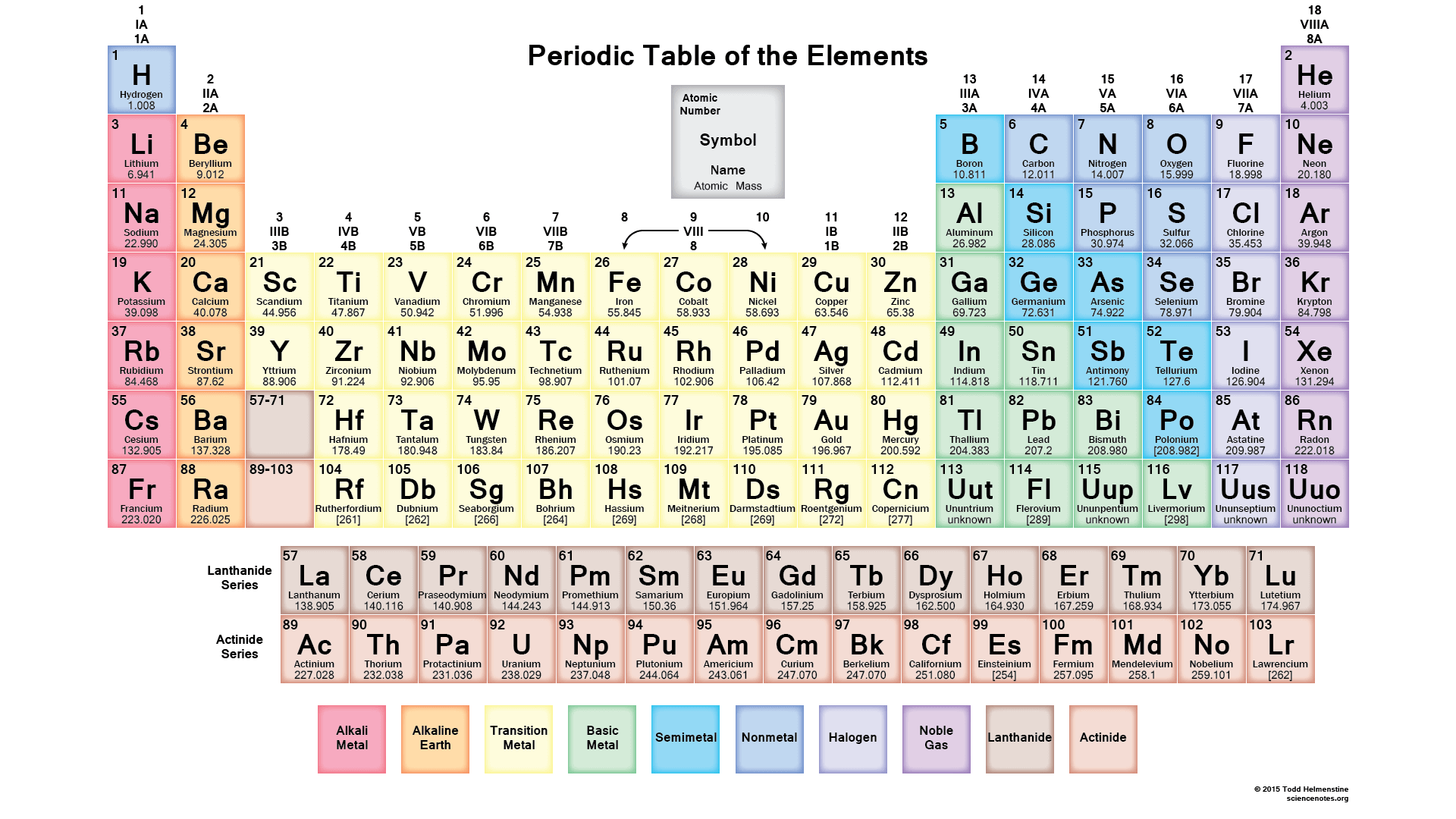
John discovered that sodium (Na) is found in group 1 on the Periodic Table of Elements. Where should John look for another element that has similar properties?

a)

In the same row

b)

In the same column

c)

On the opposite side of the table

d)

For names that begin with the letter N

15.

What can you predict from an element’s location in the Periodic Table?

a)

Its chemical symbol

b)

Its chemical name

c)

Its properties

d)

When it was discovered

16.

Using the Periodic Table, scientists can predict the properties of elements. Which of the following pairs of elements have properties that are the least similar?

a)

He and Xe

b)

Cl and I

c)

N and P

d)

Si and S

17.

Which subatomic particles can be found in the nucleus?

a)

Electrons, protons

b)

Protons, neutrons

c)

Neutrons, electrons

d)

Atoms, neutrons

18.

Which subatomic particle is yellow in the figure?

a)

Proton

b)

Neutron

c)

Electron

d)

Atom

19.

Which subatomic particle is green in the figure?

a)

Proton

b)

Neutron

c)

Electron

d)

Atom

20.

Which subatomic particle is red in the figure?

a)

Proton

b)

Neutron

c)

Electron

d)

Atom

21.

Which of the following statements is true about the diagram?

a)

This is an atom with 2 protons, 1 electron, and 3 neutrons.

b)

This is an atom with 6 electrons, 0 protons, and 0 neutrons.

c)

This is an atom with 2 electrons, 4 protons, and 0 neutrons.

d)

This is an atom with 2 protons, 2 neutrons, and 2 electrons.

22.

A solution has the pH of 2.4. How would this solution be classified?

a)

Acid

b)

Base

c)

Neutral

d)

Salt

23.

Using the pH scale above which substance is closest to neutral?

a)

Lemon juice

b)

Sea Water

c)

Distilled Water

d)

Lye

24.

Normal rainwater has a pH between 5.5 and 6. Which of the following is the most likely to be the pH of rainwater that is classified as acid rain?

a)

A pH of 6

b)

A pH of 7

c)

A pH below 5

d)

A pH above 7

25.

Which of the following is the definition of a solution?

a)

A mixture containing two or more substances that has the same properties throughout.

b)

A single kind of matter that has a specific makeup.

c)

A compound containing two or more substances that are chemically combined.

d)

A substance that cannot be broken down into any other substances.

26.

Which statement below describes the difference between mixtures and pure substances?

a)

Pure substances can be physically separated but mixtures cannot be physically separated.

b)

Mixtures can be physically separated but pure substances cannot be physically separated.

c)

Mixtures are made of a single kind of matter but a pure substance is two or more substances that are chemically bonded.

d)

Pure substances are not created through a chemical reaction and mixtures are the result of a chemical reaction.

27.

Which diagram represents a pure substance? Chose the BEST answer and reasoning.

a)

Diagram A is a pure substance because it is more evenly spread out.

b)

Diagram B is a pure substance because it is more evenly spread out.

c)

Diagram A is a pure substance because it is a compound and cannot be separated by physical means.

d)

Diagram B is a pure substance because it is a compound and cannot be separated by physical means.

28.
How are scientific theories different from scientific laws?
a)
Scientific theories are well-supported ideas that can be modified, but are rarely discarded.
b)
Scientific theories are laws that have not been proven yet.
c)
Scientific theories are claims that a few scientists believe.
d)
Scientific theories are educated guesses.
29.
Sarah conducted an experiment to determine whether salt added to a cup of water affects its boiling point. Water samples were prepared containing equal quantities of water at the same temperature. Each sample received a different amount of salt and was placed onto a heat source. The temperature of the water once it reached a rapid boil was recorded. Which conclusion correctly interprets the information from Sarah's table?
a)
Doubling the amount of salt doubled the boiling point.
b)
Increasing the amount of salt lowered the boiling point.
c)
Doubling the amount of salt decreased the boiling point.
d)
Increasing the amount of salt increased the boiling point.
30.
If you were going to do an investigation using microscopes to investigate the similarities and differences between different types of cells, which of the following choices would be the BEST way for the students to collect data for this investigation?
a)
Make a bar graph based on the details you observe.
b)
Create a data table and make a line graph to determine any relationship.
c)
Poll classmates to see which type of cell is more popular, and then put the data into a chart.
d)
Make sketches and write down the name of each tissue sample and the magnification power used.
31.
A student places three identical plants in the same type of containers, uses the same type of soil and the same amount of water for each plant. This student places the three plants in three different locations. Plant A is placed in a sunny area, Plant B is placed in a shaded location, and Plant C is placed in the dark room. Each day this student records the growth of each plant. What is the INDEPENDENT variable in this investigation?
a)
the soil
b)
the amount of light
c)
the amount of water
d)
the growth of each plant
32.
A student places three identical plants in the same type of containers, uses the same type of soil and the same amount of water for each plant. This student places the three plants in three different locations. Plant A is placed in a sunny area, Plant B is placed in a shaded location, and Plant C is placed in the dark room. Each day this student records the growth of each plant. What is the DEPENDENT variable in this investigation?
a)
the soil
b)
the amount of light
c)
the amount of water
d)
the growth of each plant
33.
Identify the INDEPENDENT variable in the following experiment: 3 identical beehives are kept in the same location but maintained at three different temperatures for a month. The bees from each hive have access to all the same flowers during the course of this experiment. Over the next month, the amount of honey each beehive produces is measured and recorded.
a)
the number of beehives
b)
the weight of each beehive
c)
the temperature of each beehive
d)
the amount of honey produced
34.
Whose experiment involved shooting small, positively charged alpha particles at a sheet of gold foil?
a)
J.J. Thompson
b)
Max Planck
c)
Ernest Rutherford
d)
Niels Bohr
35.
Rutherford referred to the center of the atom, where the mass was concentrated, as _____
a)
the kernel
b)
the nucleus
c)
the focus
d)
the heart
36.
Whose model showed atoms as uniformly packed spheres of positive matter filled with negatively charged electrons?
a)
J. J. Thomson
b)
John Dalton
c)
Ernest Rutherford
d)
Niels Bohr
37.
Who stipulated that electrons orbit the nucleus at fixed energies and distances?
a)
Albert Einstein
b)
Max Planck
c)
Ernest Rutherford
d)
Niels Bohr
38.
Everything is made up of little tiny things called _____
a)
compounds
b)
molecules
c)
atoms
d)
solids
39.
In terms of matter, the atom is almost entirely filled with _____
a)
orbiting electrons
b)
charged protons
c)
heavy neutrons
d)
empty space
40.
What carries no charge 
a)
Neutrons
b)
Electrons
c)
Protons
41.
What is the Atomic Mass?
a)
6.941
b)
7
c)
3
d)
6
42.
How many Protons are in one atom of Lithium?
a)
3
b)
6
c)
7
d)
6.941
43.
An atom has 5 protons and 7 neutrons. What is the mass number of the atom?
a)
5
b)
7
c)
2
d)
12
44.
An atom has an atomic number of 19 and a mass number of 29. How many neutrons are in the atom?
a)
30
b)
19
c)
10
d)
38
45.

The vertical (up and down) columns in the Periodic Table are called

a)

groups

b)

towers

c)

periods

d)

atomic numbers

46.
The Modern Periodic Table of Elements is arranged by
a)
atomic mass
b)
atomic number
c)
valence electrons
d)
number of isotopes
47.
Sodium (Na) is found in group 
a)
1
b)
2
c)
3
d)
4
48.
The atoms we study in 6th grade are neutral, which means they have the same number of
a)
protons and electrons
b)
protons and neutrons
c)
electrons and neutrons
49.
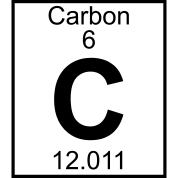
What does the 6 represent?
a)
atomic mass
b)
atomic number
c)
element name
d)
chemical symbol 
50.
What does the C represent?
a)
atomic mass
b)
atomic number
c)
element name
d)
chemical symbol 
51.
These are found on the Periodic Table.
a)
Compounds
b)
Elements
c)
Mixtures
52.
Which of the following is not a compound?
a)
HCl
b)
Cl
c)
NaCl
d)
CO2
53.
Salt water boils and the water completely evaporates, salt (NaCl) is left in the bottom of the beaker. Which of the following is left in the beaker?
a)
Compound
b)
Element
c)
Mixture
d)
None of the Above
54.
What cannot be broken down into other substances?
a)
Compound
b)
Mixture
c)
Solids
d)
Element
55.
Water (H2O) freezing is an example of:
a)
A chemical change
b)
A physical change
56.
The properties of the elements that make up a compound are usually very similar to the compound itself.
a)
True
b)
False
57.
You drop two Alka-Seltzer tablets in a glass of water and immediately see bubbles coming up through the water. They probably indicate:
a)
A change of color
b)
Formation of a gas
c)
A change in temperature
d)
Formation of a precipitate
58.
Element:Fe
a)
Gold
b)
Flourine
c)
Phosphorus
d)
Iron
59.
A change in which the form or shape of a substance changes but the chemical makeup of the substance remains the same.
a)
chemical change
b)
reaction
c)
physical change
d)
solution
60.
A scientific explanation of the structure of atoms and how they interact with other atoms.
a)
mixture
b)
compound
c)
atomic theory
d)
element
61.
Color, flexibility, texture and shape are examples of 
a)
physical properties
b)
solids 
c)
gases
d)
mixtures 
62.
Two objects are placed in water.  One sinks and the other floats.  Which conclusion can be drawn from this data?
a)
one object is magnetic and the other is not
b)
one object is solid and the other is a liquid
c)
one object has a greater density than the other
d)
one object is much larger than the other
63.
What is a property?
a)
Something that describes matter
b)
a definition
c)
the space matter takes up
d)
the weight of matter
64.
What are the physical properties of matter?
a)
color
b)
texture
c)
taste
d)
all of the above
65.
Which properties of marbles could help you to sort them out from a mixture of other objects? 
a)
shape
b)
density
c)
size
d)
all of the above
66.
True or false?   The density of an object determines whether it will float or sink in another substance. 
a)
true
b)
false
67.
The ability to burn is a ___ property.
a)
physical
b)
chemical
c)
conservitive
d)
reversed
68.
Physical or Chemical change:
Ice melts
a)
physical change
b)
chemical change
69.
Physical or Chemical change:
milk sours
a)
physical change
b)
chemical change
70.
Solubility (dissolves)
a)
Physical Proeprty
b)
Chemical Property