
 Worksheets
Thermal Energy
Total questions: 71
Worksheet time: 3hrs 7mins

___________________ is the measure of the average kinetic energy of particles.
A thermometer
Expansion
Farenheit
Temperature

What is happening in this picture of this lake freezing?
Molecules are speeding up
Molecules are slowing down

The diagram representing space and speed of these molecules matches which state of matter?
Solid
Liquid
Gas

The diagram representing space and speed of these molecules matches which state of matter?
Solid
Liquid
Gas

The diagram representing space and speed of these molecules matches which state of matter?
Solid
Liquid
Gas
Which phrase describes particle movement in a solid?
Particles can slip past one another
Particles move independently from one another
Particles vibrate within fixed positions
Which phrase describes particle movement in a liquid?
Particles move independently from one another
Particles can slip past one another
Particles vibrate within fixed positions
Which phrase describes particle movement in a gas?
Particles vibrate within fixed positions
Particles can slip past one another
Particles move independently from one another
When pressure is added to a substance what happens to the particles?
They get closer together
They do not move
The y get further apart
Which two changes of state can result from added pressure?
liquid to gas AND liquid to solid
gas to liquid AND liquid to solid
gas to liquid AND solid to liquid
liquid to gas AND solid to liquid
Melting point is the temperature at which a substance changes from
liquid to gas
solid to liquid
liquid to solid
gas to liquid
Boiling point is the temperature at which a substance changes from
gas to liquid
solid to liquid
liquid to solid
liquid to gas

Matter will change from one state to another if thermal energy is _______.
released
absorbed
all of the above
What is kinetic energy?
moving energy
potential energy
stored energy
renewable energy


Which Pictures represents particles in a gas?
Answer choices: 1, 2, 3
(a)
Which scenario would particles be moving the fastest?
a bottle of water with a temperature of 70 degrees
a pot of boiling water with a temperature of 200 degrees
a glass of water with a temperature of 60 degrees
a swimming pool with a temperature of 75 degrees

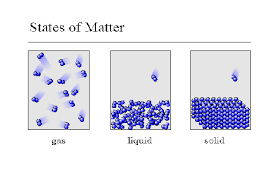
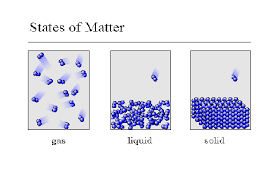
The energy from the vibration and motion of particles.
chemical
potential
thermal
interesting
Energy in motion is ____________ energy.
Potential
Energy
Kinetic
Friction
Which phrase describes particle movement in a solid?
Particles can slip past one another
Particles move independently from one another
Particles vibrate within fixed positions
Which phrase describes particle movement in a liquid?
Particles move independently from one another
Particles can slip past one another
Particles vibrate within fixed positions
Which phrase describes particle movement in a gas?
Particles vibrate within fixed positions
Particles can slip past one another
Particles move independently from one another

Heat transfers from an area of ________ temperature to an area of _______ temperature.
high to low
low to high
high to high
low to low
The sidewalk burns your bare feet in the summer time is an example of
Conduction
Convection
Radiation
Plasma
When molecules of a liquid or gas are heated up, they will
move slower and less
move faster and more
remain in the same state
become solid

Hector is standing in a closed room with a balloon filled with helium gas. If Hector pops this balloon, what will happen to the molecules in the helium gas?
They will condense into a cloud around Hector.
They will fall to the floor as a structured solid.
They will expand and flow through the room
They will flow to the floor and form a puddle.
In which state of matter will there be the LARGEST space between molecules?
Solid
Liquid
Gas
If particles are locked in place the substance is in a phase we call _____.
solid
liquid
gas
If particles are not locked in place and can slide past each other the substance is in a phase we call ____.
solid
liquid
gas
When you heat a sample of a solid, the particles that make up the solid
get bigger
lose mass
move faster
slow down
When you heat a sample of gas, what happens to the particles that make up the gas?
The particles move faster
The particles break apart
The particles get smaller
The particles become more dense
Which statement is true?
The quicker a molecule moves, the colder it is.
The quicker a molecule moves, the warmer it is
The slower a molecule moves, the warmer it is.
The movement on molecule don�t affect its temperature
Two objects at different temperatures are in contact. Which of the following happens to their thermal energy?
Their thermal energies remain the same.
Thermal energy passes from the cooler object to the warmer object
Thermal energy passes from the warmer object to the cooler object.
Thermal energy passes back and forth equally between the two objects.
In nature, heat always flows from a:
cold object to a warm object.
small object to a big object.
warm object to a cold object.
large object to a small object.
Heat is the movement of ______.
radiation
thermal energy
cold
fire
As the kinetic energy of the molecules in a substance increases, the temperature of the substance __________.
increases
decreases
Nothing happens
The measure of average kinetic energy of all the particles within an object is called ____________.
temperature
radiation
conduction
heat

Which direction is heat flowing in the picture?
heat is not being transferred
there is no way to tell
from the ice to the hand
from the hand to the ice
What tool do we use to measure temperature?
Thermometer
Ruler
Balance
Magnifying Glass
Why is there more thermal energy in an iceberg than in a pot of boiling water?
The pot insulates the heated molecules
Most icebergs are fairly warm to the touch
Icebergs contain many more molecules than pots of water
Water does not hold heat very well
___________________ is the type of heat transfer that occurs in fluids, such as warm air rising and cold air sinking; creating wind.
Convection
Conduction
Radiation
insulation.

