wayground logo

Free Printable Worksheets

NEW

Font size

S
M
L
XL
Worksheets

Science Review

Total questions: 75

Worksheet time: 1hrs 1mins

Name
Class
Date
1.
The word PHYSICAL PROPERTY means...
a)
Solid, Liquid, and Gas
b)
The way matter is described
c)
How much matter is in an object
d)
The ability to sink or float
2.
The word PHYSICAL STATE means...
a)
Solid, Liquid, and Gas
b)
Texas, Louisiana, and Georgia
c)
The way we describe matter
d)
The amount of matter in an object
3.
A CONDUCTOR is an object that...
a)
Lets thermal or electrical energy pass through easily
b)
Does not let thermal or electrical energy pass through easily
c)
Sinks to the bottom
d)
Dissolves in a substance 
4.
An INSULATOR is an object that...
a)
Lets thermal or electrical energy pass through easily
b)
Does not let thermal or electrical energy pass through easily
c)
Sinks to the bottom
d)
Dissolves in a substance 
5.
Mass is a property of ___________.
a)
waves
b)
energy
c)
matter
d)
light
6.
Volume is the amount of space an object takes up.
a)
True
b)
False
7.
A MIXTURE is....
a)
Two or more objects that keep their physical properties when combined
b)
Two or more objects that change their physical properties when combined
c)
One ingredient by itself
d)
When oil separates from water
8.
SOLUBILITY is when a substance....
a)
Has the ability to melt
b)
Has the ability to disappear 
c)
Has the ability to sink
d)
Has the ability to dissolve in water
9.
Something that takes up space and has mass.
a)
volume
b)
matter
c)
mass
d)
density
10.
A state of matter that has a definite volume and shape.
a)
solid
b)
liquid
c)
gas
d)
matter
11.
The amount of space something takes up
a)
density
b)
volume
c)
mass
d)
matter
12.
A watermelon has more matter than a grape, so it has more
a)
mass
b)
eat
c)
solid
d)
greater
13.
You can measure ______ with grams.
a)
mass
b)
volume
c)
conductivity
d)
melting point
14.
Solids have a definite _______________.
a)
smell
b)
shape
c)
picture
d)
sound
15.
Liquid matter takes the shape of _______.
a)
a gas
b)
water
c)
a pet
d)
Its container
16.
Water in its solid form is _____________.
a)
a vapor
b)
ice
c)
a liquid
d)
boiling
17.
The amount of matter something contains is its ______________.
a)
gas
b)
solid
c)
weight
d)
mass
18.
What is the measure of gravity on an object?
a)
matter
b)
mass
c)
weight
d)
volume
19.
The amount of space something takes up
a)
density
b)
volume
c)
mass
d)
matter
20.
Solids have a definite _______________.
a)
smell
b)
shape
c)
picture
d)
sound
21.
What are the three states of matter?
a)
solid, liquid, and gas
b)
solid, water, and gas
c)
wood, liquid, and gas
d)
solid, liquid, and helium
22.
________________ is anything that has mass and takes up space.
a)
volume
b)
matter
c)
mass
d)
weight
23.
What can causes ice to transform from a solid to a liquid?
a)
The air.
b)
The cold.
c)
Shape
d)
Heat
24.
This state of matter does not have a definite size or shape.
a)
gas
b)
toys
c)
solid
d)
milk
25.
What is an example of gas?
a)
crayons
b)
paper
c)
soda
d)
air
26.
What is an example of a solid?
a)
wind
b)
water
c)
rock
d)
juice
27.
The amount of matter something contains is its ______________.
a)
gas
b)
solid
c)
weight
d)
mass
28.
When a solid is turned into a liquid, the solid _______________.
a)
melts
b)
freezes
c)
turns into a gas
d)
floats
29.
Liquid matter takes the shape of _______.
a)
a gas
b)
water
c)
a pet
d)
Its container
30.
Safety is
a)
Not necessary
b)
sometimes important
c)
preventing injury, hurt or loss
31.
If something requires immediate action it is 
a)
worth slowing down
b)
not that important
c)
an emergency
32.
When mixing chemicals students should always wear
a)
hair bows
b)
goggles
c)
flip flops
33.
When using a hot plate a student needs to wear
a)
a ruler
b)
thick gloves
c)
a compass
34.
When using a hot plate a student needs to wear
a)
a ruler
b)
thick gloves
c)
a compass
35.
The FIRST thing a student should do in a science investigation is -
a)
read the steps of the investigation
b)
clean off the table
c)
get out safety equipment
36.
What do scientist do?
a)
ignore safety rules
b)
do NOT repeat their investigations
c)
affect the lives of humans through their scientific breakthroughs and inventions
37.
What can students clean up by themselves?
a)
dirt
b)
glass
c)
spilled chemicals
38.
Which tool measures the mass of an object?
a)
graduated cylinder
b)
triple beam balance
c)
meter stick
39.
When you finish working with chemicals, biological specimens, and other lab substances, always -
a)
treat your hands with skin lotion
b)
wash your hands thoroughly with soap and water
c)
wipe your hands on a towel
d)
wipe your hands on your clothes
40.
You have been injured in the laboratory (cut, burned, etc.). First you should
a)
visit the school nurse after class
b)
see a doctor after school
c)
tell the teacher at once
d)
apply first aid yourself
41.
After completing an experiment, all chemical wastes should be -
a)
left at your lab station for the next class
b)
disposed of according to your teacher's directions
c)
dumped in the sink
d)
taken home
42.
Never touch the eyewash or shower station unless it is a true emergency. 
a)
True
b)
False
43.
Part of lab safety includes reading the lab procedure -
a)
before doing the lab
b)
while doing the lab
c)
after doing the lab
d)
only if you think you really need it
44.
What is this symbol for?
a)
glove safety 
b)
apron safety
c)
clapping safety
d)
chemical safety 
45.
The lab room is an excellent place to
a)
Run around and play tag.
b)
Play a joke or prank on a fellow classmate
c)
Run an experiment.
d)
Have a snack
46.
When you walk in the room and see science equipment at your seat.  Which of the following is okay to do before your teacher starts the class or gives instructions.
a)
Don’t touch anything until your teacher tells you to.
b)
Move the science equipment out of your way so that you can set your stuff down
c)
Pick up the science equipment and see what it is for.
d)
If they are goggles pick them up and try them on to see if they fit.
47.
Which of the following should you do during a lab?
a)
Leave the lab a mess so the janitor has something to do.
b)
Pick up hot beakers with your bare hands
c)
Never eat or taste anything from an experiment.
d)
Wear goggles if you feel like it.
48.
If you accidentally break or spill something what is the first thing you should do?
a)
Pick it up and clean up after yourself.
b)
Shove it under the desk or in a cupboard to hide it so you don’t get in trouble.
c)
Tell your teacher and then ask how to clean it up
d)
Leave it where it is so that your teacher can clean it up after class.
49.
Which of the following can you do during a lab?
a)
wash your hands after the experiment is over
b)
touch your mouth after touching a dead worm
c)
touch and taste liquids
d)
pick up broken glass
50.
If you want to smell something in a lab what should you do?
a)
Put your nose next to the source and sniff
b)
Tasting it will make it easier to smell, so do both
c)
Hold the substance away from you and waft the smell towards you with your hand
d)
Ask your lab partner to put there nose in it first to see if it is safe.
51.
Safety goggles should be worn
a)
at all times in the lab
b)
at all times if you don't have glasses
c)
when liquids or small particles could get into your eyes
d)
at your own discretion
52.
After completing an experiment, all chemical wastes  should be
a)
taken home
b)
disposed of according to the teacher's instructions
c)
dumped in the sink
d)
left at your lab station for the next class
53.
When you are smelling a chemical, you should
a)
whiff
b)
waft
c)
take a deep breath
d)
smell it for as long as you can
54.
It is OK to start a lab before you read all the directions.
a)
True
b)
False
55.
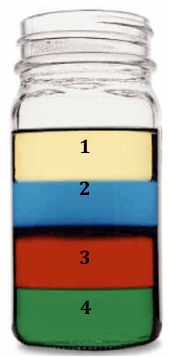
Put the liquids in order from most dense to least dense?
a)
4, 3, 2, 1
b)
1, 2, 3, 4
c)
3, 4, 2, 1, 
d)
4, 3, 1, 2
56.
A student knows the mass of an object. What other variable does the student need to know to calculate the object's density?
a)
Color
b)
Weight
c)
Volume
d)
Length
57.
How is Earth's magnetic field similar to that of a magnet?
a)
It is hundreds of miles long
b)
It has north and south poles
c)
It is made in Earth's core
d)
It is shaped like a horseshoe
58.
A description of objects that can be measured and observed.
a)
gas
b)
mustangs
c)
physical properties
d)
melting point
59.
A substance that resists change and holds it's shape.
a)
liquid
b)
solid
c)
water
d)
clouds
60.
Gas changing to a liquid that sometimes results in cloud formation.
a)
density
b)
gas
c)
evaporation
d)
condensation
61.

Which of these is a physical property of an object?

a)

Texture

b)

Color

c)

Shape

d)

All of the above

62.

What tool can be used to measure the temperature, or amount of heat, in an item?

a)

Balance Scale

b)

Thermometer

c)

Ruler

d)

Magnet

63.

Which of the following does NOT describe a liquid?

a)

Takes the shape of its container

b)

Definite volume

c)

Takes up all the space you give it

d)

Can flow

64.

What is the definition of classify?

a)

to sketch or write down

b)

to categorize or sort

c)

an object with a definite shape

d)

a characteristic of an item

65.

What is the definition of record?

a)

to sketch or write down

b)

to categorize or sort

c)

an object that has a definite shape

d)

a characteristic of an item

66.

Which of the following physical properties describe a pencil?

a)

long, wooden, yellow

b)

large, sphere, yellow

c)

soft, circular, sweet

d)

furry, soft, bendable

67.

In the illustration, which is an example of a liquid?

a)

the bubbles

b)

the straw

c)

the water

d)

the ice

68.

Which item would be attracted to a magnet?

a)

rubber band

b)

plastic bottle

c)

iron key

d)

pencil

69.

What temperature does the thermometer show?

a)

20 degrees

b)

25 degrees

c)

30 degrees

d)

35 degrees

70.
What is the mass on this triple beam?
a)
270g
b)
202g
c)
273g
71.
What is the mass on this triple beam?
a)
220g
b)
222g
c)
20g
72.
What is the mass on this triple beam?
a)
506g
b)
576g
c)
570g
73.
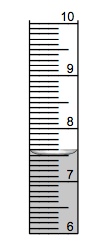
What is the volume of the liquid in this graduated cylinder?
a)
8.5 mL 
b)
7.5 mL 
c)
8 mL 
d)
.1 mL
74.
What is the volume of the liquid in this graduated cylinder?
a)
19 mL 
b)
35 mL 
c)
24 mL 
d)
1.9 mL
75.
What is the volume of the liquid in this graduated cylinder?
a)
43 mL 
b)
30.7 mL 
c)
37 mL 
d)
38 mL