
NEW
Font size
 Worksheets
Biochemistry U2 Review
Total questions: 45
Worksheet time: 25mins
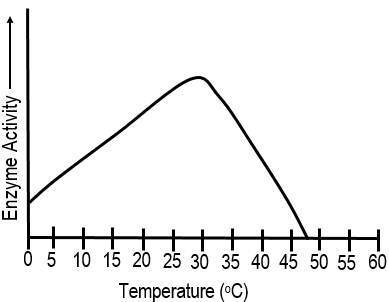
Based on the graph, what temperature does this enzyme work best?
15 C
40 C
30 C
50 C
What happens when enzymes are heated to a very high temperature?
The enzymes die.
The shapes of the enzyme are altered or denatured
The enzymes' amino acid sequence changes.
The enzymes remain the same
Carbohydrates are more easily metabolized than lipids. However, lipids provide cells with more _______ per gram.
nitrogen
proteins
structure
energy
Enzymes belong to which class of macromolecules?
lipids
carbohydrates
proteins
nucleic acids
Sugar belongs to which class of macromolecules?
proteins
lipids
nucleic acids
carbohydrates
Which macromolecule is found in grains, starches, and vegetables?
Polysaccharides
Lipids
Monosaccharides
Proteins
Butter, lard and vegetable oil are examples of what macromolecule?
Protein
Nucleic acid
Lipid
Carbohydrate
Table sugar, honey, and fruit juice are examples of what macromolecules?
Polysaccharides
Simple carbohydrates
Lipid
Protein
Almonds, chicken, and beef are foods that are high in what macromolecule?
Lipid
Nucleic acid
Carbohydrate
Protein

What is the primary function of carbohydrates in your body?
Speed up chemical reactions.
Give quick energy.
Help to store energy.
Build cell walls in plants.

How many servings are in this container?
1
8
2/3
55

What is the chemical symbol for the element Sodium?
(Also know the others in Part 1 notes!)
So
Na
NA
S
A calorie is officially defined as the amount of energy it takes to raise the _______ of 1 gram of water by 1 degree
Celsius,
temperature
volume
mass
elevation
An atom with 14 protons and 17 electrons will have a net charge of:
-3
+3
+14
-17
Which of these is an example of an ELEMENT?
Sodium hydroxide
catalase
HCl
Na
One molecule of glucose (C6H12O6) includes a combined total of ____ atoms.
12
6
24
18
What includes the protons and the neutrons?
Atomic number
Atomic mass
Ionic charge
Atomic wedgie
Which element makes a compound "organic" and can make up to 4 bonds?
Carbon
Calcium
Oxygen
Hydrogen
Which of these is NOT a property of water?
Has a high heat capacity
Contracts as it freezes
Adhesion and cohesion
A good solvent
If a solution has a pH of 2, what is it?
Acidic
Basic
Buffer
Neutral
Which of these is a polymer?
Monosaccharide
Polysaccharide
Nucleotide
Nucleic Acid
Hair, nail, muscle, blood, and skin cells all have high levels of...
Protein
Lipids
Polysaccharides
Monosaccharides
Which of these would NOT be a carb?
FructOSE
LactASE
GalactOSE
SucrOSE
Which shows a positive test for polysaccharides?
Iodine turns dark blue
Biuret solution turns purple
Benedicts solution turns orange
Sudan III turns red
Which shows a positive test for monosaccharides?
Iodine turns dark blue
Biuret solution turns purple
Benedicts solution turns orange
Sudan III turns red
Which type of fats are healthier for you to eat?
Saturated fats
Unsaturated fats
Hydrogenated or trans fats
Ones that are solid at room temperature
The average person's diet should include about...
1000 Cal (more if active, less if trying to lose weight)
2000 Cal (more if active, less if trying to lose weight)
1000 Cal (less if active, more if trying to lose weight)
2000 Cal (less if active, more if trying to lose weight)
Chemically breaking down food into smaller molecules that the body can absorb & use is called...
digestion
homeostasis
evolution
synthesis

