wayground logo

Free Printable Worksheets

Font size

S
M
L
XL
Worksheets

Unit 3b Energy Flow Review

Total questions: 62

Worksheet time: 1hrs 5mins

Name
Class
Date
1.
a system of food chains that shows the transfer of energy  is termed
a)
food web
b)
food chain
c)
prey
d)
predator
2.
an organism that can produce its own food through photosynthesis
a)
consumer
b)
heterotroph
c)
autotroph
d)
herbivore
3.
Consumer that eats plants
a)
heterotroph
b)
herbivore
c)
producer
d)
community
4.
Energy increases as you move up the food pyramid (from bottom to top).
a)
True 
b)
False
5.

What percentage of energy is passed on to each trophic level?

a)

10%

b)

50%

c)

90%

d)

100%

6.
An organism that gets energy from eating dead organisms, non-living material or waste
a)
producer
b)
consumer
c)
decomposer
7.
An animal that gets energy from eating both plants and animals is a 
a)
herbivore
b)
carnivore
c)
omnivore
8.

The shrew provides energy for the _______?

a)

cricket

b)

grasshopper

c)

frog

d)

snake

9.
Which of the following is a herbivore?
a)
cricket
b)
frog
c)
hawk
d)
shrew
10.
____________________ provides the energy necessary for photosynthesis.
a)
water
b)
sunlight
c)
glucose
d)
soil
11.
the products of photosynthesis are...
a)
glucose and sunlight
b)
carbon dioxide and water
c)
glucose and chlorophyll
d)
oxygen and glucose
12.
Glucose is a ...
a)
sugar
b)
carbohydrate
c)
source of quick energy
d)
all are correct
13.
The formula for glucose is...
a)
C12 H22 O11
b)
NaCl
c)
NaOH
d)
C6 H12 O6
14.
This is ...
a)
mitochondria
b)
chloroplast
c)
cell
d)
phloem
15.
The reactant of photosynthesis are...
a)
sunlight and chlorophyll
b)
glucose and oxygen
c)
carbon dioxide and water
d)
sunlight and water
16.

Select all that are products of Photosynthesis.

a)

Water

b)

Carbon Dioxide

c)

Oxygen

d)

Sunlight (Light Energy)

e)

Glucose (Sugar/food)

17.

Select all that are raw materials for Photosynthesis.

a)

Water

b)

Carbon Dioxide

c)

Oxygen

d)

Sunlight (Light Energy)

e)

Glucose (Sugar/food)

18.

What is the green pigment that "traps" sunlight?

a)

Chlorophyll

b)

Chloroplasts

c)

Photosynthesis

d)

ATP

19.
Which of the following statement is true regarding photosynthesis
a)
creates oxygen for animals to breath
b)
creates energy for consumers to use
c)
creates food for plants to use
d)
all of these are correct
20.

What are the reactants of cellular respiration?

a)

energy

b)

glucose

c)

carbon dioxide

d)

water

21.
______________ produces the most ATP.
a)
photosnthesis
b)
aerobic respiration
c)
anaerobic respiration
d)
glycolysis
22.
Where does glycolysis take place?
a)
Cytoplasm
b)
Stroma
c)
Thylakoid
d)
Mitochondria
23.
What is the name of the 1st step of cellular respiration?
a)
Glycolysis
b)
Kreb's Cycle
c)
ETC
d)
Anaerobic respiration
24.
Where does aerobic respiration take place?
a)
Cytoplasm
b)
Mitochondria
c)
Stroma
d)
Thylakoid
25.
What is the net gain of ATP during glycolysis?
a)
1
b)
2
c)
4
d)
34
26.
Which type of respiration occurs in the presence of oxygen?
a)
Aerobic
b)
Anaerobic
27.
Which type of respiration occurs without the presence of oxygen?
a)
Aerobic 
b)
Anaerobic 
28.
What are the two reactants of cellular respiration?
a)
C6H12O6 & 6CO2
b)
6 CO2 & 6H2O
c)
C6H12O& 6O2
d)
6CO2 & 6O2
29.
Glucose is broken down during which process?
a)
Calvin cycle
b)
Glycolysis
c)
Krebs Cycle
d)
Photosynthesis 
30.
Along with 2ATP, what is produced during glycolysis?
a)
6CO2
b)
6O2
c)
C6H12O6
d)
2 pyruvate
31.
Which is a product of Kreb's Cycle?
a)
Carbon dioxide
b)
Glucose
c)
Pyruvate
d)
Water
32.
Which is a product of the ETC?
a)
Carbon dioxide
b)
Glucose
c)
Oxygen
d)
Water
33.
What is the name of the process that helps make beer and wine?
a)
Fermentation
b)
Alcoholic fermentation
c)
Lactic acid fermentation
d)
Glycolysis
34.
Which type of fermentation occurs in muscles?
a)
Alcoholic 
b)
Lactic acid
35.
In which way are photosynthesis and cellular respiration different?
a)
Cellular respiration stores ATP, while photosynthesis releases ATP.
b)
Cellular respiration produces oxygen, while photosynthesis uses oxygen.
c)
Photosynthesis releases energy, while cellular respiration stores energy.
d)
Photosynthesis used carbon dioxide, while cellular respiration produces carbon dioxide.
36.
What is the correct equation for cellular respiration?
a)
6O2 + C6H12O6 -> 6CO2 + 6H2O + Energy
b)
6O2 + C6H12O6 + Energy -> 6CO2 + 6H2O
c)
6CO2 + 6H2O -> 6O2 + C6H12O6 + Energy
d)
6CO2 + 6H2O + Energy -> 6O2 + C6H12O6
37.

What are the reactants in cellular respiration?

a)

glucose and oxygen

b)

glucose and carbon dioxide

c)

water and carbon dioxide

d)

water and glucose

38.
What are the products in cellular respiration?
a)
water and carbon dioxide
b)
water and glucose
c)
carbon dioxide and oxygen
d)
glucose and oxygen
39.

How can energy from the sun be transferred to animals?

a)

The sun's energy is transformed into food by plants, animals eat plants as food so that they can transform that food into energy.

b)

Plants produced energy through photosynthesis, animals that eat that energy can produce food.

c)

Plants transformed energy of the sun into gases that animals can breath in to use as energy through respiration.

d)

Animals are able to use energy from the sun by eating the plants that provides energy for the animals.

40.

Where does the Light-Dependent Reaction occur?

a)

Grana/Thylakoid Membrane

b)

Stroma

c)

Mitochondrial Matrix

d)

Inner Mitochondrial Membrane

41.

Where does the Light-Independent Reaction occur?

a)

Grana/Thylakoid Membrane

b)

Stroma

c)

Mitochondrial Matrix

d)

Inner Mitochondrial Membrane

42.

Where does the Kreb's Cycle occur?

a)

Grana/Thylakoid Membrane

b)

Stroma

c)

Mitochondrial Matrix

d)

Inner Mitochondrial Membrane

43.

Where does the Electron Transport Chain occur?

a)

Grana/Thylakoid Membrane

b)

Stroma

c)

Mitochondrial Matrix

d)

Inner Mitochondrial Membrane

44.

What is made in the Light-Dependent reaction that is used in the Light-Independent reaction?

a)

ATP

b)

NADPH

c)

H2O

d)

O2

e)

Glucose

45.

How many ATP molecules are made in the Kreb's Cycle?

a)

1

b)

2

c)

15

d)

34

46.

How many ATP molecules are made in the ETC?

a)

1

b)

2

c)

15

d)

34

47.

What are the products of Alcohol Fermentation?

a)

Alchohol

b)

CO2

c)

ATP

d)

Lactic Acid

48.

What are the products of Lactic Acid Fermentation?

a)

Alchohol

b)

CO2

c)

ATP

d)

Lactic Acid

49.

What percentage of energy is lost at each trophic level?

a)

10%

b)

50%

c)

90%

d)

100%

50.
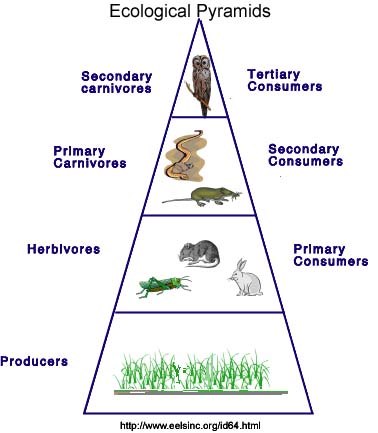
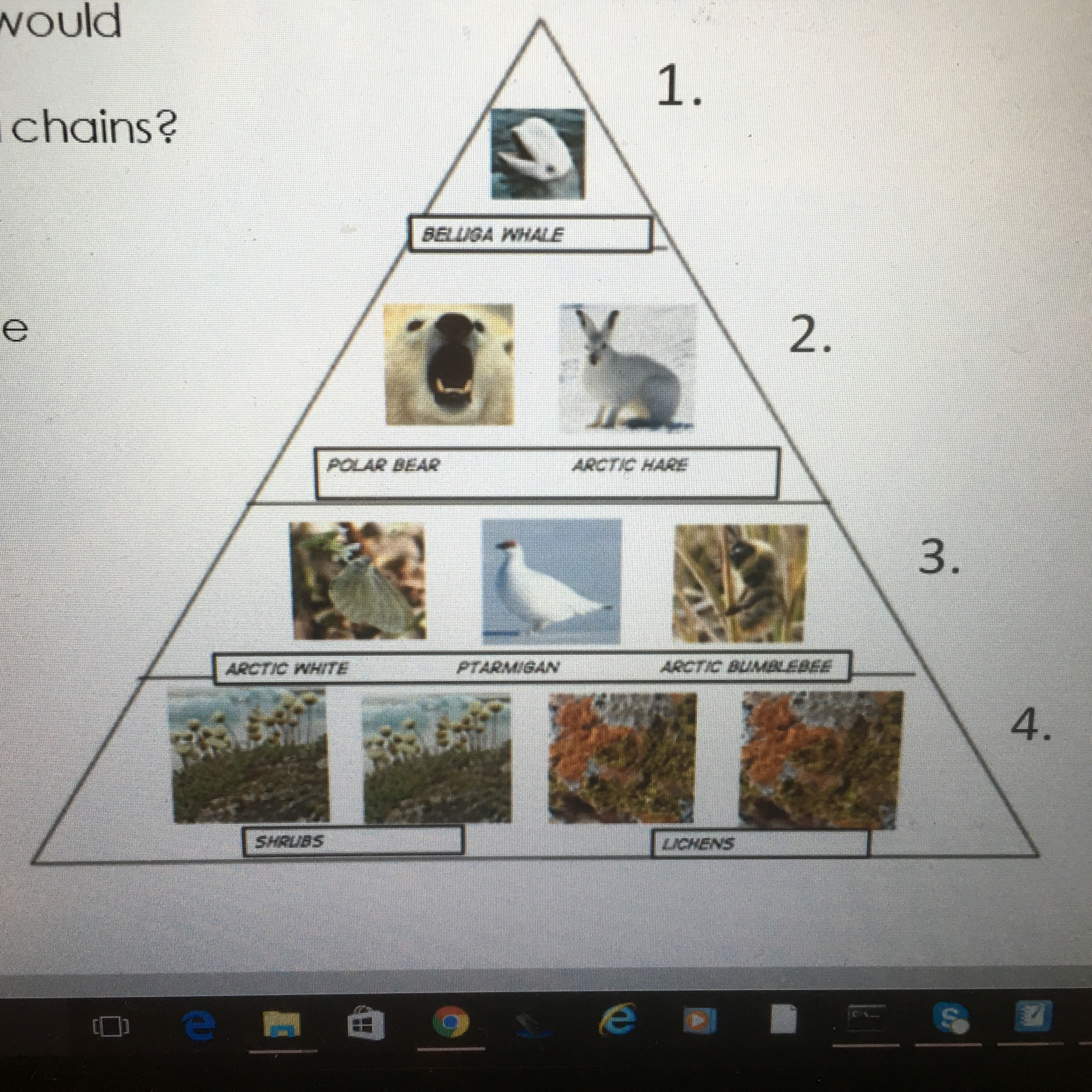
In the energy pyramid here, how much of the energy in each level gets lost as heat or used by the organism for survival?
a)
80%
b)
90%
c)
10%
d)
20%
51.
In the energy pyramid here, which organisms have the most energy available?
a)
Producers
b)
Carnivores
c)
Herbivores
d)
Top Predator
52.
In the energy pyramid below, which organism has the least amount of energy available?
a)
Producers
b)
Herbivores
c)
Carnivores
d)
Top Predator
53.
If there is 1000 Kcal available in the producers in trophic level 1, how much energy is available in the herbivores in trophic level 2?
a)
10 Kcal
b)
1 Kcal
c)
100 Kcal
d)
1000 Kcal
54.
The diagram represents a pyramid of energy in an ecosystem.  Which level would most likely contain members of the plant kingdom?
a)
A
b)
B
c)
C
d)
D
55.
Which organism recieves the least amount of energy from the producer?
a)
Owl
b)
Grasshopper
c)
Lilypad
d)
Mouse
56.
The largest group of organisms found in a food web would be:
a)
Primary Consumers
b)
Producers
c)
Decomposers
d)
Tertiary Consumers
57.
A third-level consumer has to be which type?
a)
Carnivore.
b)
Decomposer.
c)
Producer.
d)
Herbivore.
58.
A secondary consumer 
a)
eats primary consumers
b)
eats producers
c)
eats plants
59.

Which trophic level is the Primary consumer?

a)

1

b)

2

c)

3

d)

4

60.

Eats dead organisms and returns nutrients to soil

a)

Autotroph

b)

Decomposer

c)

Biomass

d)

Carnivore

61.
All the organisms on earth get their energy directly or indirectly from?
a)
Oxygen
b)
Water 
c)
Nitrogen
d)
The Sun
62.

Which organisms do photosynthesis to receive energy to make food?

a)

Plants

b)

Animals

c)

Bacteria