wayground logo

Free Printable Worksheets

NEW

Font size

S
M
L
XL
Worksheets

Unit 8 Exam Prep: Classification, Bacteria & Viruses

Total questions: 64

Worksheet time: 43mins

Name
Class
Date
1.

Which is more closely related?

a)

Lamprey and tiger

b)

Gorilla and Human

c)

Salamander and Tiger

d)

Shark and Lizard

2.

According to this cladogram, sharks are MOST closely related to which organism?

a)

Amphibians

b)

Ray-Finned Fish

c)

Primates

d)

Birds

3.

Which trait do only humans have, according to the cladogram?

a)

Bipedal and Opposable Thumbs

b)

jaws

c)

tetrapod

d)

terrestrial during all life stages

4.

Individuals that are well adapted to their environment will survive and produce:

a)

more offspring

b)

better traits

c)

stronger genes

d)

fewer mutations

5.

You look at two species and see very similar DNA. What does this likely tell you?

a)

These are the same animal.

b)

These animals are not likely related.

c)

These animals have a common ancestor.

d)

These animals are likely becoming one species.

6.

What number is the common ancestor of C and D

a)

1

b)

2

c)

3

d)

4

7.

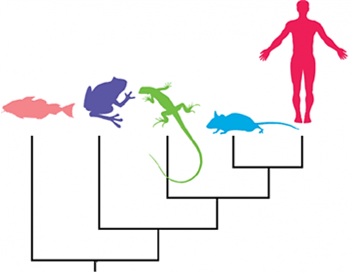
According to this phylogenetic tree, which creature is the least related out of all pictured?

a)

Fish

b)

Frog

c)

Salamander

d)

Human

8.

Who is most closely related to Taxidea taxus?

a)

Lutra lutra

b)

Panthera pardus

c)

Canis latrans

d)

Canis lupus

9.

Which group of animals on this tree are most closely related to birds?

a)

Saurischian dinosaurs

b)

Ornithischian dinosaurs

c)

Crocodiles

d)

None of these are related to birds

10.
What is the genus name here:
Canis lupus
a)
Canis
b)
lupus
11.

The correct order of classification from the most GENERAL group to the most narrow is:

a)

Species, Genus, Family, Order, Class, Phylum, Kingdom

b)

Kingdom, Phylum, Class, Family, Order, Genus, Species

c)

Kingdom, Family, Order, Phylum, Class, Genus, Species

d)

Kingdom, Phylum, Class, Order, Family, Genus, Species

12.
Which domain is capable of living in extreme environments like hot springs, geysers, or very salty waters?
a)
Bacteria
b)
Archaea
c)
Eukarya
13.
Which kingdoms have some organisms that can make their own food (autotrophic)?
a)
Plantae and Animalia
b)
Fungi and Plantae
c)
Protista and Plantae
14.
Organisms whose cells have NO nucleus are classified as...
a)
Eukaryotic
b)
Prokaryotic
c)
Dead
15.
What taxa are in a scientific name?
a)
Genus and Kingdom
b)
Species and Family 
c)
Species and Class
d)
Genus and Species
16.
Which kingdom contains only multicellular autotrophs?
a)
fungi
b)
plant
c)
animal
d)
protist
17.
What do plants and fungi have in common?
a)
They are both autotrophic
b)
They are both unicellular
c)
They both have cell walls
d)
They both are prokaryotes 
18.
What statement would NOT be good for a dichotomous key?
a)
The organism has 1 dorsal fin
b)
The organism is ugly
c)
The organism has leaves in groups of three
d)
The organism has 6 legs
19.
An organism that gets its food by consuming other organisms is known as a:
a)
heterotroph
b)
autotroph
c)
prokaryote
d)
eukaryote
20.
Which characteristics best describes the Plant Kingdom?
a)
unicellular; eukaryote; autotroph
b)
multicellular, prokaryote, autotroph
c)
multicellular, eukaryote, autotroph
d)
unicellular, prokaryote, heterotroph
21.
Which characteristics best describes the Animal Kingdom?
a)
unicellular, eukaryote, autotroph
b)
multicellular, prokaryote, heterotroph
c)
multicellular, eukaryote, autotroph
d)
multicellular, eukaryote, heterotroph
22.
Which characteristics best describe the Kingdom Protista?
a)
multicellular, eukaryote, heterotroph and autotroph
b)
multicellular and unicellular, heterotoph and autotroph, eukaryote
c)
unicellular, autotroph, prokaryote
d)
multicellular and unicellular, prokaryote, heterotroph
23.
Which characteristics best describe the Kingdom Fungi?
a)
multicellular and unicellular, eukaryote, autotroph
b)
multicellular and unicellular, prokaryote, heterotroph
c)
multicellular, eukaryote, heterotoph
d)
multicellular and unicellular, eukaryote, heterotroph
24.
Which characteristics best describes the Kingdoms Eubacteria and Archaebacteria?
a)
unicellular, prokaryote, heterotroph
b)
unicellular, prokaryote, heterotroph and autotroph
c)
multicellular, eukaryote, autotroph
d)
multicellular, prokaryote, heterotroph and autotroph
25.
Use the dichotomous key above to classify the unknown organism in the picture
a)
Kentuckyus
b)
Californius
c)
WalaWala
d)
Beverlus
26.
The 2-part naming system developed by Linneus is known as:
a)
dichotomous key
b)
taxonomy
c)
binomial nomenclature
d)
classification
27.
A person with AIDS is likely to develop infectious diseases because the virus that causes AIDS
a)
destroys cancerous cells
b)
damages the immune system
c)
increases the rate of antibody production
d)
increases the rate of microbe destruction
28.
To what would the phrase "is not a cell but has the ability to reproduce within a living cell" best describe?
a)
an alga
b)
a yeast
c)
a bacterium
d)
a virus
29.
What do viruses need to reproduce?
a)
they need genetic material
b)
They need a host cell
c)
They need  bacteria
d)
They need insulin
30.
How does a virus cause a person to develop the common cold?
a)
invades the host cell to reproduce
b)
removes energy from the host cell
c)
produces toxins in the host cell
d)
protects the host cell from bacteria
31.
A(n) _____ is a virus that enters a bacterial cell.
a)
endospore
b)
decomposer
c)
plasmid
d)
bacteriophage
32.
What part of the phage is the DNA?
a)
A
b)
B
c)
C
d)
D
33.
Which viral life cycle kills its host cell by lysing?
a)
lytic
b)
mitosis
c)
lysogenic
d)
S phase
34.
Which viral life cycle allows viral genetic material to lay dormant while the host cell reproduces?
a)
lytic
b)
mitosis
c)
lysogenic
d)
S phase
35.
Antibiotics kill viruses
a)
True
b)
False
36.
Antibiotics can cure infections caused by
a)
viruses
b)
bacteria
c)
viruses or bacteria
d)
anything
37.
Vaccines are made from
a)
dead or weakened viruses
b)
fungi
c)
allergens
d)
strong, active viruses
38.
A vaccine makes people immune to a disease by causing their bodies to make
a)
bacteria
b)
virus-fighting antibodies
c)
antibiotics 
d)
more protective skin cells
39.

What shape are these bacteria?

a)

cocci

b)

bacili

c)

spirilla

d)

linguine

40.

What shape are these bacteria?

a)

cocci

b)

bacilli

c)

spirilla

d)

fusilli

41.

What shape are these bacteria?

a)

cocci

b)

bacilli

c)

spirilla

d)

tortellini

42.

Cells that lack membrane bound organelles such a nucleus are called

a)

prokaryotic

b)

eukaryotic

43.

Type of medicine used to kill bacterial infections.

a)

vaccine

b)

antibiotics

c)

pasteurization

d)

vitamins

44.

Bacteria are single-celled microscopic organisms

a)

true

b)

false

45.

Which of the following is a true statement about bacteria?

a)

Bacteria exist in only a few environments on earth

b)

Bacteria can grow to extremely large sizes

c)

Most bacteria are harmful to humans

d)

Bacteria can be both harmful and helpful to humans

46.
Cyanobacteria are
a)
eubacterial heterotrophs
b)
photosynthetic autotrophs
c)
self-loving archaebacteria
d)
chemosynthetic autotrops
47.
Process by which bacteria reproduce asexually
a)
binary fission
b)
transduction
c)
transformation
d)
conjugation
48.
simple form of sexual reproduction
a)
budding
b)
binary fission
c)
conjugation
d)
replication
49.
Which of the structures is NOT found in bacteria?
a)
ribosome
b)
cell membrane
c)
cytoplasm
d)
nuclear membrane
50.
Besides DNA or RNA, what else is a virus made of?
a)
a cell wall
b)
a cell membrane
c)
a protein coat
d)
a lipid coat
51.
Scientists classify viruses as nonliving.
a)
True
b)
False
52.
Archea differ from Bacteria in that the cell wall 
a)
contains peptidoglycan
b)
contains lipids
c)
contains oxygen
d)
contains nitrogen
53.
All bacteria have DNA. 
a)
true
b)
false
54.

Layer outside the cell membrane that gives the bacterial cell a solid shape.

a)

Cytoplasm

b)

Cell wall

c)

Plasma membrane

d)

Pilli

55.
DNA is a single strand and circular in shape
a)
Prokaryote
b)
Eukaryote
56.

Archaebacteria have cell walls made out of Peptidoglycan

a)

True

b)

False

57.

Eubacteria cell walls are made out of ______.

a)

Chitin

b)

Cellulose

c)

Peptidoglycan

d)

Glucose

58.
What is a way to become immune to a disease without first having the disease?
a)
antibiotics
b)
Anti-retroviral drugs
c)
Vaccinations
d)
Exposure Therapies
59.
Which of the following occurs after a virus attaches to a host cell in the viral reproduction process?
a)
The host cell dies
b)
The virus dies
c)
The virus inserts its genetic information into the host cell
d)
copies of the virus are immediately released from the host
60.
What is the 1st step of virus infection?
a)
Entry
b)
Attachment
c)
Replication
d)
Assembly
61.
The lysing of a cell occurs in which phase?
a)
1
b)
2
c)
4
d)
5
62.

Host DNA is compromised and viral DNA takes over in which phase?

a)

1

b)

2

c)

3

d)

4

63.
Which of the following systems protects the body from disease?
a)
Digestive System
b)
Nervous System
c)
Immune System
d)
Skeletal System
64.
Compared to bacteria, viruses are much...
a)
smaller. 
b)
larger. 
c)
the same.