
 Worksheets
Blood Review
Total questions: 62
Worksheet time: 47mins
Name
Class
Date
1.
Which of the following is NOT one of the functions blood?
a)
Transport gas, nutrients, waste, & processed molecules
b)
Transport hormones & enzymes
c)
Homeostasis of pH, body temperature, & osmoregulation
d)
Blood cells go through cell division to create more blood cells
2.
The extracellular liquid matrix of blood is called
a)
plasma
b)
erythrocytes
c)
buffy coat
d)
lympocytes
3.
Which of the following matching terms are correct concerning red blood cells (RBCs) and white blood cells (WBCs)?
a)
RBCs = leukocytes & WBCs = erythrocytes
b)
RBCs = erythrocytes & WBCs = leukocytes
c)
RBCs = formed elements & WBCs = plasma
d)
RBCs = blood cells & WBCs = immune cells
4.
Which of the following is not a plasma protein?
a)
albumins
b)
platelets
c)
globulins
d)
fibrogen
5.
Which blood cells are most abundant in the body?
a)
erythrocytes
b)
platelets
c)
lymphocytes
d)
eosinophils
6.
Low levels of oxygen in the blood stimulate the kidneys to release the hormone ______ (increase RBCs production)
a)
erythropoietin
b)
adrenalin
c)
insulin
d)
epinephrine
7.
Where does hematopoiesis take place, producing new RBCs?
a)
red bone marrow
b)
yellow bone marrow
c)
synovial membrane
d)
articular cartilage
8.
Antibodies binding to antigens on RBCs causes a clumping known as __________
a)
agglutination
b)
coagulation
c)
clotting cascade
d)
hemolysis
9.
About 91% of blood plasma is
a)
Solutes
b)
Proteins
c)
Red blood cells
d)
Water
10.
Which of the following plasma protein is incorrectly matched with its function?
a)
globulins - immune defense
b)
albumins - osmotic pressure
c)
fibrinogen - release chemicals to fight infections
11.
Which leukocyte produces antibodies?
a)
lymphocytes
b)
monocytes
c)
eosinophils
d)
basophils
12.
Cell fragments that form from the rupture of a megakaryocyte are called ______
a)
platelets
b)
erythrocytes
c)
leukocytes
d)
plasma
13.
What part of blood is responsible for clotting blood?
a)
Red Blood Cells
b)
White Blood Cells
c)
Platelets
d)
Plasma
14.
Plasma protein important for blood clotting
a)
fibrinogen
b)
albumin
c)
globulin
d)
heoglobin
15.
What part of blood is responsible for carrying oxygen and carbon dioxide to body cells?
a)
Red Blood Cells
b)
White Blood Cells
c)
Platelets
d)
Plasma
16.
Platelets are also known as
a)
leukocytes
b)
erthryocytes
c)
thrombocytes
d)
monocytes
17.
Formation of blood cells from stem cells
a)
hemoglobin
b)
hematocrit
c)
hemostasis
d)
hematopoeisis
18.
What antigen(s) does A- blood have?
a)
Antigen A
b)
Antigen B
c)
Antigen Rh
d)
Antigen A and Rh
19.
If blood has Antigen B and the Rh antigen what is its blood type?
a)
A-
b)
B-
c)
B+
d)
O-
20.
What blood type has no antigens?
a)
O+
b)
O-
c)
AB+
d)
AB-
21.
What blood type has the Rh Antigen, the A Antigen, and the B Antigen?
a)
O-
b)
A+
c)
AB-
d)
AB+
22.
Someone with type A+ blood has which antibodies?
a)
Anti-A
b)
Anti-B
c)
Anti-Rh
d)
No antibodies
23.
Which of the following blood types could an individual with A- receive blood from?
a)
O+
b)
A+
c)
B-
d)
O-
24.
A person who is type A+ can receive blood from someone who is A-
a)
True
b)
False
25.
A person who is type AB- can receive blood from a person type AB+
a)
True
b)
False
26.
Which of the following blood types can B- donate to?
a)
AB+
b)
A-
c)
O-
d)
O+
27.
Which blood type is also known as the universal recipient?
a)
O-
b)
O+
c)
AB+
d)
AB-
28.
What is the main job of an erythrocyte?
a)
Build Proteins
b)
Clot Blood
c)
Fight Bacteria
d)
Carry Gasses
29.
Which of the following cells in the blood contains a nucleus?
a)
Erythrocyte
b)
Leukocyte
c)
Platelet
d)
All of these
30.
These blood cells protect the body against bacteria and viruses
a)
Erythrocytes
b)
Leukocytes
c)
Plasma
d)
Platelets
31.
Negative blood types can DONATE to what types of blood?
a)
Negative, only
b)
Positive, only
c)
Both Negative and Positive
32.
What is found on hemoglobin that helps oxygen gas attach and be carried on the Red Blood Cells?
a)
Iron (Fe)
b)
Magnesium (Mg)
c)
Sodium (Na)
d)
Calcium (Ca)
33.
After blood leaves the right atrium it passes through the ________.
a)
right ventricle
b)
aortic valve
c)
av valve
d)
tricuspid valve
34.
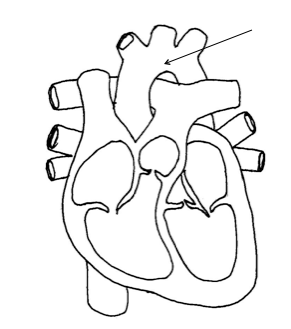
Name the part.
a)
Pulmonary vein
b)
Right atrium
c)
Aorta
d)
Pulmonary artery
35.
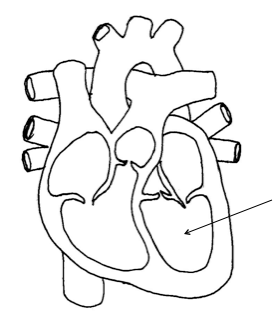
Name the part.
a)
Left ventricle
b)
Vena cava
c)
Right atrium
d)
Right ventricle
36.
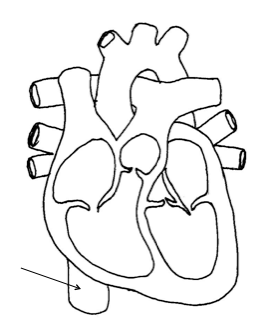
Name this part.
a)
Superior vena cava
b)
Right ventricle
c)
Inferior vena cava
d)
Pulmonary vein
37.
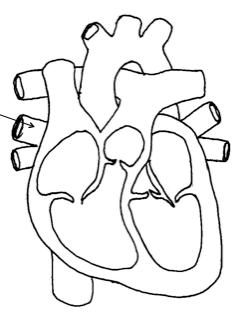
Name this part.
a)
Pulmonary veins
b)
Left atrium
c)
Aorta
d)
Pulmonary artery
38.
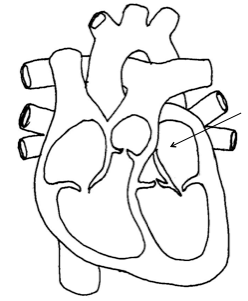
Name this part.
a)
Right atrium
b)
Left ventricle
c)
Right ventricle
d)
Left atrium
39.

Name this part.
a)
Left ventricle
b)
Pulmonary artery
c)
Right atrium
d)
Pulmonary veins
40.
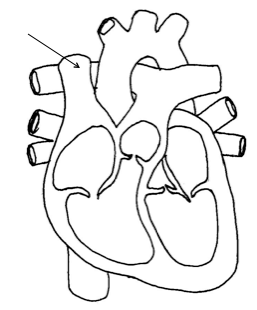
Name this part.
a)
Superior vena cava
b)
Right ventricle
c)
Right atrium
d)
Inferior vena cava
41.
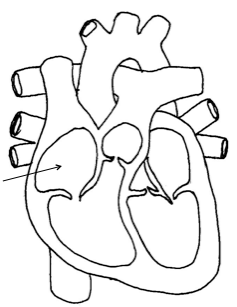
Name this part.
a)
Right ventricle
b)
Aorta
c)
Right atrium
d)
Atrium
42.

Name this part.
a)
Right ventricle
b)
Pulmonary artery
c)
Left ventricle
d)
Right atrium
43.
Which side of the heart pumps oxygen-rich blood to the rest of the body?
a)
Right
b)
Left
44.
Which side of the heart pumps blood into the lungs?
a)
Right
b)
Left
45.
______ carry blood to the heart.
a)
Arteries
b)
Veins
c)
Capillaries
d)
Vena Cava
46.
_____ carries blood away from the heart.
a)
Blood cells
b)
Veins
c)
Capillaries
d)
Arteries
47.
How many chambers are in the heart?
a)
1
b)
2
c)
3
d)
4
48.
How many valves are in the heart?
a)
4
b)
3
c)
2
d)
1
49.
The largest artery in the body is called the...
a)
pulmonary artery
b)
jugular artery
c)
carotid artery
d)
aorta
50.
The right side of the heart contains ________ blood
a)
deoxygenated blood
b)
oxygenated blood
c)
RBCs
d)
poor
51.
During atrial contraction and ventricular filling,
a)
the AV valves are open
b)
the semilunar valves are open
c)
the ventricles are contracted
d)
the atria are relaxed
52.
The semilunar valves are only open during which phase
a)
atrial contraction and ventricular filling
b)
isovolumetric contraction
c)
ventricular ejection
d)
isovolumetric relaxation
53.
What is the definition of the Cardiac Cycle?
a)
the contraction of the atria
b)
the sequence of events that occur during one complete heartbeat
c)
the contraction and relaxation of the ventricles
d)
the circulation of blood in the heart
54.

Which letter/s of the ECG shows the ventricles contracting.....
a)
P
b)
QRS
c)
ST
55.
The pacemaker of the heart is also known as the....
a)
AV node
b)
SA node
c)
Purkinje fibres
d)
Bundle of His
56.
What fibres allow the ventricles to contract?
a)
SA
b)
AV
c)
Purkinje
d)
Bundle of His
57.
During the systole phase of the cardiac cycle, the ventricles....
a)
Contract
b)
Relax
58.

A flap of tissue that prevents blood from flowing backward
a)
Aorta
b)
Atrium
c)
Septum
d)
Valve
59.

The Purkinje fibers are located at...
a)
F
b)
G
c)
H
d)
I
60.

The AV node is located at...
a)
A
b)
B
c)
C
d)
D
61.
An electrocardiogram measures what?
a)
The amount of pressure exerted on blood vessels.
b)
The electrical activity of the heart.
c)
How many times the heart contracts over time.
d)
The body's temperature caused by friction of blood in vessel.
62.

What is going on in the heart during the T-wave?
a)
SA node triggers depolarization in atria
b)
AV node triggers depolarization in ventricle, the main pumpung action
c)
Delay caused by the SA node
d)
Repolarization of the ventricle
100 %

