wayground logo

Free Printable Worksheets

NEW

Font size

S
M
L
XL
Worksheets

Marine Unit 1

Total questions: 66

Worksheet time: 57mins

Name
Class
Date
1.

The idea that all the major oceans are connected

a)

Marine Science

b)

Biosynthesis

c)

Nebula

d)

World Ocean

2.

The ancient seafarers used the ocean primarily for

a)

shipping and trading

b)

scientific exploration

c)

underwater research

d)

recreational travel.

3.

What covers 70% of the earth's surface

a)

Ocean

b)

Rivers

c)

Lakes

d)

Ponds

4.

Valleys cut deep into the ocean floor

a)

Plankton

b)

Salinity

c)

Surface Current

d)

Ocean Trench

5.

Warm water surface current located on the coast (Gulf of Mexico)

a)

Gulf Stream

b)

Ecosystem

c)

Organism

d)

Density

6.

Underwater Volcanoes and Mountains?

a)

Seamounts or Mid- Ocean Ridge

b)

Mountain Ridge

c)

Coastal Plains

d)

Abyssal Plains

7.

The Mariana __________ is the deepest known place on Earth

a)

Volcanoe

b)

Seamount

c)

Ridge

d)

Trench

8.
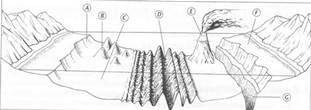
What is letter E?
a)
Volcanic Island
b)
Seamount
c)
Mid-Ocean Ridge
d)
Abyssal Plain
9.
The place where new ocean floor forms is called the...
a)
mid ocean ridge
b)
abyssal plain
c)
trench
d)
continental shelf
10.
What is the difference between a volcanic island & a seamount?
a)
A volcanic island rises above the water & a seamount does not
b)
A seamount rises above the water & a volcanic island does not
c)
Both the seamount & volcanic island are underwater
d)
Both the seamount & the volcanic island rise above the water
11.
Scientists use ______ to determine the oceans depth.
a)
Submarines
b)
Sonar
c)
Helicopters
d)
Radiowaves
12.
Which is the largest ocean?
a)
Pacific
b)
Atlantic
c)
Arctic
d)
Indian
13.
How many oceans are there?
a)
1
b)
10
c)
5
d)
2
14.
A volcanic mountain that rises above the surface of the water is called ____________
a)
trench
b)
island
c)
mid-ocean ridge
d)
seamount
15.
What is a deep, underwater valley or canyon on the ocean floor?
a)
seamount
b)
trench
c)
continental rise
d)
continental slope
16.
A trench is _______________
a)
cold and shallow
b)
deep and warm
c)
 deep and cold
d)
warm and shallow
17.
If you are on the beach, laying on a beach towel and playing in the sand, you are on the _______________________
a)
continent
b)
continental slope
c)
abyssal plain
d)
continental shelf
18.
mountain ranges in the ocean
a)
mid -ocean ridge
b)
trenches
c)
rift
d)
ocean basin
19.
the deepest part of the ocean
a)
trenches
b)
abyssal plain
c)
ocean basin
d)
rift
20.
Which process adds more crust to the ocean floor?
a)
earthquakes
b)
sea floor spreading 
c)
subduction
d)
convection
21.
This boundary is also called a colliding boundary.
a)
transform
b)
convergent
c)
divergent
22.
Alfred Wegener believed that all the continents were connected at one time.  What did he call this one large land mass?
a)
Pancakes
b)
Pangaea
c)
Pancreas
d)
Patches
23.
This boundary moves away from another boundary.
a)
divergent
b)
convergent
c)
transform
24.
A valley found in the middle of the mid-ocean ridge
a)
rift
b)
trenches
c)
abyssal plain
d)
ocean basin
25.
What type of boundary do earthquakes usually occur along?
a)
transform
b)
divergent
c)
convergent
26.
What type of boundary do earthquakes usually occur along?
a)
transform
b)
divergent
c)
convergent
27.
The cracks in Earth's crust are called ___________.
a)
tectonic plates
b)
faults
c)
magma
d)
lava
28.
What are the puzzle pieces of the Earth's surface called?
a)
Tectonic plates
b)
Puzzles
c)
Earthquakes
29.
What is the outermost layer of the Earth called?
a)
Core
b)
Mantle
c)
Crust
30.
The area around the Pacific Ocean where lots of earthquakes and volcanoes happen is called the ____________.
a)
Ring of Earth
b)
Ring of Fire
c)
Ring of Stone
d)
Ring of Diamond
31.
Lava that is still deep inside the earth is called ____________________________.
a)
lava
b)
magma
c)
volcano
d)
earthquake
32.

This famous fault in California has a lot of earthquakes!

a)

New Madrid

b)

Denali Fault

c)

Ramapo Seismic Zone

d)

San Andreas Fault

33.

What type of boundary is shown in the diagram?

a)

Divergent

b)

Convergent

c)

Transform

34.

What type of boundary is shown in the diagram?

a)

Divergent

b)

Convergent

c)

Slide/Transform

35.

What type of boundary is shown in the diagram?

a)

Divergent

b)

Convergent

c)

Slide/Transform

36.
Early observers thought continents may have been joined based on what observations
a)
rocks and fossils
b)
earthquakes.
c)
magnetism.
d)
coastline
37.
A German scientist Alfred Wegener was the first to hypothesize that ...........
a)
Continents were once joined
b)
The sea floor is spreading
c)
Continents are moving
d)
The Earth's magnetic pole flips
38.
Pangaea was an ancient supercontinent made up of...
a)
America, Greenland, and Europe.
b)
Antarctica, India, and America.
c)
all of Earth’s continents.
d)
South Africa, India, Australia, and South America.
39.
Peer scientists reviewing Wegener’s hypothesis of continental drift rejected his notion because
a)
His evidence was too few to make a valid conclusion 
b)
He did not explain how continents move and what moves them
c)
His evidence was not clear in showing  how continents were joined
d)
He lied by including false evidence
40.
Where are most divergent boundaries located?
a)
Along the middle of most ocean floors
b)
Along the margins of most continents
c)
Across the middle of many continents
d)
All the above options are correct
41.
The Himalayan mountains have some of the highest peaks like Mt. Everest, on which type of convergent boundary are they located?
a)
Oceanic/Continental
b)
Oceanic/Oceanic
c)
Continental/Continental
d)
None of the above
42.
What type of features are associated with a divergent boundary?
a)
Rift valleys
b)
Volcanic mountains
c)
Fold mountains
d)
Fault block mountains
43.
The mechanism that moves continents is based on heat energy moving by
a)
Radiation in the core
b)
Conduction in the lithosphere
c)
Convection in the Asthenosphere
d)
None of these options is true
44.
What type of rock makes most of the oceanic crust
a)
Sedimentary
b)
Basalt
c)
Metamorphic
d)
Limestone
45.
The San Andréa fault in California is one example of a...  
a)
Divergent boundary
b)
Convergent boundary
c)
Transform boundary
d)
All of the above
46.
Los Angeles and San Francisco are cities on opposite sides of the San Andreas transform boundary. Suggest how both cities will be like at some point in future
a)
Furthest north and south apart than now
b)
At the same positions as today
c)
Drift apart away from the fault line
d)
Side by side somewhere between them now
47.
In the Atlantic ocean, where is the youngest seafloor located?
a)
Towards the edges, near the eastern and western continents
b)
Towards the middle of the ocean
c)
Towards the north and south poles
d)
Young seafloor is located randomly throughout the ocean
48.
How do scientists figure out the age of the seafloor?
a)
They research it from ancient sea maps that trading vessels would use in the 1700s
b)
They use the moon phases and eclipses to calculate the age
c)
They use seismographs and the depth as well as location of earthquakes to calculate the age
d)
They take drill ships to many locations in the oceans and collect, then date, rock samples. 
49.
True or False: The Mid-Atlantic ridge in the Atlantic ocean is the ONLY example of a divergent boundary (<---->)
a)
True
b)
False
50.
True or False: The continents on the eastern (the Americas) and western (Europe, Africa) side of the Atlantic Ocean are moving closer together. 
a)
True
b)
False
51.
True or False: The Pacific Ocean is shrinking
a)
True
b)
False
52.
What is FALSE about the age pattern on the seafloor in the Atlantic Ocean? 
a)
The pattern is symmetrical on each side of the Mid-Atlantic ridge (plate tectonic boundary)
b)
The oldest seafloor can be found towards the edges of the ocean, near the eastern and western continents
c)
The youngest sea floor can be found towards the edges of the ocean, near the eastern and western continents
d)
Seafloor near the Mid-Atlantic ridge (plate tectonic boundary) can be up to 10 million years old
53.
What two words are BEST used to describe how the seafloor spreads?
a)
Magma and convection
b)
Earthquakes and convection
c)
Magma and convention
d)
Volcanoes and earthquakes
54.
True or False: The plates will never stop moving
a)
True
b)
False
55.
Lines of Longitude measure how far from the _______ a place is located.
a)
Equator
b)
International Date Line
c)
Prime Meridian
d)
Tropic of Cancer
56.
Lines of Latitude can be measured up to what degree?
a)
150 degrees
b)
180 degrees
c)
90 degrees
d)
100 degrees
57.
Lines of Longitude run from the _____ to the ______.
a)
East, West
b)
North, South
c)
South, East
d)
North, West
58.
Lines of ______ measure how far from the equator a place is located?
a)
Longitude
b)
Latitude
59.
The invisible line at 0 degrees latitude is called the ________. 
a)
International Date Line
b)
Prime Meridian
c)
Equator
d)
Arctic Circle
60.
The invisible line at 0 degrees longitude is called the _________.
a)
International Date Line
b)
Prime Meridian
c)
Equator
d)
Antarctic Circle
61.
Latitude lines run from the _____ to the  _______.
a)
West, East
b)
North, South
c)
North, East
d)
South, West
62.
The equator breaks the Earth into what two hemispheres?
a)
Eastern and Southern
b)
Northern and Southern
c)
Western and Eastern
d)
Northern and Western
63.
The Prime Meridian separates the Earth into what two hemispheres?
a)
Northern and Southern
b)
Western and Eastern
c)
Northern and Eastern
d)
Southern and Western
64.
Lines of longitude are also called  ____________.
a)
Hemispheres
b)
Meridians
c)
parallels
d)
International Date Lines
65.
Latitude and Longitude lines are measured in __________.
a)
inches
b)
miles
c)
degrees
d)
ounces
66.
The two imaginary lines of latitude that are farthest from the equator are called the __________  and the  ____________.
a)
Tropic of Capricorn and Tropic of Cancer
b)
Arctic Circle and Antarctic Circle 
c)
Prime meridian and International Date Line
d)
Equator and Prime Meridian