wayground logo

Free Printable Worksheets

NEW

Font size

S
M
L
XL
Worksheets

Final Exam Review

Total questions: 65

Worksheet time: 58mins

Name
Class
Date
1.

All living things are composed of ___. The units of structure and function in all living things.

a)

cells

b)

ecosystem

c)

unicellular

d)

bacteria

2.

The two types of cells are..

a)

unicellular & multicellular

b)

asexual & sexual

c)

autotrophs & heterotrophs

d)

prokaryote & eukaryote

3.

Composed of ONE cell.

a)

multicellular

b)

unicellular

c)

polycellular

d)

bicellular

4.

The two types of reproduction are..

a)

unicellular & multicellular

b)

asexual & sexual

c)

autotrophs & heterotrophs

d)

prokaryote & eukaryote

5.

Tiny structures within cells that perform specific jobs

a)

organelle

b)

tissue

c)

organ

d)

organ system

6.

The process by which plants use sunlight energy to create food for itself.

a)

photosynthesis

b)

producer

c)

consumption

d)

chemosynthesis

7.

Stable internal conditions of the body.

a)

stimuli

b)

irritability

c)

homeostasis

d)

survive

8.

Anything that causes a reaction.

a)

stimuli

b)

irritability

c)

homeostasis

d)

survive

9.
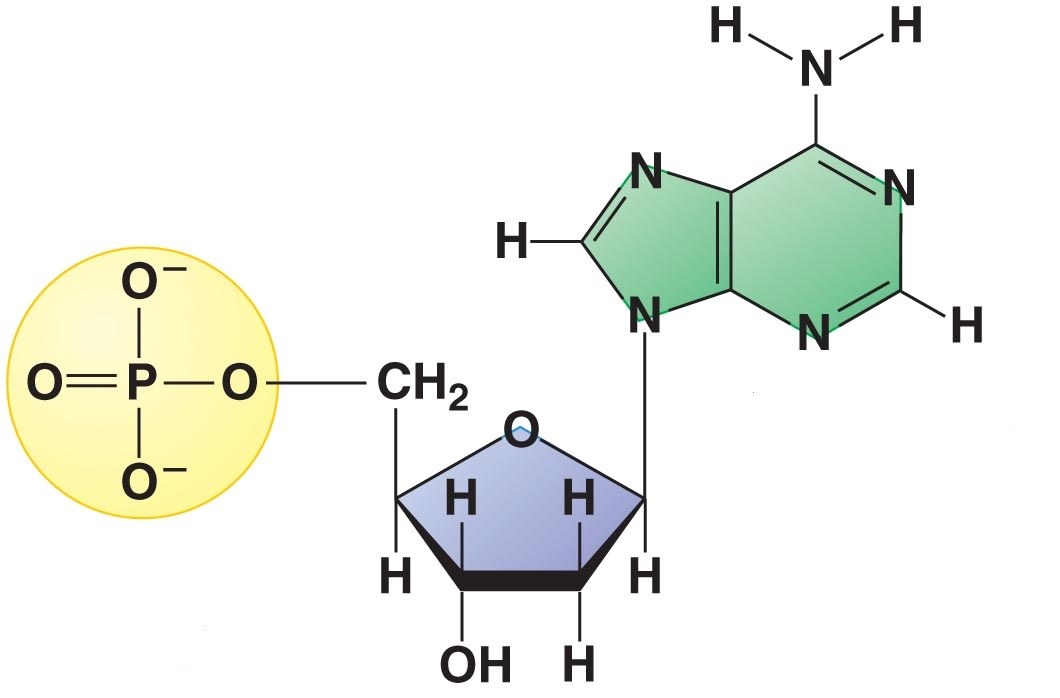
Which of the following units are repeatedly joined together to form a strand of DNA? (This is the MONOMER of DNA.) 
a)
amino acids
b)
nucleotides
c)
fatty acids
d)
polysaccharides
10.
Adenine bonds with ______________.
a)
Guanine
b)
Thymine
c)
Cytosine
d)
Adenine
11.
Guanine bonds with ______________.
a)
Adenine
b)
Guanine
c)
Cytosine
d)
Thymine
12.
What are the 4 nitrogen bases?
a)
adenine, thymine, cytoplasm, and guanine
b)
adenine, thymine cytosine, and guanine
c)
adenine, thymine, cytosine, and gylcerol
d)
adenine, thymine, cytosine, and glucose
13.
Which 2 molecules forms the sides (backbone) of the DNA ladder?
a)
deoxyribose and adenine
b)
deoxyribose and a hydrogen bond
c)
sugar and the nucleus
d)
deoxyribose (sugar) and phosphate
14.
Which organelle is DNA usually found in?
a)
cell membrane
b)
vacuole
c)
chloroplast
d)
nucleus
15.
Nitrogenous bases are joined by which type of bond?
a)
polar bonds
b)
ionic bonds
c)
covalent bonds
d)
hydrogen bonds
16.
The sugar in DNA is ?
a)
sucrose
b)
glucose
c)
deoxyribose
d)
fructose
17.
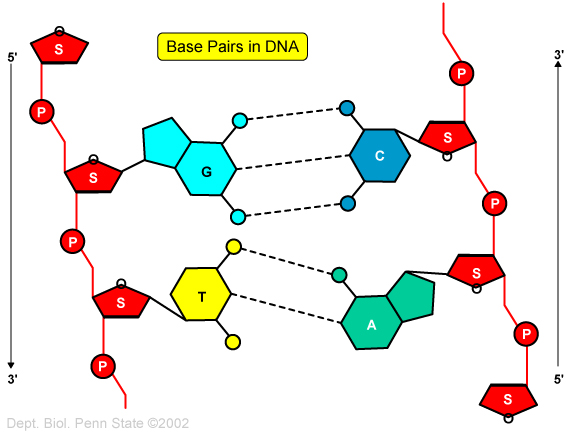
Name this structure
a)
double helix
b)
nucelotide
c)
twisted ladder
d)
hydrogen bond
18.

Amount of A=T and G=C

a)

Chargaff

b)

Franklin

c)

Watson and Crick

d)

Hershey and Chase

19.

Won the Nobel Prize

a)

Chargaff

b)

Franklin

c)

Watson and Crick

d)

Hershey and Chase

20.

Figured out the amount of A, T, G, and C that many different organisms have

a)

Chargaff

b)

Franklin

c)

Watson and Crick

d)

Hershey and Chase

21.

Conducted research on bacteria that cause pneumonia

a)

Mendel

b)

Griffith

c)

Avery

d)

Hershey and Chase

22.
What type of RNA carries the DNA message out of the nucleus to the ribosomes?
a)
mRNA
b)
tRNA
c)
RNA
d)
DNA
23.
What do we call the process of turning DNA into mRNA?
a)
Translation
b)
Transcription 
c)
Replication
24.
Amino acids are the building blocks of... 
a)
DNA
b)
RNA
c)
Atoms
d)
Proteins
25.
Where does transcription take place?
a)
nucleus
b)
cytoplasm
c)
ribosome
26.
One difference between DNA and RNA is that....
a)
Only RNA has the base Uracil
b)
only RNA contains the base Thymine
c)
only RNA contains the base Cytocine
d)
only RNA contained the base Guanine
27.
True or false:  RNA is double-stranded.
a)
true
b)
false
c)
it depends on the type
28.
Which of these bases does not exist in RNA?
a)
C
b)
T
c)
U
d)
A
29.
_______ is made during transcription and ________ is made during translation.
a)
mRNA / a protein
b)
a protein / mRNA
c)
Ribosome / Nucleus
d)
mRNA / tRNA
30.
Which of the following is the sugar found in RNA?
a)
Ribose
b)
Maltose
c)
Deoxyribose
d)
Amylose
31.
Codons contain ______ bases
a)
1
b)
3
c)
6
d)
9
32.
Which is the organelle that makes proteins?
a)
Nucleus
b)
Ribosomes
c)
Rough ER
d)
Golgi Apparatus
33.
What is the correct order?
a)
Transcription then Translation
b)
Translation then transcription
c)
Translation then replication
d)
Replication then Translation
34.
What is a substance called if it speeds up a chemical reaction?
a)
reusable
b)
catalyst
c)
specific
d)
fragile
35.
With what 3 letters do enzymes typically end?
a)
-ose
b)
-ase
c)
-ese
d)
-tic
36.

Enzymes are an example of

a)

Lipids

b)

Carbohydrate

c)

Protein

d)

Nucleic Acid

37.
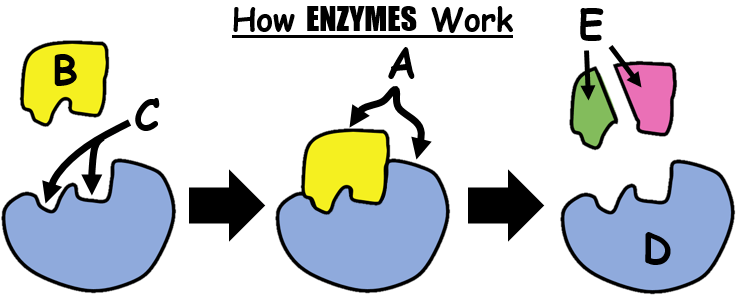
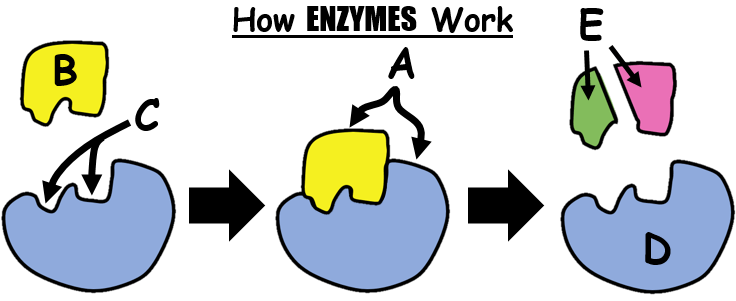
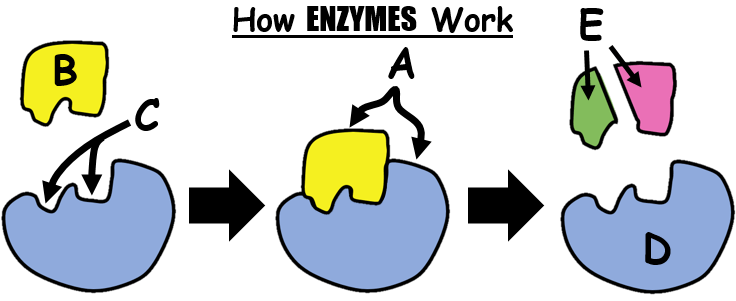
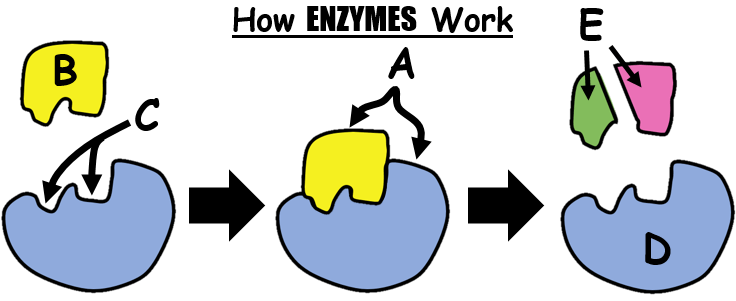
Letter D...
a)
active site
b)
enzyme
c)
substrate
d)
products
38.
Letter B...
a)
active site
b)
enzyme
c)
substrate
d)
products
39.
Letter C...
a)
active site
b)
enzymes
c)
substrate
d)
products
40.
Letter E...
a)
active site
b)
enzyme
c)
substrate
d)
products
41.
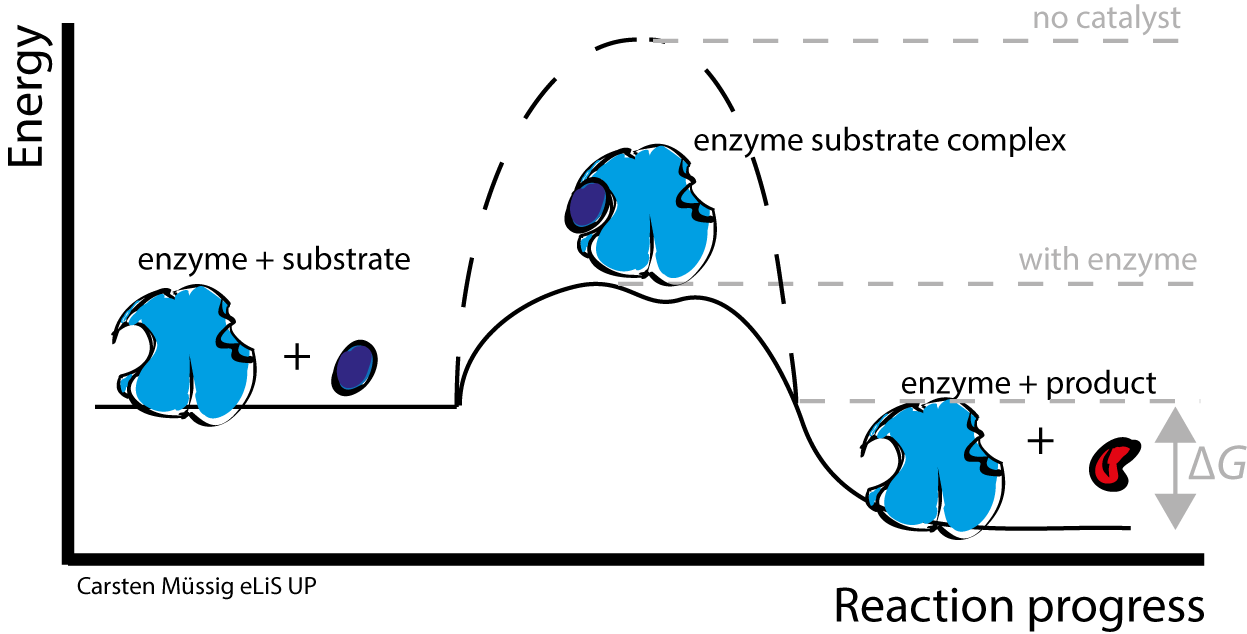
An enzyme speeds up a reaction by
a)
lowering the activation energy.
b)
raising the activation energy.
c)
releasing energy.
d)
absorbing energy.
42.

What happens when enzymes are heated to a high temperature?

a)

The enzymes die.

b)

The shape of the enzyme are changed and it denatures

c)

The enzymes' amino acid sequence changes.

d)

The enzymes remain the same

43.
Any change in the sequence of DNA is...
a)
transgenic shift
b)
Single Genotype
c)
Monohybrid Trait
d)
Mutation
44.

Why are insertion and deletion mutations so harmful?

a)

They change all of the codons from the mutation on down the line, which changes the amino acid sequence

b)

They insert things that an organism doesn't need.

c)

They often delete things that organisms need.

d)

Insertion and deletions are not any more harmful than substitution mutations.

45.

What do gene mutations change?

a)

DNA

b)

RNA

c)

Proteins

d)

Lipids

46.

What is a GMO?

a)

An organism that has had its DNA modified by humans

b)

An organism missing a chromosome

c)

Epigenetics

d)

A genetically identical organism

47.
Putting the gene for bioluminescence into a fish is an example of...
a)
Genetic Engineering
b)
Selective Breeding
c)
Artificial Selection
d)
Gene Mutation
48.
DNA can be spliced, in order to insert it in a different organism, using
a)
prescription enzymes
b)
digestive enzymes
c)
restriction enzymes
d)
transcription enzymes
49.
When human DNA is inserted in bacterial DNA to create insulin it is called
a)
viral DNA
b)
bacterial DNA
c)
recombinant DNA
d)
transcribed DNA
50.
Advantages of genetically modified crops include(s)
a)
insect resistance
b)
drought/freeze resistance
c)
higher yield
d)
all of these are reasons for using GMOs
51.
Concerns about genetically modified organisms include(s)
a)
risk to human health
b)
may be harmful to ecosystems
c)
seed/pollen drift to organic farms
d)
all of these are valid concerns
52.

What is the first cloned mammal?

a)

goat

b)

cat

c)

sheep

d)

cow

53.
A clone can be BEST thought of as a(n)  _____ created in the lab. 
a)
identical twin
b)
GMO
c)
science fiction experiment
54.
SCNT stands for . . . 
a)
Somatic Cell Nuclear Transfer
b)
Somatic Cell Natural Transcription
c)
Somatic Cell Nerve Transfer
d)
Skin Cell Nuclear Translation
55.
Why might people be against cloning? 
a)
It's creepy
b)
It can cause unknown defects
c)
It is detrimental to genetic diversity
d)
All of the above
56.
In cloning, what is the purpose of the surrogate mother? 
a)
Donate her DNA
b)
Donate her egg cell
c)
Incubate and carry the baby until birth
d)
Nothing.  She's useless.
57.
Mr. Jones was killed in a car accident.  Afterwards, a former girlfriend filed a paternity suit claiming that Mr. Jones was the father of her child, and thus she was entitled to the man’s estate.  Which sample of DNA would have to be from Mr. Jones if he were the child’s father? 
a)
2
b)
3
c)
4
d)
5
58.
DNA fingerprinting works because
a)
Most genes are dominant
b)
All organisms contain RNA
c)
The most important genes are different among most people
d)
No two people, except identical twins, have exactly the same DNA 
59.
Functions in energy production, known as the energy factory of the cell
a)
mitochondria
b)
chloroplast
c)
vacuole
d)
cytoplasm
60.
The control center that controls all the functions of the cell
a)
cytoplasm
b)
cell wall
c)
cell membrane
d)
nucleus
61.
Contains chlorophyll and is where photosynthesis takes place. Found in plant cells only.
a)
mitochondria
b)
chloroplast
c)
vacuole
d)
cytoplasm
62.
Semi-permeable layer around the cell that encloses the contents of the cell
a)
nucleus
b)
cell membrane
c)
cell wall
d)
chloroplast
63.
jelly-like substance that is located between the cell membrane and the nucleus
a)
mitochondria
b)
chloroplast
c)
vacuole
d)
cytoplasm
64.
I am located in the nucleus – I’m the genetic material of a cell
a)
cytoplasm
b)
membrane
c)
chromosomes/DNA
d)
vacuole
65.
I store water in both plant and animal cells. What am I?
a)
cytoplasm
b)
ribosomes
c)
vacuole
d)
lysosomes