wayground logo

Free Printable Worksheets

NEW

Font size

S
M
L
XL
Worksheets

Systems of Animals Review

Total questions: 70

Worksheet time: 1hrs 18mins

Name
Class
Date
1.
Homeostasis
a)
allows for a wildly fluctuating internal environment
b)
is impossible in vertebrates
c)
is the maintenance of a relatively stable internal environment and often incorporates a form of feedback regulation
d)
is the maintenance of a relatively stable external environment and often incorporates a form of feedback regulation
2.

The group of organisms that use the process of homeostasis includes

a)

mammals, only

b)

animals, only

c)

plants and animals

d)

all living things

3.
a body system that controls and coordinates all body activities through electric impulses/messages between brain, spinal cord and nerves.
a)
endocrine system 
b)
nervous system
c)
nerve
d)
neuron
4.
What are the three (3) main parts of the nervous system?
a)
cerebellum, cerebrum, medulla
b)
cochlea, nerves, vestibule
c)
brain, spinal cord, nerves
5.
The bony structure that protects the brain.
a)
Back bone 
b)
Teeth 
c)
Skull
d)
Helmet 
6.
What is the main function of the nervous system?
a)
clean waste from the cells
b)
absorb nutrients for energy
c)
deliver messages to the brain
7.
Which part of the body is like a highway for sending messages?
a)
Blood
b)
Spinal Cord
c)
Atrium
d)
Ventricle
8.
bundle of wire-like nerves threaded through the backbones, through which electrical messages travel between the brain and body.
a)
neurons
b)
spinal cord
c)
spaghetti
d)
brain
9.

Examples of a hinge joint are the elbow and knee.

a)

True

b)

False

10.

Babies have more bones than adults.

a)

True

b)

False

11.

An example of a pivot joint can be found in the forearm.

a)

True

b)

False

12.

A function of the skeletal system is to protect vital organs.

a)

True

b)

False

13.
How many bones are there in the human body?
a)
208
b)
126
c)
206
d)
80
14.
The soft inside part of the bone is
called__________________ .
a)
periosteum
b)
spongy 
c)
marrow
d)
cancellous
15.

Which system of the human body provides protection to most of the major organs?

a)

skeletal system

b)

circulatory system

c)

respiratory system

d)

muscular system

16.

Which of the following best describes the job of the skeletal system?

a)

Gives shape and support to the body.

b)

Sends messages from the stomach to the brain.

c)

Brings in and breaks down all nutrients for the body

17.
Major organs of the digestive system
a)
Kidneys, nephrons
b)
Stomach, intestines, mouth
c)
Heart, blood vessels, blood
d)
Liver, kidneys, heart
18.
Heart, blood vessels, blood
a)
Digestive system
b)
Excretory system
c)
Circulatory system
d)
Immune system
19.
Nose, trachea, lungs, alveoli
a)
Respiratory system
b)
Endocrine system
c)
Muscular system
d)
Skeletal system
20.
Major organs of the muscular system
a)
Shoulder-blade, kneecap, triceps
b)
Muscles, tendons
c)
Bones, ligaments
d)
Heart, intestines, stomach
21.
 What do tissues form?
a)
Blood 
b)
Organ Systems
c)
Organs
d)
Nails
22.
Which is the correct sequence?
a)
dorsal> immune> lymphatic
b)
lymphatic> dorsal> tissues
c)
tissue> organs> form organ systems
d)
organ> tissues> organ system
23.
Which organ belongs to the digestive system?
a)
heart
b)
stomach
c)
femur
d)
brain
24.
Which organ system does the hair belong to?
a)
Lymphatic
b)
Integumentary
c)
Circulatory
d)
Skeletal
25.
Which organ system does the brain belong to?
a)
Reproductive
b)
Cardiovascular
c)
Integumentary
d)
Nervous
26.
Which organ belongs to the reproductive system?
a)
ovaries
b)
spleen
c)
large intestine
d)
liver
27.
Which organ belongs to the reproductive system?
a)
gluteus maximus
b)
humerus
c)
radial artery
d)
testes
28.

A group of tissues that work together is a(n) ______________________.

a)

cell

b)

organ

c)

organ system

29.

Organs that work together are part of a(n) ________________________.

a)

cells

b)

tissue

c)

organ system

30.

The dark structure in the middle of each cell is a

a)

nucleus

b)

lysosome

c)

mitochondria

31.

A specialized cell is a cell that has ...

a)

the ability to divide

b)

a specific role to do

c)

no specific function in the bod

32.

When similar cells group together it is called a tissue

a)

true

b)

false

33.

This muscle tissue is only found in the heart.

a)

Skeletal

b)

Smooth

c)

Cardiac

34.

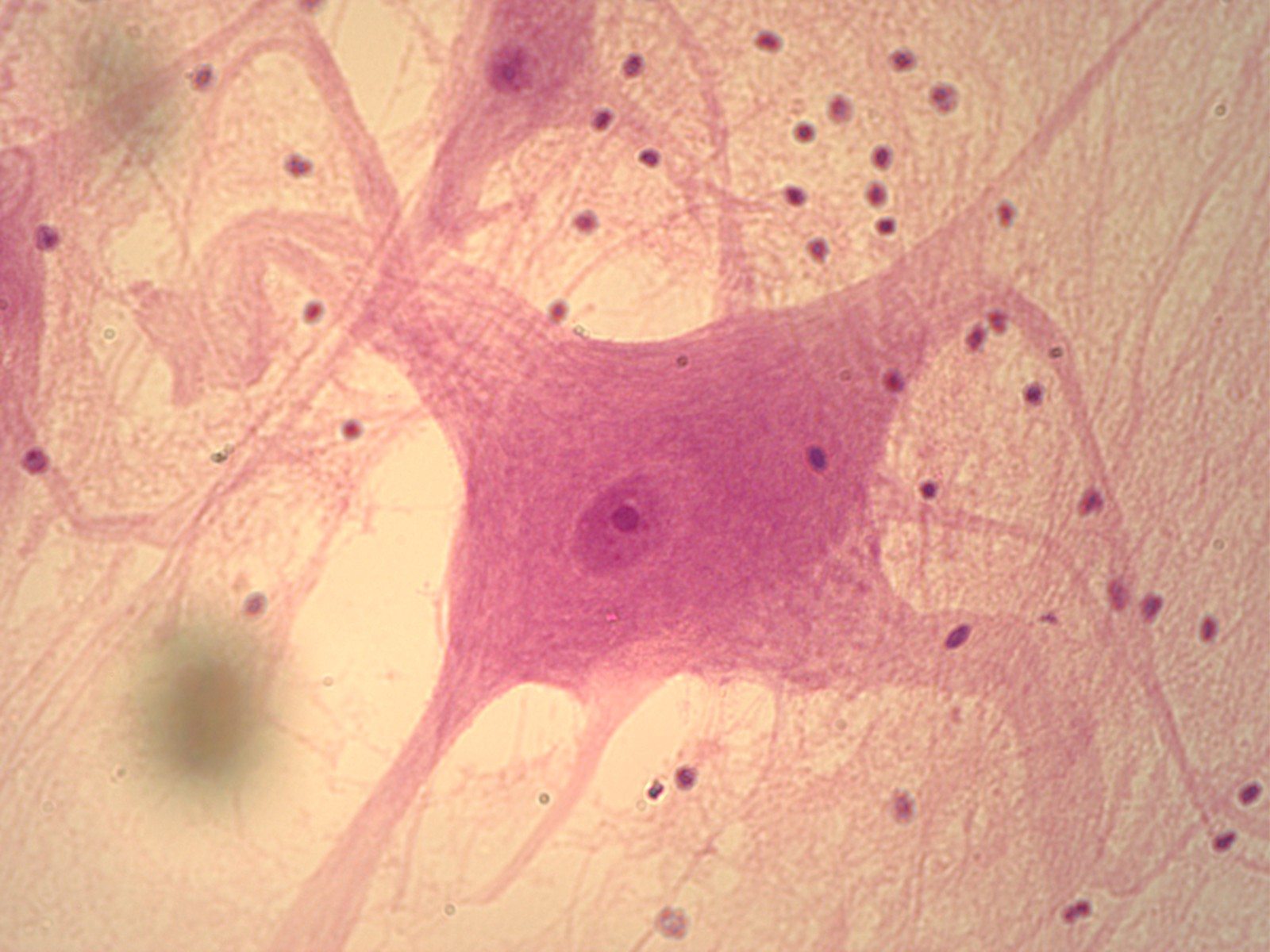
This type of tissue shown in the picture transmits information throughout the body to and from the brain.

a)

Nervous Tissue

b)

Connective Tissue

c)

Muscular Tissue

35.

Which of the following tissues is made up of cells that contract to move substances through the body and help the body move?

a)

Epithelial

b)

Connective

c)

Muscle

36.

What is the correct order of organization?

a)

cells->tissue->organs->organ systems-> organism

b)

tissue->cells->organs->organ systems-> organism

c)

organs->organ systems-> organism->cells->tissue

37.

Endocrine glands secrete _

a)

Hormones

b)

Neurotransmitters

c)

A wide range of chemical substances

38.

What is the endocrine system?

a)

A system of vessels that circulates blood around the body.

b)

A group of bones and tissue that provides support and structure for the body.

c)

A group of glands that work together with the nervous system to coordinate all body functions

d)

A group of organs that is responsible for eliminating wastes.

39.
Movements that you choose to control
a)
Cramp
b)
Voluntary
c)
Strain
d)
Involuntary
40.
Movements that you cannot control
a)
Strain
b)
Sprain
c)
Voluntary
d)
Involuntary
41.
The main purpose of the muscular system is to....
a)
Keep the heart beating
b)
Move the body
c)
Hit the dab
d)
Transfer oxygen
42.
Skeletal muscles are attached to the _________.
a)
Stomach
b)
Lungs
c)
Bones
d)
Involuntary Muscles
43.
Cardiac muscles are ONLY located in the heart
a)
TRUE
b)
FALSE
44.
A place where two bones meet is called a 
a)
Hip Bone
b)
Synovial Fluid
c)
Joint
d)
Biceps
45.
The framework of the body, that consists of bones and connective tissues is called the
a)
Muscular System
b)
Skeletal System
c)
Nervous System
d)
Blood System
46.
What is the name for your bones in your spinal cord?
a)
Vertebrae
b)
Joints
c)
Spine
d)
Tailbone
47.
True or False:  Daily exercise is a good way to keep your bones healthy?
a)
True
b)
False
48.
The innermost part of the bone, where blood cells are made is called the 
a)
Cancellous bone
b)
Bone Marrow
c)
Periosteum
d)
Hollow bone
49.
Internal Skeleton
a)
Endoskeleton
b)
Exoskeleton
c)
Hydrostatic
50.
External Skeleton
a)
Endoskeleton
b)
Exoskeleton
c)
Hydrostatic
51.
What type of skeleton is shown with this animal?
a)
endoskeleton
b)
exoskeleton
52.
Both endoskeletons and exoskeletons
a)
support the body
b)
protect the body
c)
provide a place for muscle attachment
d)
do all of these
53.
A hard, outer covering is called a(n)
a)
endoskeleton
b)
exoskeleton
c)
armorskeleton
d)
ectoskeleton
54.
Invertebrates
a)
have backbones
b)
do not have backbones
c)
are immobile
d)
are asymmetrical
55.
This group feeds milk to its young.
a)
birds
b)
mammals
c)
fish
d)
reptile
56.
Is the picture a vertebrate or invertebrate?
a)
Vertebrate
b)
Invertebrate
57.
hairy warm blooded animals that feed their babies milk
a)
mammals
b)
marsupials
c)
monotremes
d)
macropods
58.

cold blooded vertebrate animals with dry, scaley skin

a)

amphibians

b)

reptiles

c)

birds

d)

fish

59.

This system controls everything you do.

a)

Nervous system

b)

Olfactory system

c)

Respiratory system

d)

Endocrine system

60.

Without the nervous system, you couldn't

a)

walk

b)

breathe

c)

think

d)

all of the above

61.
The brain is the ______ ______ of the body.
a)
nervous center
b)
nueropathy
c)
control center
d)
extension
62.
The red part of the picture shows the ________ which is part of the nervous system.
a)
brain
b)
spinal cord
c)
peripheral nerves
d)
neurons
63.
What is the main function of the nervous system?
a)
clean waste from the cells
b)
absorb nutrients for energy
c)
deliver messages to the brain
64.
main organ of the nervous system. protected by the skull, and made of neurons, it is the control center for all actions, thoughts and emotions.
a)
brain
b)
electrical impulse
c)
gland
d)
heart
65.
When you react to catch a dropped ruler your body reacts in this order:
a)
1) muscles contract 2) eyes sense ruler move 3) message sent to brain 4) message sent to the muscles
b)
1) message sent to muscles 2) muscles contract 3) message sent to brain 4) eyes sense ruler move
c)
1) eyes contract 2) muscles sent to brain 3) message sense moves 4) ruler is sent to muscles
d)
1) eyes sense ruler move 2) message sent to brain 3) message sent to muscles 4) muscles contract
66.
The nervous system is composed of the ___, ___, and ___.
a)
heart, brain, kidneys
b)
lungs, liver, stomach
c)
brain, spinal cord, nerves
d)
eyes, pancreas, veins
67.

Our ______ receive messages and send them to the brain. The brain sends messages to our body on how to respond.

a)

heart

b)

lungs

c)

nerves

68.
A chemical produced by neurons that carries messages to other neurons
a)
myelin sheath
b)
neurotransmitter
c)
axon
d)
axon terminal
69.
The tiny gap between neurons where nerve impulses are sent from one neuron to another.  It is where communication occurs between an axon and dendrite
a)
synapse
b)
axon terminal
c)
impulse
d)
myelin
70.
Which system is most closely associated with the brain?
a)
nervous
b)
muscular
c)
circulatory
d)
respiratory