wayground logo

Free Printable Worksheets

Font size

S
M
L
XL
Worksheets

protein synthesis 2/12/24

Total questions: 67

Worksheet time: 2hrs 41mins

Name
Class
Date
1.

Which of the following are differences in the structure between RNA and DNA

a)

DNA uses deoxyribose sugar, RNA uses sugar ribose

b)

DNA pairs Adenine with Uracil, RNA pairs Adenine with Thymine

c)

DNA is a double helix, RNA is a single helix

d)

DNA pairs Adenine with Thymine, RNA pairs Adenine with Uracil

2.

Which organelle is the location where protein is made?

a)

Ribosome

b)

Nucleus

c)

Cytoplasm

d)

Nucleotide

3.

During transcription, this type of ribonucleic acid is responsible for copying the DNA and brining it out of the nucleus.

a)

tRNA

b)

mRNA

c)

rRNA

d)

dRNA

4.

When these bond together, they form a protein

a)

Amino Acids

b)

Peptide Bonds

c)

Ribose

d)

Nucleotides

5.

These building blocks consist of a sugar, phosphate, and nitrogen base.

a)

Ribose

b)

Nucleotide

c)

Gene

d)

Protein

6.

A string of nucleotides that contain the information to make a specific protein

a)

Ribose

b)

Amino Acids

c)

tRNA

d)

Gene

7.

How many amino acids are found on one tRNA?

a)

20

b)

4

c)

1

d)

3

8.

Which of the following is the complementary mRNA sequence to this DNA strand: AACTGAA

a)

UUGACUU

b)

TTGACTT

c)

AACTGAA

d)

AACUGAA

9.
A sugar, a phosphate group, and a nitrogen base form the building blocks of which organic compound?
a)
carbohydrates
b)
nucleic acids
c)
lipids
d)
proteins
10.
The genetic material of an organism is composed of
a)
lipids
b)
proteins
c)
deoxyribonucleic acids
d)
complex carbohydrates
11.
Which of the following best describes how DNA and RNA are similar?
a)
they both contain A and T
b)
They both have a double helix
c)
They are both composed of 5 different nucleotides
d)
they both have C and G
12.
DNA sequence is ACAGTGC. How would this be coded on mRNA?
a)
TGTCACG
b)
UGUCACG
c)
GUGACAU
d)
CACUGUA
13.
Genetic info flows in one direction. Which best represents this flow?
a)
DNA-protein-RNA
b)
Protein-RNA-DNA
c)
RNA-protein-DNA
d)
DNA-RNA-protein
14.
The main function of tRNA is to...
a)
carry a message that, when translated, forms proteins
b)
form a portion of ribosomes
c)
string together complementary RNA and DNA strands
d)
bring amino acids from the cytoplasm to the ribosomes
15.
What is the term for a three-nucleotide sequence that codes for an amino acid?
a)
base
b)
codon
c)
amine
d)
serine
16.
Which phrase best describes translation?
a)
converts mRNA into a polypeptide
b)
catalyzes bonds between amino acids
c)
produces RNA from DNA molecules
d)
recycles tRNA molecules for reuse
17.
Which of the following is the site of transcription?
a)
vacuole
b)
lysosome
c)
nucleus
d)
ribosome
18.
Which of the following is the site of translation?
a)
vacuole
b)
lysosome
c)
nucleus
d)
ribosome
19.
The process to go from DNA to mRNA is _______
a)
translation
b)
transcription
c)
replication
20.
The process to go from mRNA to a protein is called ____
a)
transcription
b)
rRNA
c)
replication
d)
translation
21.

Which organelle is the location where protein is made?

a)

Ribosome

b)

Nucleus

c)

Cytoplasm

d)

Nucleotide

22.

During transcription, this type of ribonucleic acid is responsible for copying the DNA and brining it out of the nucleus.

a)

tRNA

b)

mRNA

c)

rRNA

d)

dRNA

23.

When these bond together, they form a protein

a)

Amino Acids

b)

Peptide Bonds

c)

Ribose

d)

Nucleotides

24.

mRNA occurs during this process

a)

Translation

b)

Transcription

c)

Replication

d)

Delivery

25.

Which of the following is the complementary mRNA sequence to this DNA strand: AACTGAA

a)

UUGACUU

b)

TTGACTT

c)

AACTGAA

d)

AACUGAA

26.
What is the term for a three-nucleotide sequence that codes for an amino acid?
a)
base
b)
codon
c)
amine
d)
serine
27.
The process to go from DNA to mRNA is _______
a)
translation
b)
transcription
c)
replication
28.
The process to go from mRNA to a protein is called ____
a)
transcription
b)
rRNA
c)
replication
d)
translation
29.
Genetic info flows in one direction. Which best represents this flow?
a)
DNA-protein-RNA
b)
Protein-RNA-DNA
c)
RNA-protein-DNA
d)
DNA-RNA-protein
30.
What is the location in the cell for transcription?
a)
nucleus
b)
cytoplasm
c)
ribosome
d)
mitochondria
31.

In what process is mRNA synthesized?

a)

Transcription

b)

Translation

c)

DNA Replication

d)

Mitosis

32.

Which organelle contains rRNA and reads the mRNA to synthesize a protein?

a)

Ribosome

b)

Nucleus

c)

Cytoplasm

d)

Nucleotide

33.

What brings the amino acids to the ribosome to assemble a protein?

a)
mRNA
b)
tRNA
c)
rRNA
d)

DNA

34.

How many nucleotides code for 1 amino acid?

a)

1

b)

2

c)

3

d)

4

35.

What is the location in the cell for translation?

a)

Cytoplasm

b)

Nucleus

c)

Lysosome

d)

Golgi apparatus

36.
Which of the following represents the maximum number of amino acids that could be incorporated into a polypeptide encoded by 21 nucleotides of messenger RNA?
a)
3
b)
7
c)
21
d)
42
37.
DNA replication occurs through a complex series of steps involving several enzymes.  Which of the following represents the correct order beginning with the earliest activity of enzymes involved in DNA replication?
a)
helicase RNA primase, DNA polymerase, ligase, 
b)
DNA polymerase, RNA primase, helicase, ligase
c)
RNA primase, DNA polymerase, ligase, helicase
d)
Helicase, RNA primase, DNA polymerase, ligase
38.
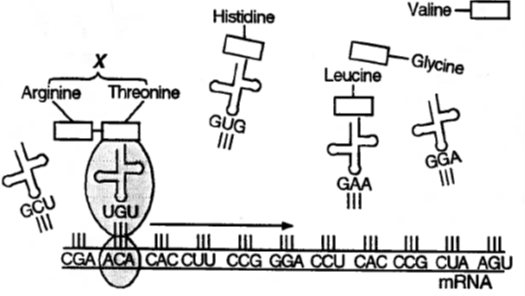
Which of the following DNA strands would serve as a template for the amino acid sequence shown above?
a)
3'-ATGCGACCAGCACGT-5'
b)
3'- AUGCCACUAGCACGU-5'
c)
3'-TACGGTGATCGTGCA-5'
d)
3'UACCGGUGAUCGUGCA-5'
39.
The mRNA above was found to be much smaller than the original mRNA synthesized in the nucleus.  This is due to the
a)
addition of a poly(A) tail to the mRNA moleucle
b)
addition of a cap to the mRNA molecule
c)
excision of exons from the mRNA molecule
d)
excision of introns from the mRNA molecule
40.
Carries the genetic code to the ribosome
a)
mRNA
b)
tRNA
c)
rRNA
d)
DNA
41.
A certain gene codes for a polypeptide that is 120 amino acids long. Approximately how many nucleotides long is the mRNA that codes for this polypeptide likely to be?
a)
360
b)
480
c)
40
d)
30
42.
Which component of DNA determines the traits of an organism? 
a)
Nitrogen Bases
b)
Sugar-Phosphate Backbone
c)
Hydrogen bonds
43.
What is a peptide bond?
a)
Bond that holds two amino acids together.
b)
A bond that holds hydrogen and oxygen molecules together.
c)
A bond that holds the phosphate group of one nucleotide and a sugar of a neighboring nucleotide.
d)
A bond that is formed by the sharing of electrons.
44.
The process to go from mRNA to a protein is called ____
a)
transcription
b)
rRNA
c)
replication
d)
translation
45.
A possible sequence of nucleotides in the template strand of DNA that would code for the polypeptide sequence phe-leu-ile-val would be?
a)
5'-TTG-CTG-CAG-TAG-3'
b)
3'-AAC-GAC-GUC-AUA-5'
c)
3'-AAA-AAT-ATA-ACA-5'
d)
3'-AAA-GAA-TAA-CAA-5'
46.

This cannot leave the nucleus

a)

DNA

b)

RNA

c)

Both

47.

The diagram shows the process of

a)

Transcription

b)

Translation

c)

Replication

d)

Mitosis

48.

Which phase of which process does this picture show?

a)

Transcription

b)

Translation

c)

Replication

49.

The start codon is _______:

a)

AUG

b)

GGG

c)

UCG

d)

AAU

50.
What process is going on in this photo? 
a)
Transcription 
b)
Translation 
c)
Replication 
d)
All the above 
51.

DNA molecule segment is : TTACGCAAG

The mutated DNA segment is TTACGCAAC. This is an example of ___ mutation.

a)

Substitution

b)

Insertion

c)

Inversion

d)

Translocation

52.

ATT-TGA-GCC- Original

ATT-GAG-CC - Mutated

The example above is an example of a

a)

Insertion- Frameshift

b)

Deletion- Substitution

c)

Deletion -Frameshift

d)

All of the above

53.

Chromosomal mutations could involve which of the following:

a)

many nucleotides deleted

b)

many nucleotides relocated

c)

many nucleotides copied

d)

a nucleotide inserted

54.

The model shows a mutation to a partial sequence of bases in a gene.

Which type of mutation does the model demonstrate?

a)

Deletion

b)

Insertion

c)

Substitution

d)

Translocation

55.

Different types of mutations can occur in DNA. The diagram represents a type of mutation.

Which statement describes the mutation in the diagram?

a)

A silent mutation results in the insertion of a different amino acid.

b)

A substitution occurs with the adenine base.

c)

A deletion of a cytosine base occurs.

d)

A base is inserted into one strand of the DNA.

56.

Why would a frameshift be more harmful?

a)

It changes all the code downstream

b)

Only one nucleotide is changing

c)

All mutations are harmful

d)

It can't correct iself

57.

THEBIGFATREDCATSAT is normal, what would this be:

THESBIGFATREDCATSAT

a)

Substitution

b)

Insertion

c)

Deletion

58.

THEBIGFATREDCATSAT is normal, what is this:

THEBIGFATREDATSAT

a)

Substitution

b)

Insertion

c)

Deletion

59.

ATTTGAGCC- Original

ATTGAGCC - Mutated

The example above is an example of a

a)

Insertion- Frameshift

b)

Deletion- Substitution

c)

Deletion -Frameshift

d)

All of the above

60.

What mutation has occurred here?

T-G-A-C-C-A

T-G-A-G-C-A

a)

Substitution

b)

Deletion

c)

Insertion

d)

Frameshift

61.
If you are a boy, what percent of your genes did you get from your dad?
a)
25%
b)
50%
c)
75%
d)
100%
62.
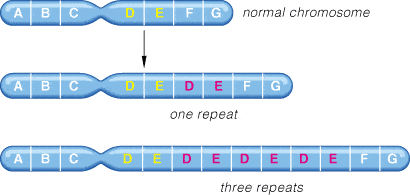
Identify the mutation in the picture.
a)
Inversion
b)
Duplication
c)
Deletion
d)
Translocation
63.

______________________________________ is a type of chromosomal mutation when part of the chromosome breaks off and attaches to another chromosome.

a)

duplication

b)

translocation

c)

subtraction

d)

deletion

64.

The bottom DNA sequence in the image has been altered by this type of mutation

a)

substitution

b)

insertion

c)

deletion

d)

translocation

65.

Which one is a chromosome?

a)

A

b)

B

c)

C

d)

D

66.

Which one is DNA?

a)

A

b)

B

c)

C

d)

D

67.
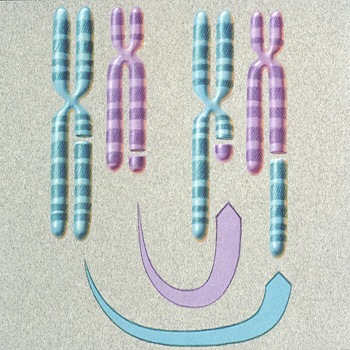
What type of chromosomal mutation is this?
a)
Translocation
b)
Inversion
c)
Deletion
d)
Duplication