
Font size
 Worksheets
Radiation and Spectra Review
Total questions: 30
Worksheet time: 16mins

The color of emitted light with the LONGEST wavelength is
violet
green
red
indigo
The color of emitted light with the SHORTEST wavelength is
violet
green
red
indigo
A wave with a long wavelength will have a ______ frequency and _____ energy
high, low
high, high
low, high
low, low
When analyzing star light or elements in a lab, what are the different color patterns produced by the prism called?
emission spectra
the rainbow
absorption spectra
spectral rainbow
Scientists learn what stars are made of by analyzing their.....
The Doppler Effect
Emission Spectra
Radio Waves
The Electromagnetic Spectrum
If astronomers examine the spectral lines of a distant galaxy and saw that they displayed a blue shift, what would this mean about the motion of the galaxy?
The galaxy is not moving.
The galaxy is moving toward Earth.
The galaxy is moving away from Earth.
The galaxy is shifting back and forth at 650 Thz, the frequency of blue light.
Astronomers examine the spectra from a distant galaxy and find that the spectra exhibit a red Doppler shift. What does this mean about the galaxy?
The galaxy is not moving.
The galaxy is moving away from Earth.
The galaxy contains mostly red giant stars.
The galaxy is a spiral galaxy.

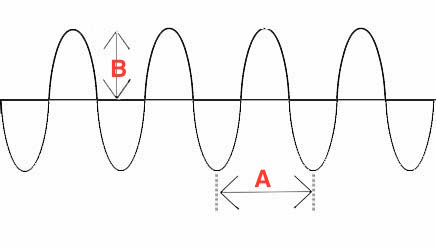
What property of this wave is represented by the letter "A"
amplitude
crest
trough
wavelength


Which section of the electromagnetic spectrum is the ONLY one we can see?
X-rays
Visible Light
Gamma Rays
Ultraviolet Rays


Elements emit radiation that show up as ___________ on their spectra.
Continuums
Bands
Absorption Spectra
Emission Spectra
Emission spectra result from ________________ gas.
hot, low-density
hot, high-density
cool, low-density
cool, high-density
Absorption spectra result from ________________ gas.
hot, high-density
hot, low-density
cool, high-density
cool, low-density
We primarily use __________ to find information about the temperature of high-density material.
absorption spectra
blackbody curves
emission spectra
laser oscillators
We primarily use emission/absorption spectra to identify ____________ of stars.
composition
temperature
luminosity
frankfurter
Which parts of the EM spectrum make it through our atmosphere?
radio
visible
gamma
x-ray
Which part of the EM spectrum has the lowest energy?
infrared
radio
x-ray
UV
__________________ material provides us with a blackbody spectrum.
low-density
high-density

What changes about a blackbody curve as the temperature changes?
color
position
shape
owls
A continuous spectrum/blackbody curve provides us with what information?
temperature
velocity
composition
doppler effect
What determines a high-density material's spectral properties?
temperature
phase
The _________ provides us with an absorption spectrum.
planets
moons
stars
creatures from the blue lagoon
This astronomer survived an explosion and is credited with discovering the absorption lines in the sun's spectrum.
Wein
Stefan
Fraunhofer
Newton

