wayground logo

Free Printable Worksheets

Font size

S
M
L
XL
Worksheets

Ecology Evolution Review

Total questions: 50

Worksheet time: 43mins

Name
Class
Date
1.

A symbiotic relationship where one is harmed and the other is benefited is called?

a)

parasitism

b)

commensalism

c)

predation

d)

mutualism

2.

A symbiotic relationship where one is benefited and the other is unaffected is what?

a)

parasitism

b)

mutualism

c)

commensalism

d)

predation

3.

In this food chain, what does the seal represent?

a)

primary consumer

b)

secondary consumer

c)

tertiary consumer

d)

quaternary consumer

4.

In this energy pyramid, how much available energy is passed from the humans to the zombies?

a)

10%

b)

90%

c)

50%

d)

75%

5.

Which of the following is a type of evidence scientists use to determine evolutionary relationships?

a)

DNA sequencing

b)

embryo development

c)

fossil evidence

d)

habitat location

6.

Which of the following is not a morphological characteristic?

a)

DNA

b)

scales

c)

tail fins

d)

flippers

7.

In this cladogram, what is the ancestral trait?

a)

vertebrae

b)

tail

c)

fur

d)

cranium structure

8.

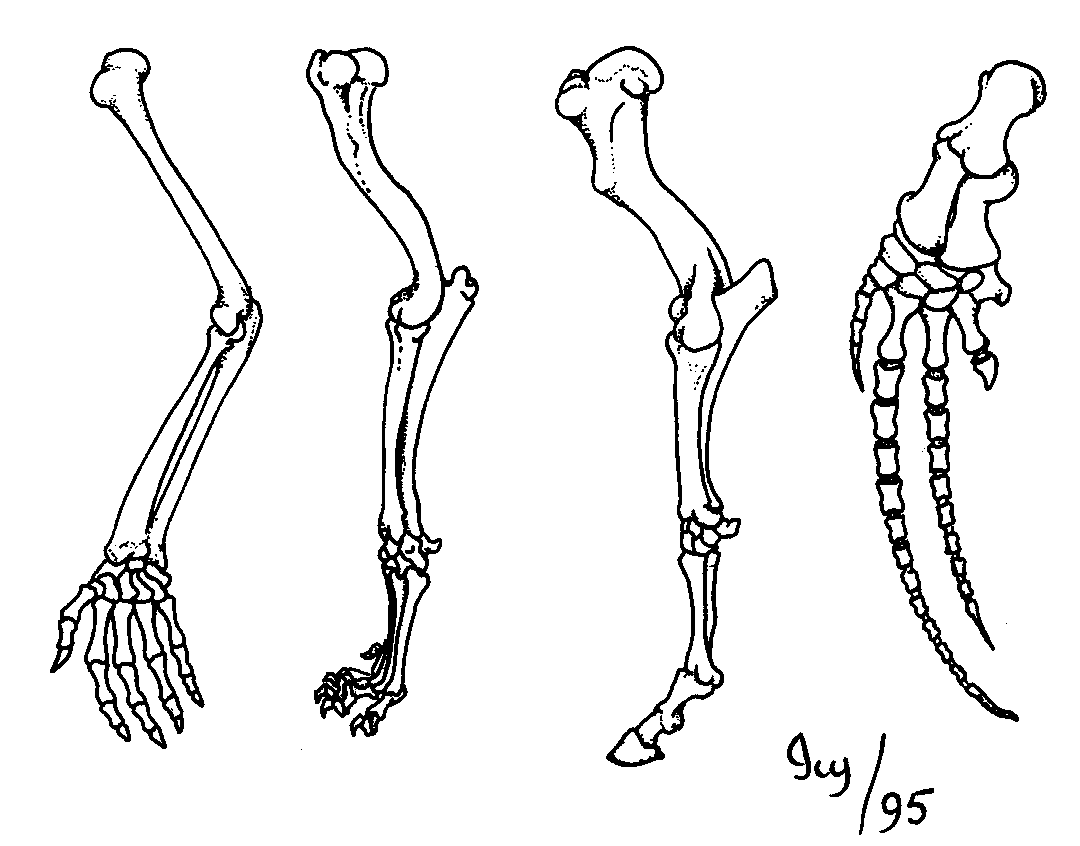
Shark fins, penguin wings, and dolphin flippers all have the same function but different structure. What kind of relationship do these appendages share?

a)

homologous structures

b)

analogous structures

c)

vestigial structures

d)

speciation

9.

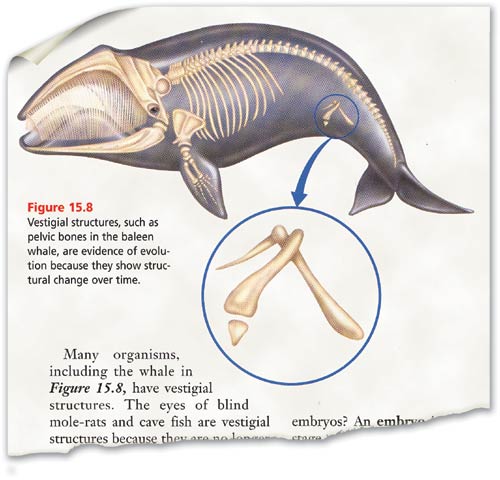
The pelvic bones of whales are considered _______ structures.

a)

vestigial

b)

homologous

c)

analogous

d)

diverged

10.
What do we call the non-living part of the environment?
a)
Biotic
b)
Population
c)
Abiotic
d)
Antibiotic
11.
What does the direction of the arrow represent in a food chain or energy pyramid?
a)
the flow of energy
b)
which way is north
c)
the expenditure of energy
d)
increase of energy
12.
Where do plants get their energy?
a)
Powerade
b)
5 hour energy drinks
c)
candy
d)
sun
13.
What is a diagram that shows a direct straight line of a feeding relationship?
a)
energy pyramid
b)
food pyramid
c)
food web 
d)
food chain
14.
What is the diagram that shows all feeding relationships possible with available resources in an ecosystem?
a)
energy pyramid
b)
food pyramid
c)
food chain
d)
food web
15.
If one species in an ecosystem is destroyed, what would happen to the other species?
a)
benefit
b)
die
c)
thrown out of balance
d)
are unaffected
16.
Bees pollinating flowers is an example of:
a)
Predation
b)
Commensalism
c)
Mutualism
d)
Parasitism
17.
Your cat has fleas. Fleas suck blood and your kitty gets an infection.
a)
Mutualism
b)
Predation
c)
Commensalism
d)
Parasitiem
18.
A remora hitches a ride with the shark. It gets a free ride unbeknownst to the shark.
a)
Parasitism
b)
Predation
c)
Commensalism
d)
Mutualism
19.
A wolf eating a lamb is an example of:
a)
Parasitism
b)
Mutualism
c)
Predator/Prey
d)
Commensalism
20.
What is an animal called that eats only plants?
a)
Carnivore
b)
Omnivore
c)
Parasite
d)
Herbivore
21.
A lion eats meat. That makes a lion a_____________
a)
Carnivore
b)
Herbivore
c)
Plant hater
d)
Omnivore
22.
I had chicken and broccoli for dinner. That makes me a:
a)
Herbivore
b)
Carnivore
c)
Parasite
d)
Omnivore
23.
What is the level of organization where the community is interacting with abiotic factors?
a)
community
b)
ecosystem
c)
population
d)
biome
24.
Which of the following is a term for a group of similar organisms that can reproduce fertile offspring?
a)
individual
b)
population
c)
species
d)
fossil
25.
If an organism has a vestigial structure, that structure likely once had a function in a(n)
a)
close relative
b)
early ancestor
c)
unrelated organism
d)
embryological stage
26.
Mutations are important because they bring about
a)
death of the organism in which they develop
b)
genetic variation needed for a population to evolve
c)
benefits for the individual, not for the population
d)
Hardey-Weinberg equilibrium within a population
27.
Finches on the Galapagos Islands had different beaks in order to help them do what?
a)
Build nests
b)
Fight off predators
c)
Collect food sources
d)
Compete with rivals
28.
This scientist came up with the idea of natural selection.
a)
Jean Baptiste Lamarck
b)
Gregor Mendel
c)
Charles Darwin
d)
Thomas Malthus
29.
A remnant or trace of an organism from the past is called a _______.
a)
Ancestor
b)
Skeleton
c)
Fossil
d)
Imprints
30.
Inherited trait that helps an organism survive is a(n) __________.
a)
Fossil
b)
Adaptation
c)
Ancestor
d)
Natural selection
31.
Survival of the fittest or when favorable adaptations reproduce faster is called what?
a)
Evolution
b)
Adaptation
c)
Natural selection
d)
Fossilization
32.
According to the diagram, which organism is older?
a)
ammonite
b)
coral
c)
gastropod
d)
trilobite
33.
Structures with the same parts have different functions; suggests that organisms share a common ancestry
a)
vestigial structures
b)
homologous structures
c)
adaptive radiation
d)
fossil
34.
Which of the following is an example of a vestigial structure?
a)
the wings of a red-tailed hawk
b)
the hind limbs of a house cat
c)
the fins of sharks
d)
the tailbone of a human
35.
The diagram shows fossils in different rock layers. Which of these statements about the age of these fossils is most likely correct?
a)
Fossil A and C are the same age
b)
Fossil B is older than fossil C
c)
Fossils A is older than fossil B
d)
Fossil D is older than fossil C
36.
If species A and B have very similar genes and proteins, what is probably TRUE?
a)
species A and B share a relatively recent common ancestor
b)
species A evolved independently of species B for a long period
c)
species A is younger than species B
d)
species A is older than species B
37.
Why are advantageous traits more likely to be passed onto offspring?
a)
Because they are more likely to survive and reproduce.
b)
Because they come from dominant alleles.
c)
Because they come from recessive alleles.
d)
Because the trait is an acquired phenotype.
38.
Farmers breed cows to produce high amounts of milk. This is an example of...
a)
Natural Selection 
b)
Variations in a species 
c)
Selective Breeding 
d)
inbreeding
39.
______________ is the process by which populations change in response to their environment.
a)
natural selection
b)
adaptation
c)
reproductive isolation
d)
divergence
40.
__________ enable an organism to survive in its environment.
a)
adaptations
b)
natural selections
c)
divergence
d)
extinctions
41.
The gradual change in species over time is...
a)
Evolution
b)
Nucleotide 
c)
Adaptation
d)
Natural Selection
42.
Darwin wrote that organisms with traits that are best suited to the environment will ________________
a)
increase in number
b)
become extinct
43.
Another word for adapt is ____________.
a)
change
b)
create
44.
Which term refers to the process by which individuals that are better suited to the environment survive and reproduce therefore passing down their genes to their offspring? 
a)
Evolution 
b)
Variation 
c)
Adaptation
d)
Natural Selection 
45.
When an organism completely dies out, it is called.....
a)
Adaption
b)
Extinction
c)
Fossilization
d)
Mutation
46.
The white feathers of a snowy owl allow it to blend in with its environment during the winter months (snow). This is an example of ________________
a)
Species
b)
Environmental Change
c)
Adaptation
d)
Variation
47.
Darwin referred to this as survival of the fittest. Over time, it results in changes in the inherited characteristics of a population because organisms with adaptations that make them fit for their environment will survive and reproduce better than those without favorable traits.
a)
Natural Selection
b)
Genetic Variation
c)
Survival of the Fittest
48.
Genetic differences between organisms of the same species
a)
Variation
b)
Adaptation
c)
Behavior
d)
Environment
49.
A well-tested concept that explains a wide range of observations is called a(an):
a)
hypothesis
b)
experiment
c)
cause and effect
d)
scientific theory
50.
A group of similar organisms that can mate with each other and produce fertile offspring is called a species.  
a)
True  
b)
False