
 Worksheets
Plate Tectonics
Total questions: 53
Worksheet time: 3hrs 39mins

divergent boundary
convergent boundary
transform boundary

divergent boundary
convergent boundary
transform boundary

divergent boundary
convergent boundary
transform boundary
This type of boundary can be found along the San Andreas fault in California....
divergent
convergent
transform
New crust is formed at this type of boundary
divergent
convergent
transform
This type of boundary creates folded mountains.
transform
divergent
continental-continental convergent
continental-oceanic convergent
This feature can be found along a divergent boundary found in oceanic crust?
mid-ocean ridge
folded mountains
deep sea trench
rift valley
At which of these boundaries would you find a deep sea trench?
transform
divergent
oceanic-oceanic convergent
Volcanoes are formed when which type of crust subducts under another plate?
continental
oceanic
magma
Subduction means.....
one plate goes under another plate
two plates slide past each other
two plate collide and form folded mountains
The process that causes the tectonic plates to move is called.....
subduction
transform
convection
Sea-floor spreading explains how.....
new crust is created at a divergent boundary
volcanoes are formed on continents
deep sea trenches are formed
divergent plates move
away from each other
towards each other
slide past each other
convergent plates move
towards each other
away from each other
past each other
At a transform boundary the plates.....
collide
diverge
slide past each other

This area is called the....
Arc of Volcanoes
Ring of Fire
Horseshoe of Magma

What type of boundary is shown in the diagram?
Divergent
Convergent
Transform

What type of boundary is shown in the diagram?
Divergent
Convergent
Slide/Transform


What is Pangea?
the name of a German scientist
the name of a supercontinent that existed millions of years ago
another name for continental drift
the name of an ancient fossil
What is Wegener's idea that continents are slowly moving over Earth's surface called?
divergence
faults
plates
continental drift
Boundary between 2 plates that are sliding past one another
Transform fault boundary
Convergent boundary
Divergent boundary
Reverse fault
Which layer of Earth flows slowly and causes the crust to move?
Crust
Mantle
Inner Core
Outer core

One piece of evidence for Plate Tectonics is that--
some continents appear to fit together like a puzzle.
we have video footage of the plates actually moving.
all continents have formed from volcanic eruptions.
the continents are no longer moving.
Which of the following is NOT evidence to support the theory of plate tectonics?
Fossils
Continental fit
Glaciers
Sand Erosion
The movement of the tectonic plates is caused by
the rotation of the Earth.
convection currents in the Asthenosphere
the gravity of the iron-nickel core.
the Moho discontinuity.
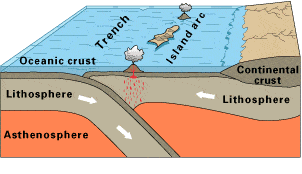
Observe this diagram of a plate boundary. One statement BEST describes what is happening. It is that
the oceanic crust is melting.
the denser oceanic crust is subducting under the less dense oceanic crust
volcanic islands are forming.
the tectonic plates are moving away from each other.
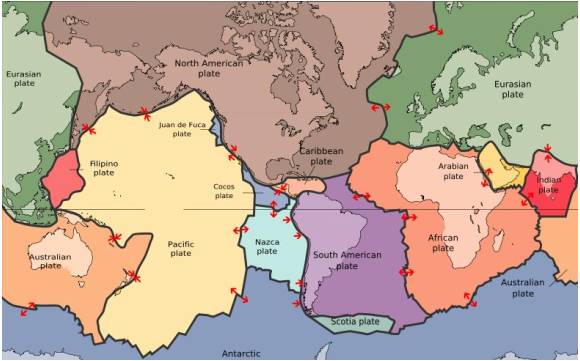
The map in the picture shows tectonic plate boundaries. This map would be useful in predicting the location of future
droughts
hurricanes
earthquakes
tornadoes
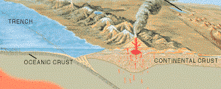
The 2004 Indian Ocean tsunami was caused by a shift in two plates that pushed one section of the sea floor under another section of the sea floor by 5 meters. What type of boundary is this?
divergent
convergent
transform
metamorphic
___________ currents in the Earth's asthenosphere cause plate to shift at their boundaries. This movement also causes earthquakes and volcanic activity.
conduction
convection
radiation
ocean
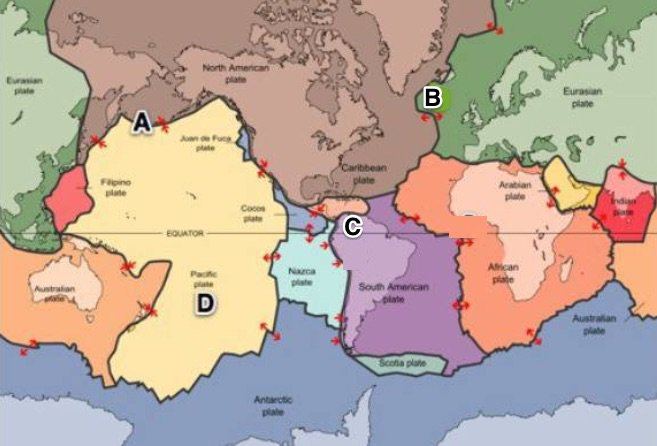
Where would sea floor spreading most likely occur?
At convergent boundaries (oceanic vs. oceanic)
At convergent boundaries (oceanic vs. continental)
At divergent plate boundaries (oceanic vs. oceanic)
At transform plate boundaries

What is the correct order (starting from the surface) of Earth’s layers?
crust, outer core, inner core, mantle
mantle, outer core, inner core, crust
crust, mantle, outer core, inner core
outer core, inner core, crust, mantle
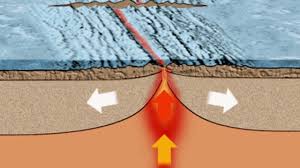
In sea-floor spreading, molten material rises from the mantle and erupts
along the edges of all the continents.
along mid-ocean ridges.
in deep-ocean trenches.
at the north and south poles.
The geological theory of _______ states that pieces of Earth’s lithosphere are in constant, slow motion.
subduction
plate tectonics
deep-ocean trenches
sea-floor spreading
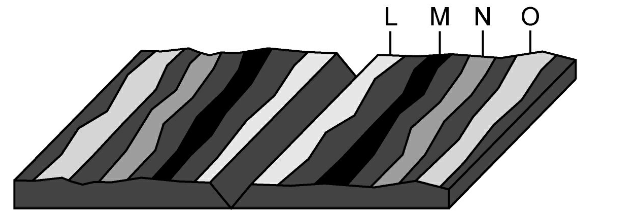

What is the difference between the lithosphere and asthenosphere that makes up the mantle?
The lithosphere is made of dense solid meal while the asthenosphere is made of liquid molten metal
The lithosphere is a mixture of gasses while the asthenosphere is made of solid rock
The lithosphere is molten rock that moves while the asthenosphere is ridid and thin
The lithosphere is made of solid rock while the asthenosphere is more flexible hot rock that moves.
Which layers of the earth are SOLID?
Crust
Mantle
Outer Core
Inner Core

