wayground logo

Free Printable Worksheets

NEW

Font size

S
M
L
XL
Worksheets

Flashback Friday 10-18

Total questions: 35

Worksheet time: 1hrs 10mins

Name
Class
Date
1.

The diagram represents two solids and the temperature of each. What occurs when the two solids are placed in contact with each other?

a)

Heat energy flows from solid A to solid B. Solid A decreases in temperature

b)

Heat energy flows from solid A to solid B. Solid A increases in temperature

c)

Heat energy flows from solid B to solid A. Solid B decreases in temperature.

d)

Heat energy flows from solid B to solid A. Solid B increases in temperature.

2.

The amount of heat energy required to change the temperature of 12 g of gold from 45°C to 15°C is -47 J. What is the specific heat capacity of gold?

a)

0.13 J/(g°C)

b)

17,000 J/(g°C)

c)

1600 J/(g°C)

d)

0.065 J/(g°C)

3.

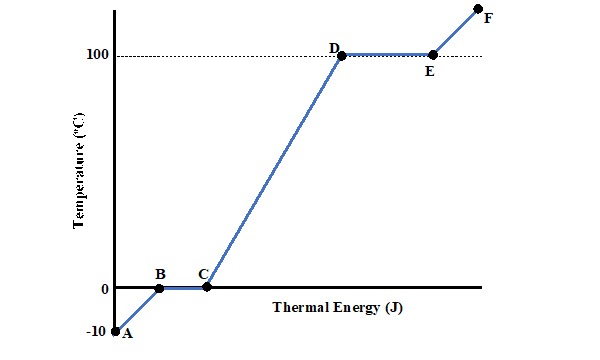
The graph represents the uniform heating of a substance, starting with the substance as a solid below its melting point. Which line segment listed below represents an increase in potential energy and no change in average kinetic energy?

a)

Line segment AB

b)

Line segment BC

c)

Line segment CD

d)

Line segment EF

4.

A cast iron skillet is used to fry bacon. For optimal frying, the pan must be heated to about 178 oC from a room temperature of 22.0 oC. It is known that 1.58 x 10⁵ J of heat energy are absorbed by the pan to reach the desired temperature and the specific heat of iron is 0.450 J/g oC. What must the mass of the skillet be?

a)

12.7 kg

b)

2.25 kg

c)

110 kg

d)

1.97 kg

5.
Heat flows from _______ to ______ objects
a)
cooler to warmer
b)
warmer to warmer
c)
warmer to cooler
d)
cooler to cooler
6.
Heat is measured in 
a)
joules
b)
grams
c)
degrees celcius
7.
The specific heat(c) of copper is 0.39 J/g °C. What is the temperature change(∆t) when 100 Joules of heat(Q) is added to 20 grams?
a)
12.82 °C
b)
24.12°C
c)
351 °C
8.
A slower particle has a lower energy than an identical, faster particle.
a)
True
b)
False
9.
The transfer of thermal energy between objects of different temperatures is called...
a)
temperature
b)
heat
c)
internal energy
d)
none of these
10.
When thermal energy is added to a substance, the substance's particles move:
a)
More rapidly at an increased diestance from each other.
b)
More rapidly with less distance between each other.
c)
More slowly with a greater distance between each other.
d)
More slowly with a reduced distance between each other.
11.
The temperature of a glass of cold water will eventually...
a)
Match the temperature of the surrounding environment.
b)
Always be colder than the surrounding environment.
c)
Become warmer than the surrounding environment.
d)
Never change temperature.
12.
A chemical reaction that absorbs heat from the surroundings is said to be __________ and has a __________ ΔH at constant pressure.
a)
endothermic; positive
b)
endothermic; negative
c)
exothermic; negative
d)
exothermic; positive
13.
If the enthalpy ter (ΔH) is negative the reaction is ____.
a)
Endothermic
b)
Exothermic
c)
Neutral
14.
How much heat does an aluminum block absorb if 10.00 grams ae heated from 25.0oC to 50.0oC? the specific heat of aluminum is .900J/goC
a)
450
b)
-450
c)
225
d)
-225
15.
When you dropped a hot metal sample into room temperature water in the lab what happened?
a)
the heat from the metal traveled into the water
b)
the cool from the water traveled into the hot metal
c)
both of the other answers are correct
16.
A measure of the average kinetic energy of a substance.
a)
heat
b)
temperature
c)
enthalpy
d)
entropy
17.
The SI unit of heat and energy is the __________.
a)
calorie
b)
heat
c)
joule
d)
watt
18.
Which phase of matter has the greatest motion and least orderly arrangement?
a)
solid
b)
liquid
c)
gas
19.
 _?_  is the amount of energy required to raise the temperature of 1 gram of any substance 1oC.
a)
Specific heat
b)
A calorie
c)
Thermal energy
d)
Conduction
20.

Between which two points is Heat of Fusion?

a)

A <----> B

b)

B <----> C

c)

C <----> D

d)

D <----> E

e)

E <----> F

21.

Between which two points is Heat of Vaporization?

a)

A <----> B

b)

B <----> C

c)

C <----> D

d)

D <----> E

e)

E <----> F

22.
A substance's heating curve is shown in the graph.  What is its boiling point?
a)
100 C
b)
60 C
c)
80 C
d)
20 C
23.
The graph shows a cooling curve for an unknown substance.  What is happening during segment DE?
a)
boiling
b)
condensation
c)
freezing
d)
melting
24.

Which equation do you use to solve for segment B-C?

a)

q=mCΔT

b)

q= Hv*m

c)

q= Hf*m

d)

PV=nRT

25.

The energy of which segments can be found using the equation q=mCΔT?

a)

A-B, D-E, E-F

b)

B-C, D-E ,E-F

c)

B-C, C-D, E-F

d)

A-B, C-D, E-F

26.
Which of the following terms identifies the change from a liquid to gas?
a)
Vaporization
b)
Condensation
c)
Deposition
d)
Sublimation
27.
When the temperature of matter increases the particles...
a)
speed up and move closer
b)
speed up and move farther apart
c)
slow down and move closer together
d)
slow down and move farther apart
28.
In an endothermic reaction the system is releasing energy.
a)
True
b)
False
29.

When you freeze water, it turns to ice. What kind of change is this?

a)

endothermic

b)

exothermic

30.
Evaporation is what kind of change?
a)
Endothermic
b)
Exothermic
31.

Between which two points is Heat of Vaporization?

a)

A <----> B

b)

B <----> C

c)

C <----> D

d)

D <----> E

e)

E <----> F

32.
What state of matter is X?
a)
solid 
b)
liquid
c)
gas
d)
supercritical fluid
33.
What state of matter is Y?
a)
solid 
b)
liquid
c)
gas
d)
supercritical fluid
34.
What is the normal boiling point of this substance?
a)
150 °C
b)
100 °C
c)
-50 °C
d)
0 °C
35.
What is point B?
a)
triple point
b)
critical point
c)
equilibrium point
d)
normal melting point