
 Worksheets
Introduction to Periodic Table
Total questions: 56
Worksheet time: 4hrs 0mins

There are ---- periods on the periodic table.
18
7
This tells the number of protons and electrons in an element-
Atomic mass
Atomic number
Valence electron
Period
Most of the periodic table consist of ----
Non-metals
Metalloids
Metals

Positively charged particle found in the nucleus of an atom
Neutron
Electron
Proton

This is where the metalloids are located-
Right side
Along the zig-zag line
Left side
Bottom
A shorthand way of writing an element's name is called a---
Chemical symbol
Chemical formula

Negatively charged particle located outside of the nucleus-
Neutron
Electron
Proton
The number of electrons found in the last energy level-
Valence electrons
Group electrons
Periods
Neutrons

What is the atomic number?
14.00643
7

True or False: Metals have luster.
True
False

Elements in A
Noble gases
Transition metals
Alkali metals
Alkaline Earth metals
Lanthanides
Elements in B
Halogens
Transition metals
Alkali metals
Alkaline Earth metals
Noble gases


What are valence electrons?
Any of an atom's electrons
Electrons located on the first energy level
Electrons not attached to any atom
electrons located on the outer energy level
What period is Lead (Pb) in?
6
4
Metals
4A


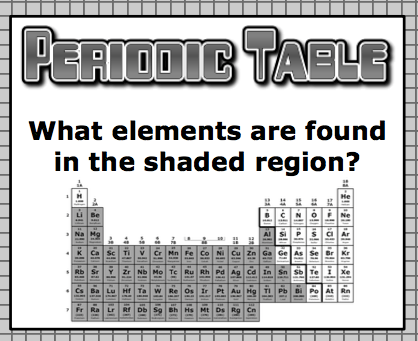
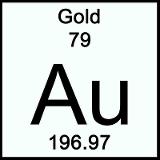


Who invented the Periodic Table?
Mendeleev
Bohr
Lewis
Democritus
As you move left to right on a row or period what happens?
Atomic number increases by 1
Electrons decrease
Number of shells decrease
Nothing
Mendeleev's genius was his ability to
predict elements that were not discovered yet
organize elements by their mass
had an element named after himself
organize elements by properties

Rows on the periodic table are called ___________.
Periods
Sentences
Fences
Elements in the same group have __________
Similar Properties
Same number of shells
Similar Mass

