
 Worksheets
Unit 4 Review
Total questions: 39
Worksheet time: 2hrs 57mins
Name
Class
Date
1.
Ionic bonds are between...
a)
nonmetals and nonmetals
b)
carbon and oxygen
c)
metals and nonmentals
d)
hydrogen and chlorine
2.
Covalent bonds are between...
a)
two or more nonmetals
b)
sodium and chlorine
c)
metals and metals
d)
metals and nonmetals
3.
What is the name for an ion with a positive charge?
a)
cation
b)
anion
c)
onion
d)
union
4.
What is the name for an ion with a negative charge?
a)
cation
b)
anion
c)
onion
d)
union
5.
What kind of bond forms when atoms share electrons?
a)
ionic
b)
covalent
c)
artificial
d)
univalent
6.
What kind of bond forms when atoms exchange electrons?
a)
ionic
b)
covalent
c)
artificial
d)
univalent
7.
What are valence electrons?
a)
sum of the protons and neutrons
b)
protons minus electrons
c)
electrons in the inner shells
d)
electrons in the outer shell
8.
If an atom loses two electrons what charge will it have?
a)
-2
b)
-1
c)
+1
d)
+2
9.
If an atom gains two electrons what charge will it have?
a)
-2
b)
-1
c)
+1
d)
+2
10.
What happens when a sodium atom loses an electron?
a)
0
b)
-1
c)
+1
d)
-2
11.
How many valence electrons does oxygen have?
a)
2
b)
4
c)
5
d)
6
12.
Predict the bond that will form between Se and Cl.
a)
Ionic
b)
Covalent
13.
Predict the bond that will form between Sr and S.
a)
Ionic
b)
Covalent
14.

What type of diagram is this?
a)
Electron Dot Diagram
b)
Bohr Model
c)
Alkali Diagram
d)
Chemical Diagram
15.
Why do elements bond?
a)
To be friends
b)
To create a new element
c)
To become stable
16.
Group numbers on the periodic table help us determine
a)
The number of valence electrons
b)
Color of the elements
17.
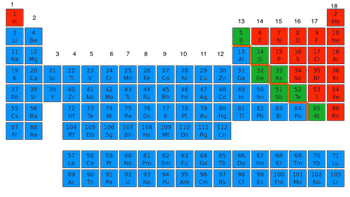
Where are metals located on the periodic table?
a)
Blue
b)
Green
c)
Red
18.
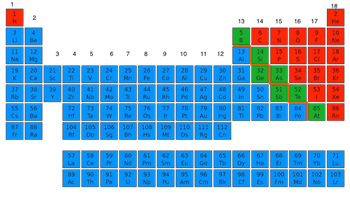
Where are the nonmetals located on the periodic table?
a)
Blue
b)
Red
c)
Green
19.
Which of these is not a real bond in chemistry?
a)
James
b)
Ionic
c)
Covalent
20.
All but Hydrogen and Helium want how many valence electrons?
a)
1
b)
2
c)
8
d)
0
21.
What is the proper name for CaCl2?
a)
Calcium dichloride
b)
Monocalcium dichloride
c)
Calcium chloride
d)
Calcium chlorine
22.
What is the proper name for S2O2?
a)
Sulfur oxide
b)
Sulfur dioxide
c)
sulfur (II) oxide
d)
disulfur dioxide
23.
Why do atoms share electrons?
a)
To attain the electron configuration of a noble gas.
b)
To become ions and take a charge
c)
to increase the mass
d)
it's a nice thing to do.
24.
How many electrons should Nitrogen have around its Lewis dot model?
a)
1
b)
3
c)
4
d)
5
25.
For metals (groups 1-3), its easier to _____ electrons to have a full outer shell.
a)
gain
b)
lose
c)
share
26.
For nonmetals (groups 5-7), its easier to _____ electrons to have a full outer shell.
a)
gain
b)
lose
c)
share
27.
What is the formula of Sodium oxide?
a)
Na2O
b)
NaO2
c)
Na2O2
d)
Na2O
28.
Phosphorous trichloride
a)
PCl3
b)
P3Cl
c)
P3Cl3
d)
PCL
29.
The octet rules states that most elements want to have _____ valence electrons.
a)
2
b)
4
c)
6
d)
8
30.

Name group 1 on the periodic table.
a)
alkali metals
b)
alkaline earth metals
c)
noble gases
noble gases
noble gases
d)
halogens
31.

Name group 2 on the periodic table.
a)
alkali metals
b)
alkaline earth metals
c)
noble gases
d)
transition metals
32.

Name group 18 on the periodic table.
a)
alkali metals
b)
alkaline earth metals
c)
transition metals
d)
noble gases
33.

Name group 17 on the periodic table.
a)
transition metals
b)
metalloids
c)
halogens
d)
alkali metals
34.

Which group has the most reactive nonmetals?
a)
alkali metals
b)
noble gases
c)
metalloids
d)
halogens
35.

Name the group that contains inert (nonreactive) elements.
a)
noble gases
b)
halogens
c)
alkali metals
d)
alkaline earth metals
36.
Elements in the same ________ are more chemically similar.
a)
group
b)
period
c)
club
d)
table
37.
Which elements have the most similar chemical properties?
a)
K and Na
b)
K and Ca
c)
K and Cl
d)
K and S
38.
What are oxidation numbers?
a)
Number of electrons in the outer most energy level
b)
Number of protons
c)
Electrons gained or lost in chemical bonding (charge on the ion of that atom)
d)
Number of neutrons gained or lost
39.
Which group has the most reactive metals?
a)
alkali metals
b)
noble gases
c)
metalloids
d)
halogens
100 %

