wayground logo

Free Printable Worksheets

NEW

Font size

S
M
L
XL
Worksheets

Chapter 6 Quiz

Total questions: 34

Worksheet time: 27mins

Name
Class
Date
1.

Kinetic energy is...

a)

energy carried in ultraviolet waves

b)

energy stored in food

c)

energy in motion

d)

energy from splitting an atom

2.
What is potential energy? (PE)
a)
energy in motion
b)
energy that is created
c)
energy that is lost
d)
energy that is stored
3.
The Law of Conservation of Energy states that__________
a)
The overall amount of energy remains the same but some energy is completely destroyed during energy transformations
b)
The overall amount of energy remains the same energy cannot be created or destroyed.
c)
The overall amount of energy can change depending on the energy conversions that take place. 
d)
The overall amount of energy can change because sometimes energy is lost to the environment 
4.
Energy of motion is which type of energy?
a)
Potential
b)
Kinetic
c)
Sound
d)
Gravitational
5.
What type of energy is in this picture?
a)
Kinetic
b)
Potential
c)
Chemical
d)
Sound
6.
When plants convert the sun's energy into food, which type of energy is it?
a)
kinetic
b)
chemical
c)
thermal
d)
radiant
7.
What kind of energy is represented in the picture?
a)
Thermal
b)
Chemical
c)
Sound
d)
Nuclear
8.

What is energy?

a)

moving energy

b)

stored energy

c)

renewable energy

d)

The ability to do work.

9.

Net intake of energy

a)

endergonic

b)

exergonic

10.

Net release of energy

a)

endergonic

b)

exergonic

11.

A + B --> AB + Energy

This is what type of reaction?

a)

exergonic

b)

endergonic

12.

What are the products of the chemical reaction pictured?

a)

CH4 and CO2

b)

CH4 and O2

c)

CO2 and H2O

d)

O2 and H2O

13.
Consider the chemical equation CH4 + 2 O2 → CO2 + 2 H2O. In this equation, CH4 is a
a)
product
b)
reactant
c)
displacement
14.
The reactants are on the left side of the chemical equation.
a)
True
b)
False
15.

How many products are in A + B ---> 2C

a)

1

b)

2

c)

3

d)

4

16.
2H2 + O2 ----> 2H2O What is the product?
a)
------>
b)
2H2O
c)
2H2+ O2
17.

During which process does an atom gain one or more electrons?

a)

transmutation

b)

reduction

c)

oxidation

d)

neutralization

18.

When a lithium atom forms an Li+ ion, the lithium atom

a)

gains a proton

b)

gains an electron

c)

loses a proton

d)

loses an electron

19.
Which substance is reduced in the following reaction? 
NaOH + Li --> LiOH + Na
a)
Li
b)
Na
c)
O
d)
H
20.
What are the products of photosynthesis?
a)
oxygen and carbon dioxide
b)
oxygen and glucose
c)
carbon dioxide and water
d)
water and glucose
21.
What is the function of ATP in living things?
a)
provides energy for cells
b)
stores genetic information
c)
provides structure in the nucleus
22.
What does the "TP" in ATP stand for?
a)
2 phosphates
b)
tri (3) phosphates
c)
Two proteins
d)
tri (3) proteins
23.
Energy is released from ATP when
a)
a phosphate group is added
b)
adenine bonds to ribose
c)
ATP is exposed to sunlight
d)
a phosphate group is removed
24.
What is thermodynamics?
a)
movement of heat
b)
it's magic
c)
measurement of heat
d)
none of them
25.
I can't be created nor destroyed. What am I?
a)
energy
b)
air
c)
nothi
d)
a unicorn
26.
What is the purpose  of an enzyme?
a)
give permission for the reaction
b)
raise activation energy
c)
speed up reactions
d)
control how many reactions occur
27.
Enzymes are capable of increasing the rate of a chemical reaction within a living cell.  Enzymes accomplish this through which of the following means?
a)
reducing the number of products   
b)
reducing the activation energy
c)
increasing the temperature of the cell
d)
increasing the concentration of reactants 
28.
What 3 letters do enzymes typically end in?
a)
-ose
b)
-ase
c)
-ese
d)
-tic
29.
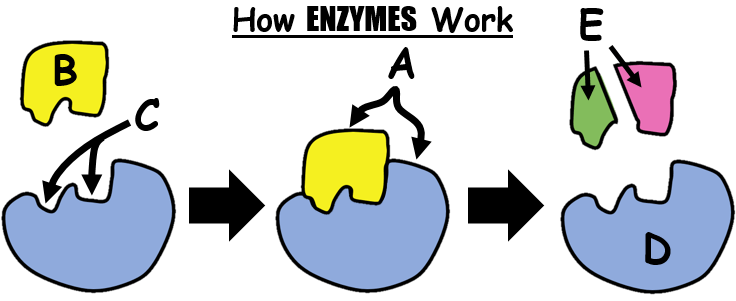
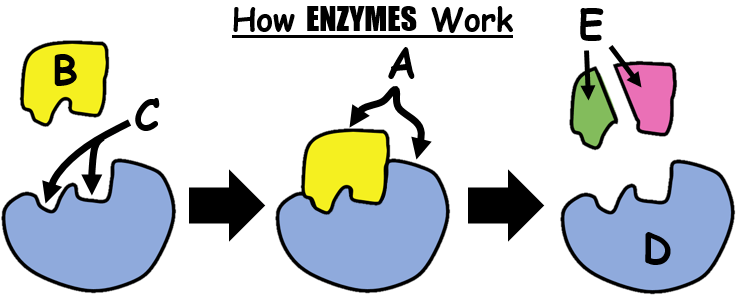
Letter B...
a)
active site
b)
enzyme
c)
substrate
d)
products
30.
Letter D...
a)
active site
b)
enzyme
c)
substrate
d)
products
31.

In a chemical reaction, ________ are what you have at the end

a)

Products

b)

Molecules

c)

Reactants

d)

Substances

32.
An enzyme speeds up a reaction by
a)
lowering the activation energy.
b)
raising the activation energy.
c)
releasing energy.
d)
absorbing energy.
33.

Energy

a)

the capacity for doing work

b)

the heat coming from the sun

c)

the vitamins we get from food

d)

a unit for thermodynamics

34.

The second law of Thermodynamics define

a)

Entropy

b)

Energy

c)

Enthalpy

d)

Heat