Wayground logo

Free Printable Worksheets

Font size

S
M
L
XL
Worksheets

Unit 5 Genetics Review

Total questions: 44

Worksheet time: 46mins

Name
Class
Date
1.

What is heredity?

a)

Most commonly seen traits

b)

Passing of genetic traits from parent to offspring

c)

Likelihood of a future event happening

2.

What is a dominant trait?

a)

One set of instructions for an inherited trait

b)

Entire genetic makeup of an individual

c)

The trait observed in the first generation when parents that have different traits are bred.

3.

What is a recessive trait?

a)

Trait that is apparent only when two recessive alleles for the same characteristic is inherited.

b)

An organisms appearance

c)

Self pollination occurring

4.

What is a gene?

a)

Likelihood that something will happen

b)

Passing of genetic traits from parent to offspring

c)

One set of instruction for an inherited trait.

5.

What is an allele?

a)

The entire genetic makeup of an organism.

b)

One of the alternative forms of a gene that governs a characteristic, such as hair color.

c)

Crossing of like traits to produce a true bred

6.

What is phenotype?

a)

An organism’s appearance.

b)

One set of instructions

c)

The trait observed in the first generation when parents that have different traits are bred.

7.

What is genotype?

a)

Physical appearance

b)

Result of a crossbred self pollination

c)

The entire genetic makeup of an organism.

8.

What did Gregor Mendel study?

a)

Hemotology

b)

Psychology

c)

Heredity

9.

A = Heart Shaped face

a = Diamond shaped face

Which would be homozygous for the recessive?

a)

Aa

b)

aa

c)

AA

10.

B = Can climb walls

b = can NOT climb walls

Which would be Heterozygous for being able to climb walls?

a)

BB

b)

bb

c)

Bb

11.

M = Wild mustang

m = calm mustang

What would Mm show?

a)

Calm

b)

In between calm and wild

c)

Wild

12.

If the dominant is present the dominant will ______________.

a)

disappear

b)

reappear

c)

show

13.

Which represents an allele?

a)

RJ

b)

T

14.

Which represents a gene

a)

NT

b)

r

15.
In pea plants, the tall allele is dominant to the short allele. What key would demonstrate this?
a)
Tall = T
Short = S
b)
Tall = T
Short = t
c)
Tall = t
Short = T
d)
Tall = TT
Short = tt
16.
A heterozygous long-tusked elephant is crossed with a homozygous recessive short-tusked elephant. What is the probability of the offspring having short tusks?
a)
0%
b)
25%
c)
50%
d)
75%
17.
A heterozygous long-tusked elephant is crossed with a homozygous recessive short-tusked elephant. What is the probability of the offspring having short tusks?
a)
0%
b)
25%
c)
50%
d)
75%
18.
Leonardo bet his friend Olivet that two heterozygous green-eyed sea monsters could not have a recessive blue-eyed baby sea monster. Olivet said they can have a blue-eyed sea monster.
Who wins the bet?
a)
Leonardo
b)
Olivet
c)
Both
d)
Neither
19.
Identify the homozygous dominant genotype:
a)
FF
b)
Ff
c)
ff
20.
Heterozygous is when...
a)
the alleles are the same
b)
the alleles are different
c)
the alleles are absent
d)
the alleles are present
21.
In a heterozygous genotype, the ___________ allele takes over in the phenotype.
a)
recessive
b)
dominant
c)
lower case letter
d)
both 
22.
T - tall and t = short
In the punnett square below, what belongs in the missing square
a)
tt
b)
Tt
c)
Bb
d)
TT
23.
G = green, g = yellow
The genotype for a yellow plant is...
a)
GG
b)
Gg
c)
gg
d)
all of the choices result in yellow
24.

What is the correct order to make a protein?

a)

Protein, DNA, RNA

b)

RNA, DNA, Protein

c)

DNA, RNA, Protein

d)

Protein, RNA, DNA

25.

DNA contains the template to make RNA

a)

True

b)

False

26.

RNA has what base that is instead of thymine?

a)

guanine

b)

adenine

c)

thymine

d)

uracil

27.

Which RNA brings amino acids?

a)

rRNA

b)

tRNA

c)

mRNA

28.

Which RNA forms part of the ribosomes?

a)

tRNA

b)

mRNA

c)

rRNA

29.

Which RNA carries the message?

a)

mRNA

b)

rRNA

c)

tRNA

30.

The goal of transcription is to make RNA.

a)

True

b)

False

31.
Translation takes place in the 
a)
ribosome
b)
chloroplast
c)
nucleus
d)
mitochondria
32.
What is the term for a three-nucleotide sequence that codes for an amino acid?
a)
base
b)
codon
c)
amine
d)
serine
33.
Which phrase best describes translation?
a)
converts mRNA into a polypeptide
b)
catalyzes bonds between amino acids
c)
produces RNA from DNA molecules
d)
recycles tRNA molecules for reuse
34.
How many amino acids are coded for by this sequence of nucleotides:
ATG GGA ACT CCA
a)
4
b)
2
c)
6
d)
12
35.
The job of tRNA is to
a)
carry amino acids to the ribisomes
b)
carry ribisomes to the ER
c)
carry glucose to mitochondria
d)
carry mRNA out of the nucleus
36.
The codon is located on the 
a)
DNA
b)
mRNA
c)
tRNA
d)
rRNA
37.
What would happen if we did not have start codons?
a)
Polypeptide chains would continue to grow
b)
Amino acids would bind to tRNA
c)
Protein synthesis wouldn't occur
d)
mRNA would form a double strand
38.
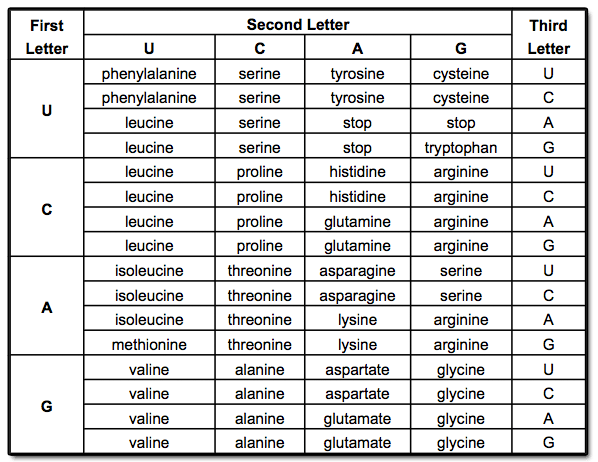
What is the correct amino acid sequence for the mRNA code AUGCCAGUAUGA
a)
Met-Pro-Ala-Val
b)
Met-Pro-Val
c)
Tyr-Gly-His
d)
Tyr-Gly-Arg-His
39.

A mutation is defined as:

a)

A change in the cell's structure

b)

Anything that changes in an embryo

c)

Any change in the physical features of a human

d)

A change in the DNA sequence

40.
Where do mutations occur?
a)
DNA and RNA
b)
DNA 
c)
RNA
d)
mRNA and tRNA
41.
What causes mutations?
a)
Mistakes in replication or environmental substances
b)
The amino acids
c)
Passed down by genetics
d)
It's how your born
42.

A mutation can occur if a base pair is ____________, deleted, or substituted for another.

a)

modified

b)

added

c)

transferred

43.

ATTTGAGCC- Original

ATTGAGCC - Mutated

The example above is an example of a

a)

Insertion

b)

Point mutation

c)

Deletion

d)

Substitution

44.

Mutations are SOMETIMES helpful to the organism.

a)

true

b)

false