

Wayground logo

Free Printable Worksheets

Font size

S
M
L
XL
Worksheets

PLATE TECTONICS

Total questions: 55

Worksheet time: 55mins
Name
Class
Date
1.
Early observers thought continents may have been joined based on what observations
a)
rocks and fossils
b)
earthquakes.
c)
magnetism.
d)
coastline
2.
A German scientist Alfred Wegener was the first to hypothesize that ...........
a)
Continents were once joined
b)
The sea floor is spreading
c)
Continents are moving
d)
The Earth's magnetic pole flips
3.
Pangaea was an ancient supercontinent made up of...
a)
America, Greenland, and Europe.
b)
Antarctica, India, and America.
c)
all of Earth’s continents.
d)
South Africa, India, Australia, and South America.
4.

In sea-floor spreading, molten material rises from the mantle and erupts

a)

along the edges of all the continents.

b)

along mid-ocean ridges.

c)

in deep-ocean trenches.

d)

at the north and south poles.

5.

Most geologists think that the movement of Earth’s plates is caused by _______

a)

convection.

b)

continental drift.

c)

subduction.

d)

conduction.

6.

The geological theory of _______ states that pieces of Earth’s lithosphere are in constant, slow motion.

a)

subduction

b)

plate tectonics

c)

deep-ocean trenches

d)

sea-floor spreading

7.

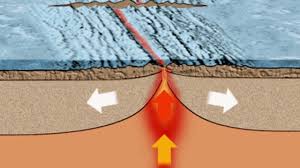
Below is a picture of sea-floor spreading. How are the ocean crusts moving?

a)

Converging

b)

Diverging

c)

Sliding

d)

No movement

8.
What are the two types of crust
a)
continental and oceanic
b)
ocean and upper
c)
lower and upper
d)
pizza and subway
9.
The Himalayas in Asia are an example of what type of plate boundary?
a)
divergent
b)
continent-to-continent convergent
c)
ocean-to-continent convergent
d)
transform
10.
What are Tectonic Plates?
a)
A continent 
b)
The Trees in Vietnam 
c)
ThE PlaTES That MoVE uNdERGRound :)
d)
The Plates that move the Continents
11.
Mountains form from ...
a)
plates sliding past one another
b)
collision of plates
c)
plates moving away from each other
12.
A plate boundary at which two plate move parallel to each other in opposite directions
a)
convergent plate boundary
b)
divergent plate boundary
c)
transform plate boundary
d)
subduction
13.

What is the name of plate 3

a)

Pacific plate

b)

Eurasian plate

c)

Antarctic plate

d)

South American plate

14.

What is the name of plate 6

a)

Eurasian plate

b)

Indo-Australian plate

c)

North American plate

d)

Antarctic plate

15.

What is the name of plate 4

a)

African plate

b)

Indo-Australian plate

c)

Pacific plate

d)

Antarctic plate

16.

What is the name of plate 1

a)

African plate

b)

North American plate

c)

Pacific plate

d)

Pacific plate

17.

What is the name of plate 2

a)

African plate

b)

North American plate

c)

Eurasian plate

d)

Pacific plate

18.

What is the name of plate 5

a)

African plate

b)

South American plate

c)

Eurasian plate

d)

Indo-Australian plate

19.

What is the name of the plate to the south of the Eurasian plate?

a)

Pacific plate

b)

South American plate

c)

Antarctic plate

d)

Indo-Australian plate

20.
Plate 1
a)
Indo-Australian
b)
Pacific Plate
c)
South American
d)
Eurasian
21.
Plate 2
a)
Indo-Australian Plate
b)
Pacific Plate
c)
South American Plate
d)
Eurasian Plate
22.
Plate 3
a)
North American Plate
b)
South American Plate
c)
African Plate
d)
Eurasian Plate
23.
Plate 4
a)
North American Plate
b)
African Plate
c)
Antarctic Plate
d)
Nazca Plate
24.
Plate 5
a)
Indo-Austrailian
b)
South American
c)
African
d)
North American
25.
Plate 6
a)
South American
b)
Antarctic
c)
African
d)
Nazca
26.
Plate 7
a)
Pacific Plate
b)
Eurasian Plate
c)
African Plate
d)
Nazca Plate
27.
Plate 8
a)
North American
b)
South American
c)
Antarctic Plate
d)
African
28.

What is the correct order (starting from the surface) of Earth’s layers?

a)

crust, outer core, inner core, mantle

b)

mantle, outer core, inner core, crust

c)

crust, mantle, outer core, inner core

d)

outer core, inner core, crust, mantle

29.
The scientific theory that the Earth's crust is made of moving plates.
a)
quakes
b)
seismic
c)
plate tectonics
d)
rotation
30.
What is Pangaea?
a)
A German Scientist
b)
the name of the supercontinent that existed millions of years ago
c)
continental drift
d)
an ancient fossil
31.
Who suggested the Continental Drift theory?
a)
Aldrin Weiner
b)
Alfred Wegener
c)
George Williams
d)
Dr Drift
32.
Earth's crust is broken up into several large rocky pieces called ...
a)
plates
b)
faults
c)
fossils
d)
puzzle pieces
33.
Which travels fastest, always being the first detected by seismic stations?
a)
P waves
b)
S waves
34.
P-wave 
a)
The center of a earthquake. 
b)
Also know as shear or secondary wave. 
c)
Always the first to arrive;  seismic wave that causes particles of rock to move in back-and-forth direction
d)
Hilbert
35.
Many earthquakes happen along the borders of...
a)
Countries
b)
Tetonic Plates
c)
Climate Zones
d)
None of the above.
36.
Which seismic wave moves at right angles?  
a)
P Waves
b)
S Waves
c)
Surface Waves
37.
Where do seismologists place seismographs?  
a)
On the focus
b)
On the fault
c)
In the mantle
d)
In the seismograph station
38.
Which seismic wave does a seismograph detect first?  
a)
P Wave
b)
S Wave
c)
Surface Wave
39.
What is the formula to calculate speed?
a)
Speed = Distance x Time
b)
Speed = Distance/Time
c)
Speed = Time/Distance
d)
Speed = Time x Distance
40.
All of the following are examples of speed except:
a)
A car traveling at 55 km/hr
b)
A snail hightailing it 45 mm/sec
c)
Jube timing himself at 23 seconds
d)
Lonnie running down the hall at 45 mph
41.
All of the following are units of speed except:
a)
Km/hr
b)
Km
c)
Kilometer per hour
d)
Kilometer/Hour
42.
All of the following are units of speed except:
a)
Seconds
b)
m/s
c)
Km/s
d)
m/min
43.
Calculate the speed:
A Car traveled 240 Km in 5 Hours
a)
48 Km/Hr
b)
1200 Km/Hr
c)
4.8 Km/Hr
d)
0.02 Km/Hr
44.
Calculate the speed:
A Motorcycle traveled 368 Km in 8 Hours
a)
2944 Km/hr
b)
4.5 Km/hr
c)
46 Km/hr
d)
0.02 Km/hr
45.
Calculate the speed:
A truck traveled 208 Km in 4 Hours
a)
52 Km/hr
b)
25 Km/hr
c)
0.019 Km/hr
d)
832 Km/hr
46.
Calculate the speed:
A bus traveled 98 Km in 2 Hours
a)
94 Km/hr
b)
49 Km/hr
c)
196 Km/hr
d)
0.02 Km/hr
47.
What is the mean of these numbers?
4,5,5,2,3,3,2,8
a)
40
b)
24
c)
4
d)
256
48.
Find the mean:
28, 18, 19, 18, 17
a)
20
b)
18
c)
11
d)
19
49.

Calculate the mean.

10, 4, 5, 9

a)

7

b)

5

c)

8

d)

4

50.

Calculate the mean.

16, 5, 7, 12

a)

9

b)

6

c)

12

d)

10

51.

Calculate the mean.

2, 9, 10, 6, 8

a)

8

b)

4

c)

7

d)

22

52.

Calculate the mean.

23, 18, 9, 10, 5

a)

55

b)

13

c)

14

d)

17

53.

Calculate the mean.

6, 9, 12, 5

a)

8

b)

13

c)

7

d)

3

54.

What is another word for AVERAGE?

a)

Mode

b)

Median

c)

Mean

d)

Not nice

55.

The average of 5 quantities is 6. The average of 3 of those 5 quantities is 8. What is the average of the remaining two quantities?

a)

6.5

b)

4

c)

3

d)

3.5
